Nursing Field Notes / Nursing Core · Fundamentals of Nursing
Med Math 🧮
Memory Tricks for Dosage Calculation
NG-171Nursing CoreADHD-friendly visual edition
Three formulas run almost every med-math question you'll ever see: D/H×Q for tablets & liquids, mL/hr for pumps, and gtt/min for gravity tubing. Learn the formula, learn where the numbers plug in, and always convert your units first.
🎯 D/H × QDesired ÷ Have × Quantity = amount to give.
💧 gtt/min(mL × drop factor) ÷ min — gravity/manual tubing.
🖥️ mL/hrmL ÷ hr — what you program into a pump.
🔁 Convert FIRSTSame units before you plug into any formula, or the whole answer is wrong.
🧮
FORMULAS
STEP 1 · KNOW THE THREE
Almost every dosage-calc question on the NCLEX is one of these three formulas wearing a different costume.
💊 The master formula: D/H × Q — "Desired over Have, times Quantity"
USE FOR tablets, capsules, and oral/IM liquids — anything where the drug comes in a fixed strength and you need to figure out how many units to give.
🧠 "What you WANT, over what you'VE GOT, times what it comes IN." D = the order, H = the label/vial, Q = tablet or mL that dose is packaged as. Multiply last, always.
🖥️ mL/hr — the pump formula
FormulamL/hr = Volume (mL) ÷ Time (hr)
USE FOR anything running on an electronic infusion pump — you program the rate directly in mL per hour.
🧠 "Pump = per hour." If it has a screen and buttons, it wants mL/hr.
💧 gtt/min — the gravity formula
Formulagtt/min = (mL/hr × drop factor) ÷ 60
USE FORmanual/gravity tubing with no pump — you count drops falling in the drip chamber per minute.
🧠 "No pump = count the drops." Drop factor (gtt/mL) is printed right on the IV tubing package.
⚖️ Weight-based dosing — same D/H×Q, plus one extra step
Many pediatric doses, and adult doses ordered as "per kilogram," use mg/kg or mcg/kg/min. You must find the total dose before you can use D/H×Q.
Step 1Weight (kg) × ordered dose (mg/kg) = total dose
Step 2If divided doses: total dose ÷ number of doses/day = dose per administration
Step 3Now plug that number into D/H × Q like any other order.
🧠 "Weight first, formula second." A weight-based order is never the final number to give — it's the D you still have to run through D/H×Q.
📐 Body Surface Area (BSA) — the formula behind chemo & some pediatric dosing
Some high-alert doses (chemotherapy, certain pediatric meds) are ordered per m² of body surface area instead of per kilogram, because BSA correlates better with organ function and drug clearance.
🧠 BSA math is high-stakes — verify with a second RN. These are exactly the calculations where facilities require an independent double-check before the drug leaves the Pyxis.
✍️
WORK IT OUT
STEP 2 · PLUG IN NUMBERS
The same five formulas, now with numbers plugged in step by step. All example numbers below are made up for practicing the math only — not real drug orders.
💊 Worked example — tablets
EXAMPLE PROBLEM · not a real order
Ordered (D)500 mg
Have (H)250 mg per tablet
Quantity (Q)1 tablet
Plug in500 ÷ 250 × 1
= 2 tablets
🧠 If D and H are already the same unit, the math is just a simple ratio.
🧴 Worked example — oral liquid
EXAMPLE PROBLEM · not a real order
Ordered (D)750 mg
Have (H)250 mg per 5 mL
Quantity (Q)5 mL
Plug in750 ÷ 250 × 5
= 15 mL
🧠 Q is whatever volume H is measured in — here H is "per 5 mL," so Q = 5 mL, not 1.
⚖️ Worked example — weight-based, divided doses
EXAMPLE PROBLEM · not a real order
Step 1154 lb ÷ 2.2 = 70 kg
Step 270 kg × 5 mg/kg/day = 350 mg/day
Step 3350 mg ÷ 2 doses = 175 mg/dose q12h
🧠 Weight goes to kg before anything else touches it. Skipping the lb→kg conversion is the single most common weight-based math error.
🖥️💧 Worked example — pump (mL/hr) vs. gravity tubing (gtt/min)
EXAMPLE PROBLEM · not a real order
Ordered1000 mL over 8 hr, drop factor 15 gtt/mL
Pump1000 ÷ 8 = 125 mL/hr
Gravity Step 11000 ÷ 8 = 125 mL/hr
Gravity Step 2(125 × 15) ÷ 60 = 31.25
Pump: 125 mL/hr · Gravity: round to 31 gtt/min
🧠 Same order, two different final answers depending on the equipment. Round gtt/min to a whole drop — you cannot count a quarter of a drop falling in the chamber.
⚡ Shortcut: skip step 2 for common drop factors
Because 60 minutes is always the denominator, common drop factors simplify to one quick division of mL/hr:
Drop factor
Tubing type
Shortcut from mL/hr
10 gtt/mL
Macrodrip
gtt/min = mL/hr ÷ 6
15 gtt/mL
Macrodrip
gtt/min = mL/hr ÷ 4
20 gtt/mL
Macrodrip
gtt/min = mL/hr ÷ 3
60 gtt/mL
Microdrip
gtt/min = mL/hr (1:1)
🧠 Microdrip = 60, and 60 makes gtt/min and mL/hr the SAME NUMBER. Microdrip tubing (60 gtt/mL) is used for peds, critical care, and any fluid needing very precise, small-volume control — the exact drop factor is always printed on the tubing package, never assumed.
🔁
CONVERT & AVOID TRAPS
STEP 3 · SAME UNITS FIRST
Every formula above only works if D and H are already in the same unit — convert before you calculate, not after.
🪜 The metric staircase — mcg ⇄ mg ⇄ g, and mL ⇄ L
Same rule for volume:1 L = 1000 mL. And for weight: 1 kg = 2.2 lb — lb → kg, divide by 2.2; kg → lb, multiply by 2.2.
🧠 "Small word, small step; big jump, big multiply." Kilo → milli → micro is always ×1000 each step down. Confusing mcg and mg is a 1000-fold overdose — always double-check the abbreviation before you calculate.
⚠️ NCLEX trap: mcg vs. mg
A misread or miswritten unit — mcg mistaken for mg — is a 1000× dosing error. High-alert IV drips are especially at risk because they're often dosed in mcg/kg/min.
🧠 "Micro is minuscule." mcg is always the smallest, most cautious unit in the room — if a number in mcg looks small, that's normal, not a mistake.
⚠️ NCLEX trap: forgetting lb → kg
Calculating a weight-based dose using pounds instead of kilograms gives an answer that's roughly 2.2× too high. Always convert weight to kg before multiplying by mg/kg.
🧠 Weight-based order? Kilos or it doesn't count. If the chart shows lb, convert first — every single time.
⚠️ NCLEX trap: pump formula vs. gravity formula
Using gtt/min math when the fluid is actually running through an electronic pump (or vice versa) gives a nonsense rate. Pump screens want mL/hr; gravity tubing needs a drop count.
🧠 "Buttons = mL/hr. No buttons = count drops." Look at the equipment before you pick the formula.
⚠️ NCLEX trap: wrong drop factor
Using 15 gtt/mL math on 60 gtt/mL microdrip tubing (or the reverse) throws the whole answer off. The drop factor is printed on the tubing package — never assume it.
🧠 Read the box before you do the math. Different tubing, different formula — every time.
🚨 High-alert meds: math isn't the only safety check
Insulin, heparin, IV opioids, chemotherapy, and other high-alert drugs typically require an independent double-check by a second RN before administration — regardless of how confident you are in your own calculation. Correct math does not replace a required double-check.
🧠 "High alert, second set of eyes." Facility policy, not your certainty, decides when a double-check is required — always verify the policy for the specific drug.
⚡
QUICK RECALL
SAY IT OUT LOUD
🎯 D/H × QDesired ÷ Have × Quantity = amount to give
💧 gtt/min(mL/hr × drop factor) ÷ 60
🖥️ mL/hrVolume (mL) ÷ Time (hr)
🔁 Convert firstkg/g/mg/mcg ×1000 down, ÷1000 up · lb÷2.2=kg
🎯 Cover & check — 4 rapid-fire questions
Q1: What's the master oral/IM dosage formula?
D/H × Q — Desired dose ÷ Have (dose on hand) × Quantity (the form that dose comes in).
Q2: An electronic pump is infusing fluid — which formula do you use, mL/hr or gtt/min?
mL/hr = Volume (mL) ÷ Time (hr). gtt/min is only for gravity/manual tubing with no pump.
Q3: Before calculating a weight-based dose given in pounds, what must you do first?
Convert pounds to kilograms (lb ÷ 2.2 = kg) before multiplying by the mg/kg order — skipping this gives an answer about 2.2× too high.
Q4: Why is mixing up mcg and mg such a dangerous error?
mcg and mg differ by a factor of 1000 — confusing them causes a 1000-fold dosing error, one of the most serious medication error categories.
📌
STUDY SHEETS
FROM YOUR SAVED SET
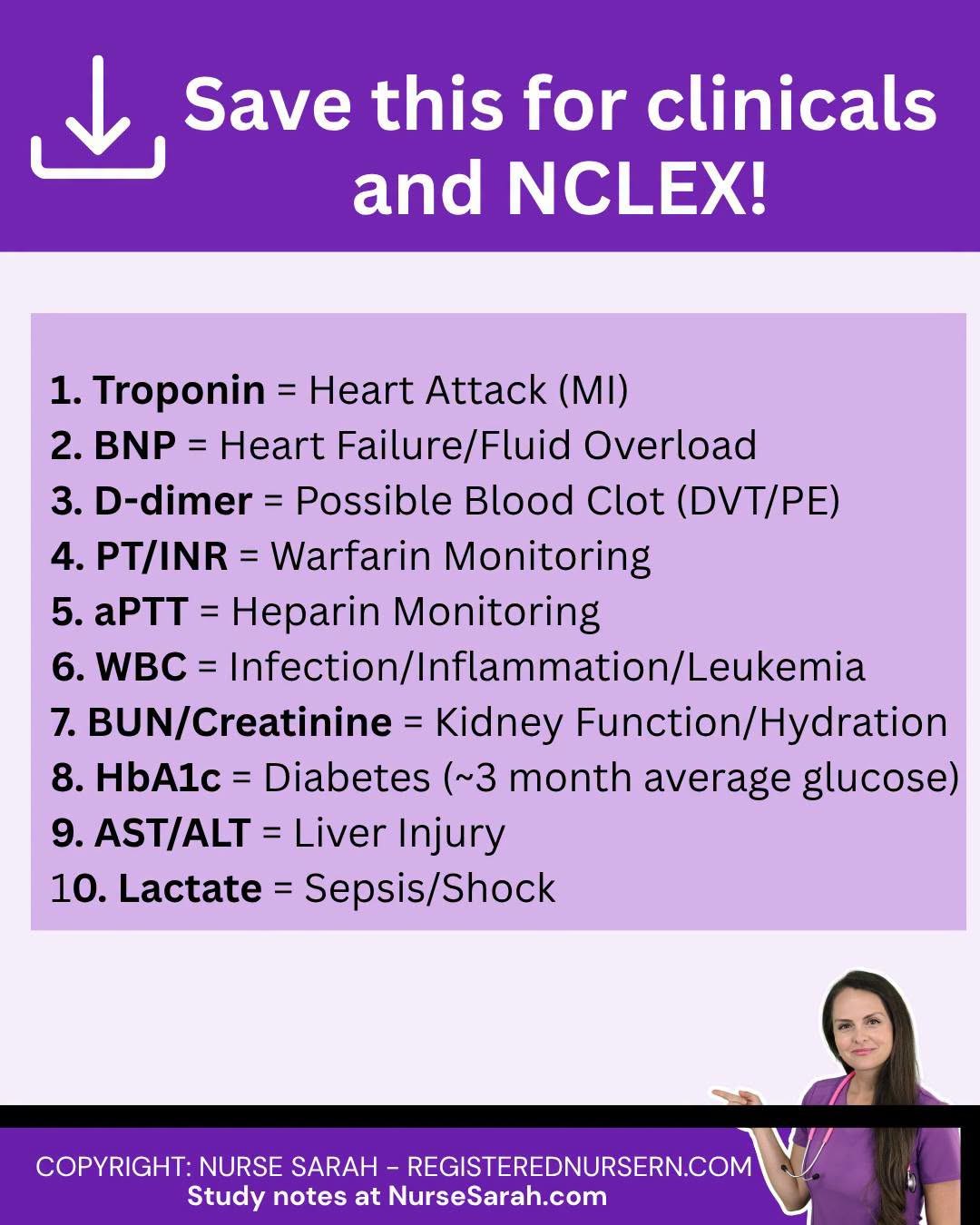
The ten labs worth knowing cold, each with what it actually tells you — troponin, BNP, D-dimer, PT/INR, aPTT, WBC, BUN/creatinine, HbA1c, AST/ALT, lactate. — swipe it sideways if it is cut off, or tap to open it full size.
Saved study graphics from your own collection. Each one is someone else’s work — check anything clinical against your course materials before you rely on it.