🧺 Growth, Development & Erikson
The two axes that answer most pediatric questions: what stage they are in, and what they fear.
⭐ Erikson, play and what they need
| Stage | Age | Erikson | Play | Fears most |
|---|---|---|---|---|
| Infant | 0–18 mo | Trust vs mistrust | Solitary | Separation from carer |
| Toddler | 18 mo–3 y | Autonomy vs shame | Parallel — beside, not with | Separation; loss of routine |
| Preschool | 3–6 y | Initiative vs guilt | Associative | Bodily harm / mutilation |
| School age | 6–12 y | Industry vs inferiority | Cooperative, team games | Loss of control; not measuring up |
| Adolescent | 12–18 y | Identity vs role confusion | Peer group | Being different; body image |
Match the intervention to the fear and most questions answer themselves.
- Infant / toddler → keep the parent present; rooming-in; keep routines and comfort objects
- Preschooler → simple honest words; let them handle equipment; say plainly it is not a punishment
- School age → give tasks and choices; explain how things work; respect privacy
- Adolescent → confidentiality; involve them in decisions; allow peer visits
🧠 The two responses that keep reappearing
Toddler having a tantrum → ignore the behavior, keep them safe. Attention reinforces it.
Toddler resisting care → offer two acceptable choices, never an open question. “Pink cup or blue cup?” not “Will you take your medicine?”
👶 Milestones worth memorizing
| Age | Motor | Social / language |
|---|---|---|
| 2 months | Lifts head when prone | Social smile |
| 4 months | Rolls front to back | Laughs, coos |
| 6 months | Sits with support; rolls both ways | Babbles; stranger anxiety begins |
| 9 months | Sits alone, crawls, pincer grasp | “Mama/dada” nonspecific |
| 12 months | Walks; birth weight TRIPLES | 1–3 words; waves bye |
| 15 months | Walks well | 3–5 words |
| 2 years | Runs, kicks a ball | 2-word phrases; ~50% intelligible |
| 3 years | Tricycle | 3-word sentences; ~75% intelligible |
| 4 years | Hops, dresses self | ~100% intelligible |
| 5 years | Skips, ties laces | Prints name |
✅ The shortcuts
- Words per phrase roughly equals age in years at 2 and 3
- Intelligibility: 2 y = 50%, 3 y = 75%, 4 y = 100%
- Weight doubles at 6 months, triples at 12
- Posterior fontanelle closes by 2–3 months; anterior by 12–18 months
A sunken fontanelle means dehydration. A bulging fontanelle means raised intracranial pressure.
🚨 Safety by age
Unintentional injury is the leading cause of death in children past infancy — and the type changes predictably with what they can newly do.
| Age | Main risk | Teach |
|---|---|---|
| Infant | Suffocation, falls, choking | Back to sleep, empty crib, rear-facing car seat |
| Toddler | Drowning, poisoning, falls, burns | Locked cupboards, stair gates, never alone near water, pot handles turned in |
| Preschool | Road traffic, burns, drowning | Supervision, road safety, swimming lessons |
| School age | Bicycles, sport, pedestrian | Helmets, booster seat until the belt fits |
| Adolescent | Motor vehicle, then suicide and homicide | Seat belts, no phone or substances when driving; ask directly about mood |
💉 Other essentials
- No honey before 12 months — infant botulism
- No cow’s milk before 12 months
- Choking foods to avoid under 4: nuts, whole grapes, hot dogs, popcorn, hard candy
- Rear-facing car seat in the back until at least 2 years
- Solids from about 6 months, iron-fortified cereal first, one new food every 4–7 days
✅ Pain scales by age
- FLACC — non-verbal, under 3
- FACES — about 3 and older
- Numeric 0–10 — about 8 and older
Children under-report pain to avoid injections. Behavior and physiology count as evidence.
🎯 NCLEX traps
- Toddler = parallel play, limited choices, autonomy
- Preschooler thinks illness is a punishment — say it is not
- Adolescent = confidentiality
- Weight doubles at 6 months, triples at 12
- Sunken = dehydrated. Bulging = raised ICP.
- Ignore the tantrum; keep them safe
STUDY SHEETS
FROM YOUR SAVED SET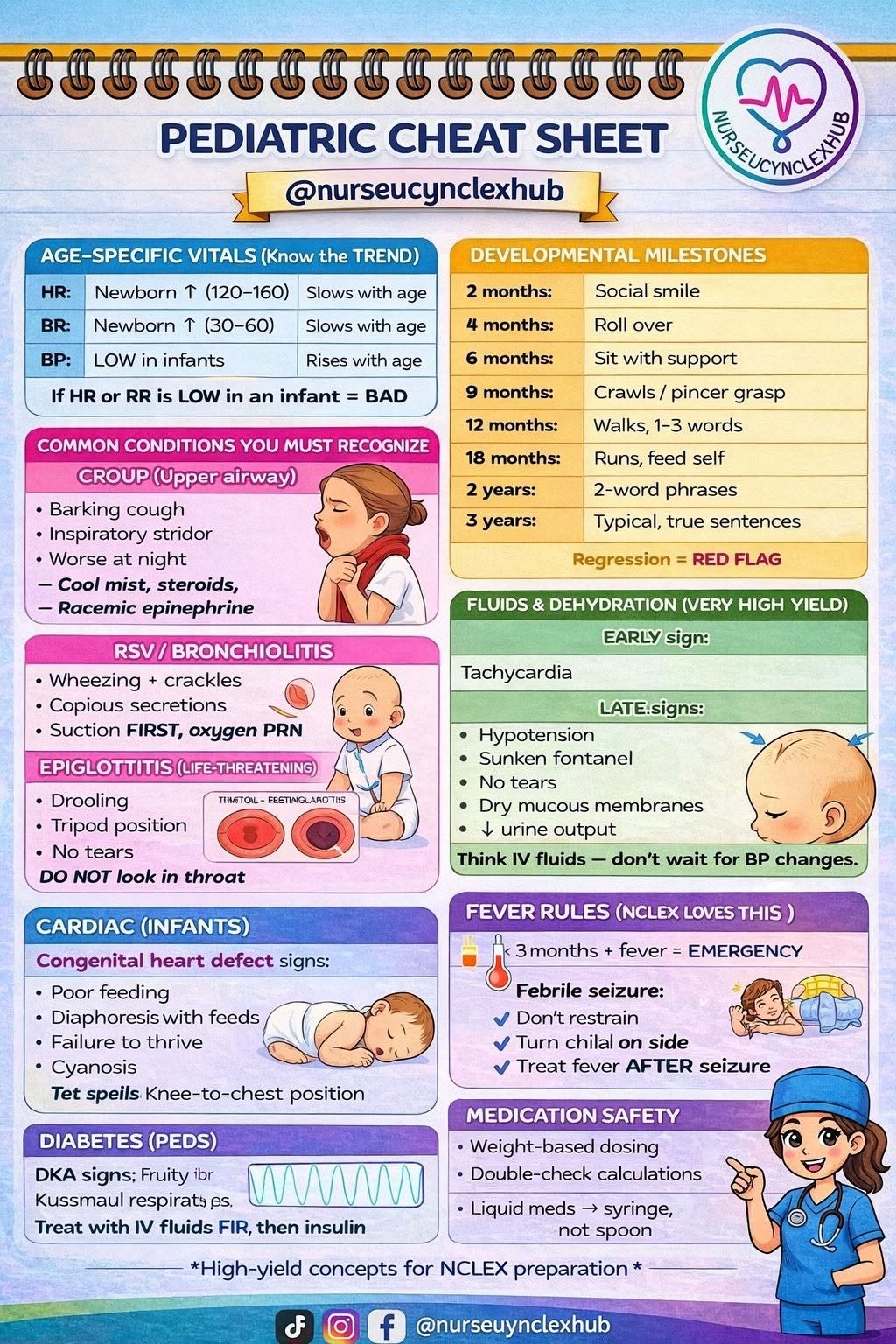
Saved study graphics from your own collection. Each one is someone else’s work — check anything clinical against your course materials before you rely on it.