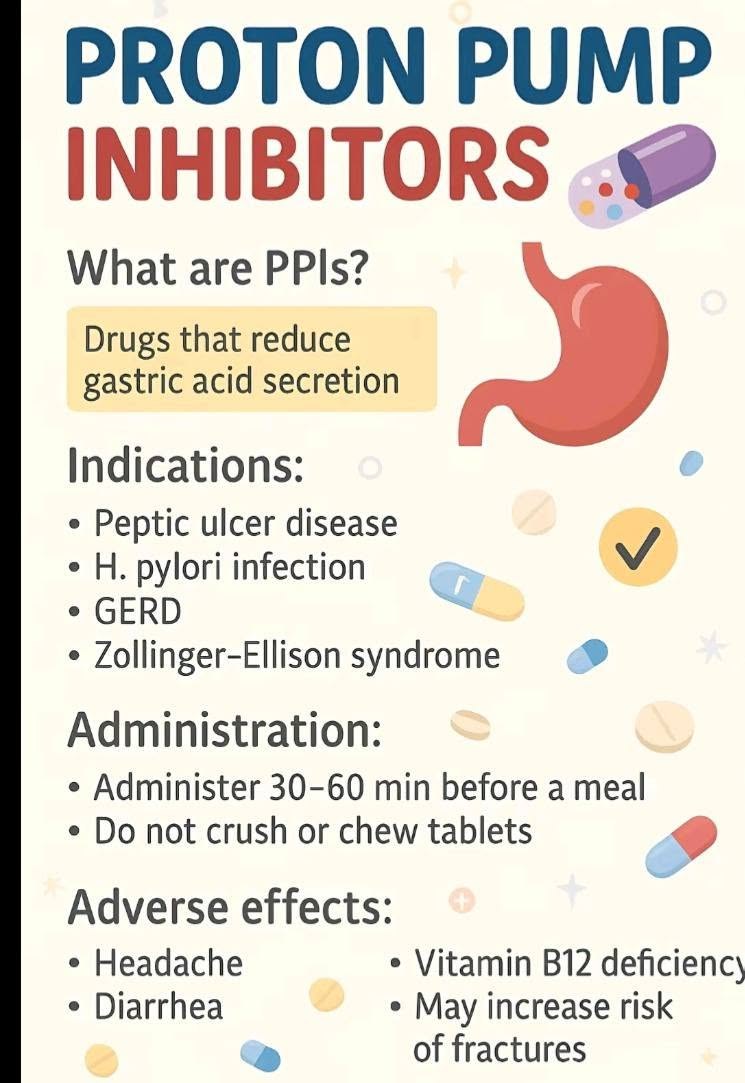
PPIs irreversibly shut off the final step of acid production — the proton pump itself — making them the most potent acid suppressors nursing students will see. Compare with H2 blockers (NG-119), the master cheat-sheet on Acid Prevention (NG-233), and Mucosal Protectants (NG-254).
One enzyme system explains the whole drug class — cap the pump, and acid production stops at the source.
🌋 Mechanism — a cap on the volcano
EXAM TIP PPIs suppress gastric acid secretion by irreversibly inhibiting the H⁺/K⁺-ATPase (proton pump) enzyme system of the gastric parietal cells — the final common step in acid production, no matter what triggered it (histamine, gastrin, or acetylcholine).
🧠 “Cap the volcano.” It doesn't matter which trigger lit the fuse — histamine, gastrin, or acetylcholine — a PPI caps the one shared pump at the very end of the line. That's why PPIs out-suppress every other acid drug class.
💊 The -prazole family & typical adult dosing
Generic
Trade
Used for
Typical adult dose*
esomeprazole
Nexium
Erosive esophagitis, GERD, H. pylori eradication, NSAID-associated gastric ulcers
20–40 mg/day PO
omeprazole
Prilosec
Same as above + hypersecretory conditions, heartburn, ↓ risk of upper GI bleed
🩸 Prevention of GI bleeding in high-risk patients on antiplatelet drugs
🏥 Stress-ulcer prophylaxis in hospitalized/surgical patients
🦠 H. pylori triple therapy
⛽ PPI (omeprazole or lansoprazole)
💊 Anti-infective #1 — amoxicillin
💊 Anti-infective #2 — clarithromycin
🧠 “1 pump + 2 antibiotics = triple play.” The PPI isn't treating the infection — it's dropping the acid so the antibiotics can do their job and the ulcer can heal.
⚠️
WATCH FOR
STEP 2 · SAFETY
Common effects are mild — the ones that matter are the ones that build up over months of use.
😐 Common adverse effects
🤕 Headache
🤢 Nausea
💩 Diarrhea
🌀 Abdominal pain
🧠 Mild & common — not the exam trap. The trap is the long-term list next door.
🚨 Long-term use = the exam trap quartet
🧠 “Bone, Bug, B12, Bounce.” Long-term PPI use can fracture a Bone, invite a Bug (C. diff), starve out B12, and cause acid to Bounce back hard if stopped cold-turkey.
⚠️ Cautions & contraindications
🚫 Hypersensitivity to the drug class
👴 Older adults, hepatic impairment — use cautiously
🤰 Omeprazole = pregnancy category C; lansoprazole, rabeprazole, pantoprazole = category B(contraindicated in pregnancy/lactation per source material — verify current labeling)
🔀 Drug interactions to flag
Interacts with
What happens
Sucralfate
Decreased absorption of the PPI
Ketoconazole, ampicillin
Decreased absorption of the anti-infective
Oral anticoagulants
Increased risk of bleeding
Digoxin
Increased absorption of digoxin
Benzodiazepines, phenytoin
Risk for toxic antiseizure/sedative drug levels
Clarithromycin(with omeprazole)
Increased plasma levels of both drugs
Bisphosphonates
Increased fracture risk
🗣️
TEACH
STEP 3 · PATIENT & NURSING TEACHING
Timing makes the drug work — safety monitoring makes the drug work safely long-term.
⏱️ Timing: 30–60 minutes before a meal
🧠 Right place, right time. The pump has to be actively pumping for the PPI to bind it — take it too late (after eating) and fewer pumps are caught.
❌ Never crush enteric-coated / delayed-release forms
Do not crush or chew enteric-coated tablets or delayed-release capsules — the coating protects the drug from stomach acid until it reaches the small intestine. If the patient cannot swallow, some capsules may be opened and the granules sprinkled on food — verify with pharmacy first.
🩺 Nursing management checklist
1
⏱️ IV infusions: monitor rate closely — too rapid an infusion may induce cardiac arrhythmias
2
📋 Track bowel movements — PPIs can cause constipation or diarrhea
🕐 Space from antacids — give other oral drugs 1–2 hr apart from an antacid dose
5
🦴 Long-term therapy: discuss bone density screening & do not taper/stop abruptly without provider guidance
🔗 See it in context — the acid-reducer family
PPIs are the most potent class but the slowest to fully kick in (days for maximum effect). For the full side-by-side, see the master comparison on Acid Prevention.
🧠 Potency order: PPI > H2 blocker > antacid for acid suppression — but antacid wins for speed of relief, and mucosal protectant doesn't reduce acid at all.
⚡
QUICK RECALL
SAY IT OUT LOUD
⛽ Irreversible pump blockMost potent acid suppression of any class
⏱️ 30–60 min before mealsEmpty stomach — swallow whole
🦴🦠🩸🔁Fracture · C. diff · B12 deficiency · rebound hyperacidity
🎯 Cover & check — 4 rapid-fire questions
Q1: Why are PPIs the strongest acid-reducer class?
They irreversibly block the H⁺/K⁺-ATPase proton pump — the final shared step in acid production, no matter which trigger (histamine, gastrin, acetylcholine) started it.
Q2: When should a PPI be given relative to meals?
30–60 minutes before a meal, on an empty stomach, swallowed whole.
Q3: Name the four long-term risks of PPI therapy.
Fracture risk (hip/wrist/spine), C. diff infection, vitamin B12 deficiency/anemia, and rebound hyperacidity if stopped abruptly.
Q4: What triple-therapy regimen uses a PPI, and why include the PPI at all?
H. pylori triple therapy: a PPI (e.g., omeprazole or lansoprazole) + amoxicillin + clarithromycin. The PPI lowers acid so the antibiotics can work and the ulcer can heal — it isn't treating the infection itself.
📌
STUDY SHEETS
FROM YOUR SAVED SET
What PPIs are, what they treat, the 30 to 60 minutes before a meal rule, and the adverse effects to warn about — B12 deficiency and fracture risk. — swipe it sideways if it is cut off, or tap to open it full size.
Saved study graphics from your own collection. Each one is someone else’s work — check anything clinical against your course materials before you rely on it.