The vocabulary every other GI page assumes you already know
NG-293GIADHD-friendly visual edition
Every GI diagnosis is a vocabulary test first. Learn these words once, here — dysphagia, reflux, PUD, hematemesis, melena, H. pylori — and the next three pages (Hiatal Hernia, Peptic Ulcer Disease, Gastritis) read like plain English instead of a foreign language.
📖 Learn it onceThese words repeat on every GI page — Hiatal Hernia, PUD & Gastritis all assume you already know them.
🩸 Up vs downHematemesis & melena = upper GI bleed. Hematochezia = lower GI bleed.
🦠 One bug, two diseasesH. pylori bacteria → both PUD and Gastritis.
📖
NAME IT
PART 1 · SYMPTOM WORDS
Trace the GI tract start to finish — each stop has its own vocabulary word waiting to trip you up on an exam.
🗺️ One tube, five trouble spots
EXAM TIP Match the word to the organ — most GI vocabulary questions are really anatomy questions in disguise.
🧠 “Top to bottom, name the trouble.” Esophagus = achalasia/dysphagia · Stomach & duodenum = PUD/gastritis · Small intestine = malabsorption · Colon = volvulus/megacolon · Rectum = where lower bleeding shows itself.
😮 Anorexia vs Cachexia — not the same word
Anorexia lack or loss of appetite for food — the desire to eat is gone.
Cachexia severe weakness & wasting of the body from chronic illness — the body is consuming itself, not just skipping meals.
🧠 “Anorexia = Appetite gone. Cachexia = Can't keep weight on.” Anorexia is about wanting food; cachexia is about the body's metabolism eating the patient alive.
🌀 Motility & structural words
Dysphagia difficulty swallowing.
Achalasia the lower esophageal muscles fail to relax, so food can't pass into the stomach.
Volvulustwisting of the intestine → bowel obstruction.
Megacolon abnormal dilation of the colon with abdominal distention.
🧠 “V for tWisted, Mega for stretched.” Volvulus = pretzel-twisted bowel. Megacolon = balloon-stretched bowel. Both end in obstruction, opposite mechanism.
🍞 Malabsorption words
Malabsorption inability to absorb nutrients from certain foods.
Lactose intolerance malabsorption of dairy — missing the enzyme lactase.
Celiac disease malabsorption of gluten — an autoimmune reaction that damages the villi of the small intestine.
🧠 Lactose = milk. Gluten = wheat/barley/rye. Both show up as bloating, gas & diarrhea after the trigger food — the fix is avoidance, not a pill.
🩸
SPOT IT
PART 2 · BLEED & ACID WORDS
The ligament of Treitz is the dividing line — everything above it bleeds one way, everything below it bleeds another.
🩸 Hematemesis · Melena · Hematochezia — where is the bleed?
🧠 “Melena is Molasses from way up High. Hematochezia is Hot red, close to the exit.” Both start with hemat-/hemato- = blood; the ending tells you the form it takes on the way out.
🔥 Acid & reflux words
Reflux stomach contents flowing backward into the esophagus.
Dyspepsia "heartburn" — burning epigastric pain, not actually the heart.
Epigastric pain pain in the upper-mid abdomen, over the stomach.
🧠 Dyspepsia sits behind the sternum, not inside it. That's why heartburn feels cardiac but is actually the esophagus.
🕳️ PUD · Gastritis · H. pylori
PUD Peptic Ulcer Disease — acid erodes through the mucosa, an open sore/hole in the stomach or duodenum.
Gastritisinflammation of the stomach lining — no hole yet, just irritated.
H. pylori spiral bacteria that burrows into gastric mucus and drives both chronic gastritis and PUD.
🧠 Gastritis = irritated. PUD = a hole punched through. Same acid-vs-mucus fight, different depth of damage — see the Gastritis & PUD pages for the full picture.
🚨 Perforation → Peritonitis — one word you must recognize fast
Perforation the ulcer erodes all the way through the stomach/duodenal wall.
Peritonitis the leaked contents inflame/infect the peritoneal cavity — surgical emergency.
🧠 "BOARD" — Board-like rigid abdomen · Over 100.3°F · Agitated & restless · Rebound tenderness + Rising pain · Dashing HR & RR. This exact word set reappears on the PUD page — memorize it once, here.
🧪
TEST IT
PART 3 · LABS THAT TALK
Three organs, three panels — liver, pancreas, and the bacteria that connects to the next two pages.
🫀 Liver labs — A-B-C
🧠 "A-B-C, the liver's ID."Albumin · Bilirubin · Clotting factors — the three things a sick liver stops making correctly. ALT/AST are the "leak" enzymes that spill out when liver cells are injured.
🦠 Pancreas labs + the shared bug
🧠 "AmyLASE = carbohydrateS, LiPASE = fat." Not protein — that's broken down by pancreatic proteases (trypsin). Both spike hard in pancreatitis.
🧪 How H. pylori gets diagnosed
Test
What it tells you
Urea breath test
Non-invasive; detects active infection via labeled CO₂
Stool antigen test
Non-invasive; can confirm eradication after treatment
Biopsy during EGD
Direct visualization + tissue sample; most definitive
Serology (IgG)
Can stay positive for life — not reliable to confirm cure
🧠 NCLEX trap: a positive IgG antibody test does NOT mean the infection is still active — antibodies persist. Use breath or stool antigen testing to confirm the bug is actually gone.
⚡
QUICK RECALL
SAY IT OUT LOUD
📖 Anorexia ≠ Cachexiaappetite loss vs. body wasting from illness
Q1: What's the difference between hematemesis, melena, and hematochezia?
Hematemesis = vomiting blood. Melena = black, tarry stool from an upper GI bleed. Hematochezia = bright red blood in/from stool, usually a lower source.
Q2: A patient's IgG H. pylori antibody test is positive one year after treatment. Is the infection still active?
Not necessarily — IgG antibodies can stay positive for life. Use a urea breath test or stool antigen test to confirm eradication.
Q3: Which liver labs make up the "A-B-C" you should always check together?
Albumin, Bilirubin, and Clotting factors — plus ALT/AST as the "leak" enzymes.
Q4: A postoperative GI patient develops a fever over 100.3°F, rebound tenderness, and a rigid board-like abdomen. What's happening and what do you do?
Suspect perforation → peritonitis. This is a PRIORITY finding — report to the HCP immediately.
📌
STUDY SHEETS
FROM YOUR SAVED SET
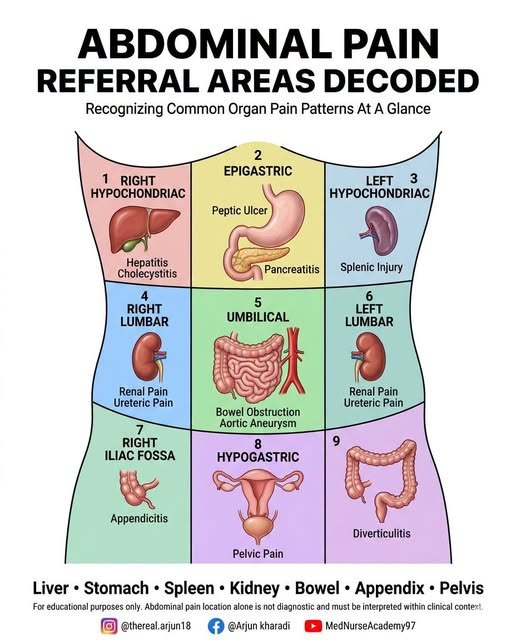
The nine abdominal regions and what hurts where — right hypochondriac liver and gallbladder, epigastric ulcer and pancreas, right iliac fossa appendix. — swipe it sideways if it is cut off, or tap to open it full size.
Saved study graphics from your own collection. Each one is someone else’s work — check anything clinical against your course materials before you rely on it.