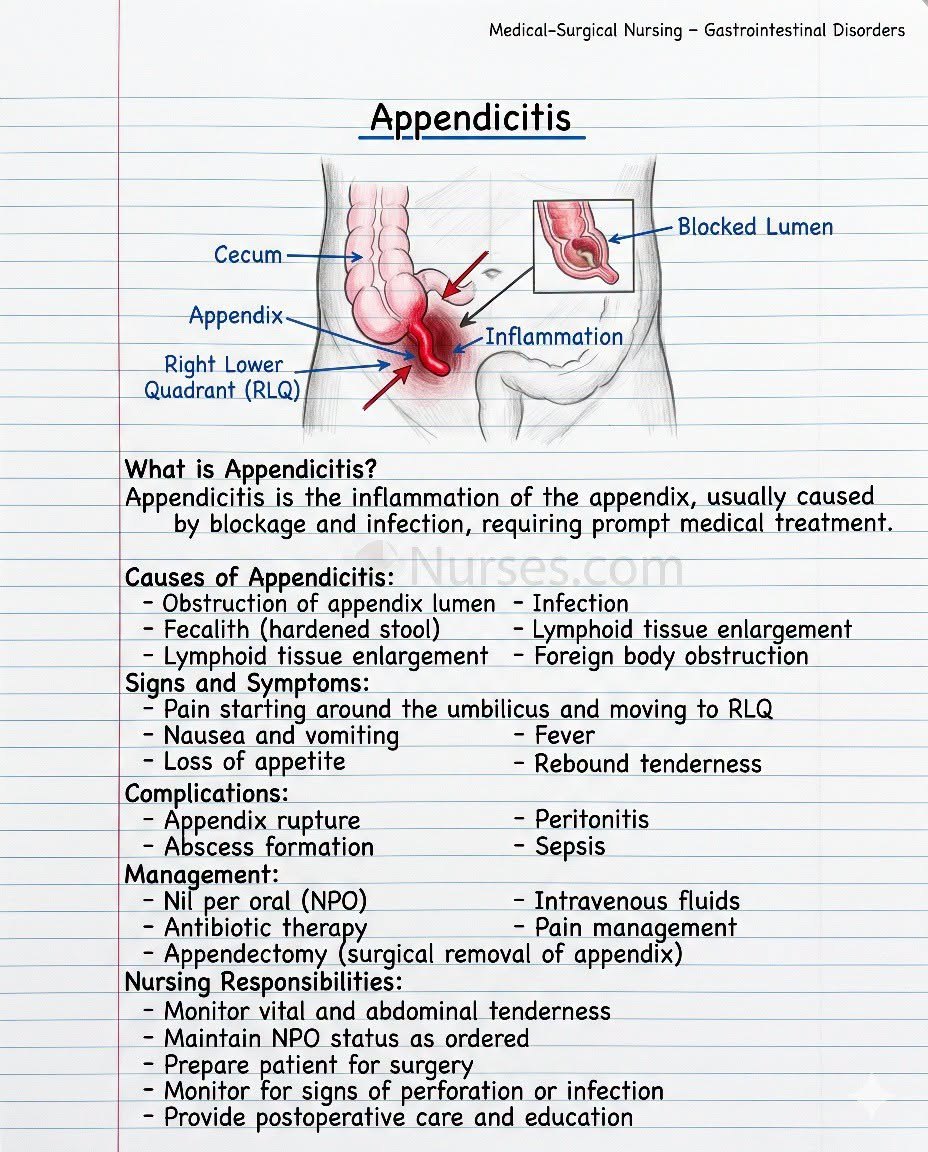
Inflammation of the appendix, located in the RLQ (Right Lower Quadrant) of the abdomen. Untreated, it can perforate → peritonitis — a medical emergency.
🎯 Pain migratesStarts at umbilicus → moves to RLQ / McBurney's point.
🙅 3 NEVERsNO heat · NO laxatives · NO enemas.
💉 NPO + IV fluids firstPain meds ONLY after the surgeon has seen the client.
🚨 Sudden pain relief = 🚩Can mean the appendix just ruptured — not that it's "better."
🧨
CAUSE
STEP 1 · A BLOCKED TUBE
One obstruction explains the entire cascade — from swelling to rupture.
🧭 Where it lives & the obstruction → perforation cascade
🧠 "Blocked pipe, backed-up pressure, blown gasket." Fecalith blocks → pressure builds → tissue dies → the appendix bursts.
🔤 Common trigger
Most often a fecalith (hardened stool) obstructs the appendiceal lumen. Can also be lymphoid tissue swelling, a foreign body, or a tumor.
🧠 Appendicitis = "the left-behind organ that gets clogged." No real digestive job — but it can still get plugged and become dangerous.
⚠️ Why it's an emergency
🚫 The appendix has no room to swell — a rigid tube
🩸 Swelling → cuts off its own blood supply → ischemia
💥 Ischemic tissue ruptures → gut contents spill into the sterile peritoneal cavity
🧠 A ruptured appendix is a race against the clock — this is why "watch and wait" is never the plan.
🔎
CLUES
STEP 2 · READ THE PAIN PATTERN
Where the pain starts, where it ends up, and what happens when you press and let go.
🎯 The classic pain migration — this IS the exam question
COMMON EXAM QUESTION What's the typical pain presentation? Pain starts around the umbilicus, then moves to the right lower quadrant — described as "pain between the right hip area and belly button."
🔵 Vague, dull pain around the umbilicus (belly button)
▼ hours later
🔴 Sharp, localized pain at McBurney's point (RLQ)
🧠 Wrong-answer traps on this question: pain starting in the LUQ, radiating to the shoulder, or "diffuse all over" are distractors — the correct pattern is umbilicus → RLQ.
🚩 Signs & symptoms
🌡️ Low-grade fever
📍 RLQ pain with rebound tenderness
🤢 Nausea, vomiting, anorexia
🪵 Rigid, "board-like" abdomen
💓 Tachycardia, tachypnea
🧠 "Rebound tenderness" = pain that spikes when you release the pressure, not when you press it — this is the hallmark peritoneal sign.
🚨 Complication: perforation = peritonitis — a medical emergency
🌡️ Fever — over 100.3°F
🤲 Rebound tenderness
🪵 "Rigid" or "board-like" abdomen
📈 Increasing pain, tenderness
😰 Restless
💓 Fast HR & RR (tachycardia / tachypnea)
🧠 Sudden, total pain relief after hours of steady RLQ pain is NOT a good sign — it can mean the appendix just ruptured and the pressure released. Report it immediately, don't chart it as "improved."
🩺
CARE
STEP 3 · PROTECT THE SURGICAL PICTURE
Before surgery: don't mask it, don't move it, don't feed it. After surgery: get them up and breathing.
💉 Pre-op interventions, in order
1
🚫 NPO — nothing by mouth, surgery is likely
2
💧 IV normal saline or LR (Lactated Ringer's)
3
💊 Pain meds: IV morphine/hydromorphone — ONLY after the surgeon has assessed the client
🧠 Why wait on pain meds? Masking the pain and exam findings too early can hide the very signs (rebound tenderness, location, rigidity) the surgeon needs to make the call.
❌ The 3 NEVERs
🔥NO heat pador blanket
💊NO laxatives
💦NO enemas
All three can increase pressure or blood flow to an inflamed appendix and trigger rupture.
🧠 Constipation care (fiber, fluid, laxatives — see NG-301) is the opposite of what an inflamed appendix needs.
🔪 Surgery: appendectomy
Definitive treatment — surgical removal of the appendix, done urgently once diagnosis is confirmed to prevent rupture.
🧠 Appendectomy = PRIORITY once diagnosed — this is not a "schedule it for next week" surgery.
🩹 Post-op care
🚶Early ambulation
🌬️Deep breathe & cough+ incentive spirometer
🛁Shower ONLYno tub baths
🏋️Avoid heavy lifting
👀Report redness/swelling/drainageat incision site
Prevent pneumonia: assist with early ambulation, deep breathing/coughing, incentive spirometer. Prevent infection: shower-only bathing, monitor incision.
🧠 "Walk, breathe, watch the wound." The three post-op jobs that prevent the two big complications — pneumonia and wound infection.
⚡
QUICK RECALL
SAY IT OUT LOUD
🎯 Umbilicus → RLQthe classic pain migration.
🙅 NO heat, laxatives, enemasall can trigger rupture.
💉 NPO + IV fluids firstpain meds only after surgeon sees them.
Q1: Describe the classic pain pattern of appendicitis.
Pain starts around the umbilicus, then migrates to the right lower quadrant (McBurney's point).
Q2: Name the 3 never-do interventions before an appendicitis diagnosis is confirmed.
No heat pad/blanket, no laxatives, no enemas — all can increase pressure or blood flow and trigger rupture.
Q3: When can the client receive pain medication?
Only after the surgeon has assessed the client — masking pain too early can hide key exam findings.
Q4: A client's RLQ pain suddenly disappears entirely — what should you think?
Possible perforation/rupture, not improvement — report immediately and watch for peritonitis signs (fever, rigid abdomen, tachycardia).
📌
STUDY SHEETS
FROM YOUR SAVED SET
Appendicitis — the blocked lumen, pain that starts at the umbilicus and moves to the right lower quadrant, and the NPO-before-surgery rule. — swipe it sideways if it is cut off, or tap to open it full size.
Saved study graphics from your own collection. Each one is someone else’s work — check anything clinical against your course materials before you rely on it.