SBO — Mechanical vs. Non-Mechanical (Paralytic Ileus)
NG-305GIADHD-friendly visual edition
A blockage in the small intestine — food, fluid & gas back up behind the block. Two flavors: mechanical (a physical block — adhesions, hernia, tumor, volvulus) and non-mechanical (paralytic ileus — the bowel just stops moving). Untreated → bowel perforation & peritonitis.
🌀 The classic triadColicky pain + distension + vomiting.
🎧 Bowel sounds tell locationHyperactive above the block, hypoactive/absent below.
❌ No opioidsSlow the gut further — avoid morphine, hydrocodone, hydromorphone.
🧨
CAUSE
STEP 1 · WHAT'S BLOCKING THE TUBE
Split obstruction into two categories: something physically in the way, or the bowel simply stopped moving.
🌀 Mechanical vs. non-mechanical (paralytic ileus)
DEFINITION A small bowel obstruction is a blockage in the small intestine that stops the normal flow of contents.
🧠 "Mechanical = something's IN the way. Paralytic = nothing works, PERIOD." One is a roadblock; the other is a stalled engine.
⚠️ Mechanical obstruction — causes
🩹 Adhesions (scar tissue) — from prior surgery, most common cause
🕳️ Hernias
🌀 Volvulus — twisting of the bowel
📥 Intussusception — bowel telescopes into itself
🎗️ Tumor (cancer)
🧠 "AHVIT" — Adhesions · Hernias · Volvulus · Intussusception · Tumor. Adhesions from a past surgery are the #1 answer.
⚠️ Non-mechanical (paralytic ileus) — think "why isn't it moving?"
🔪 Recent abdominal surgery (bowel handling)
💊 Opioids & anticholinergics slow motility
🧂 Electrolyte imbalance — hypokalemia is classic
🦠 Peritonitis / sepsis
🧠 A quiet, non-tender, evenly distended belly after surgery = suspect ileus, not a mechanical block.
🚨 RED FLAG — call the provider now (bowel perforation)
An unrelieved obstruction stretches the bowel wall until it perforates → contents spill into the peritoneum → peritonitis is a medical emergency.
🌡️Feversudden
💓Tachycardia
💨Tachypnea
🪵Rigid, board-like abdomen
🎈Worsening distension
🧠 COMMON EXAM QUESTION Client with an SBO suddenly develops tachycardia, tachypnea, and a high fever. Most likely problem? Bowel perforation — notify the HCP immediately. (Not PE, pneumonia, or atelectasis — those don't fit a sudden fever + rigid abdomen picture in this context.)
🔎
CLUES
STEP 2 · THE CLASSIC TRIAD
Colicky pain, a swelling belly, and vomiting that won't quit — plus bowel sounds that tell you exactly where the block is.
🌀 The classic triad — RAPID onset
⚡Colicky painintermittent, cramping
🎈Abdominal distension
🤮Frequent nausea & vomiting
🧠 "Colic, Cramp, Can't-keep-it-down." Three C-sounding clues = triad of SBO: Colicky pain, belly bloats like a bCalloon (distension), and Can't stop vomiting.
🎧 Bowel sounds — location clue
🧠 Loud before, quiet after. The gut is straining to push past the block (hyperactive above); nothing gets through to the segment below (hypoactive/absent).
⚠️ Complication ladder
🌀 Obstruction — pain, distension, vomiting
▼
🎈 Worsening distension, dehydration, electrolyte loss
▼
🚨 Peritonitis — medical emergency
🧠 If it's not relieved, the bowel wall stretches until it tears. Every unmanaged SBO is a countdown to perforation.
🔬 Common exam question, broken down
"Client with a small bowel obstruction suddenly develops tachycardia and tachypnea with a high fever. What is most likely the problem?"
4. Atelectasis — ❌ doesn't cause fever/tachycardia like this
🧠 New fever + tachycardia + tachypnea in the context of a known obstruction = perforation until proven otherwise.
🩺
CARE
STEP 3 · REST THE GUT, RELIEVE THE PRESSURE
Stop feeding it, decompress it, and don't slow it down further with opioids.
✅ Treatment — priority actions
1
NPO — nothing by mouth, rest the bowel
2
NGT insertion — nasogastric tube for decompression + IV fluids
3
Semi-Fowler's position
4
Pain control — non-opioid preferred
🧠 "NNSP" — NPO · NGT · Semi-Fowler's · Pain control (non-opioid). Rest it, drain it, sit it up, treat pain smartly.
❌ AVOID opioid analgesics
Opioids further slow GI motility — the last thing a stalled bowel needs.
💊Morphine
💊Hydrocodone
💊Hydromorphone
🧠 Opioids = "constipation in a syringe." They slow the very motility the bowel is already failing at.
🔪 Surgery — when conservative care fails
Clients who fail to improve need a bowel resection to remove the diseased/dead segment, and may need a temporary ostomy until the bowel heals.
🧠 NGT + NPO buys time — surgery is the fallback if the obstruction won't resolve or perforation occurs.
🩹 NGT decompression — how it helps
⚡
QUICK RECALL
SAY IT OUT LOUD
🌀 TriadColicky pain + distension + vomiting
🚧 Mechanical= physical block (adhesions #1 cause)
😴 Paralytic ileus= bowel just stops moving
❌ No opioidsNPO + NGT + semi-Fowler's + non-opioid pain control
🎯 Cover & check — 4 rapid-fire questions
Q1: What's the classic triad of small bowel obstruction?
Colicky abdominal pain, abdominal distension, and frequent nausea/vomiting.
Q2: Client's bowel sounds are hyperactive in the upper abdomen and absent lower down. What does that tell you?
The obstruction is between the two — hyperactive sounds occur above the block, hypoactive/absent sounds occur below it.
Q3: What's the most common cause of mechanical SBO?
Adhesions (scar tissue) from prior abdominal surgery.
Q4: Why avoid morphine for SBO pain?
Opioids further slow GI motility, worsening the obstruction — use non-opioid pain control instead.
📌
STUDY SHEETS
FROM YOUR SAVED SET
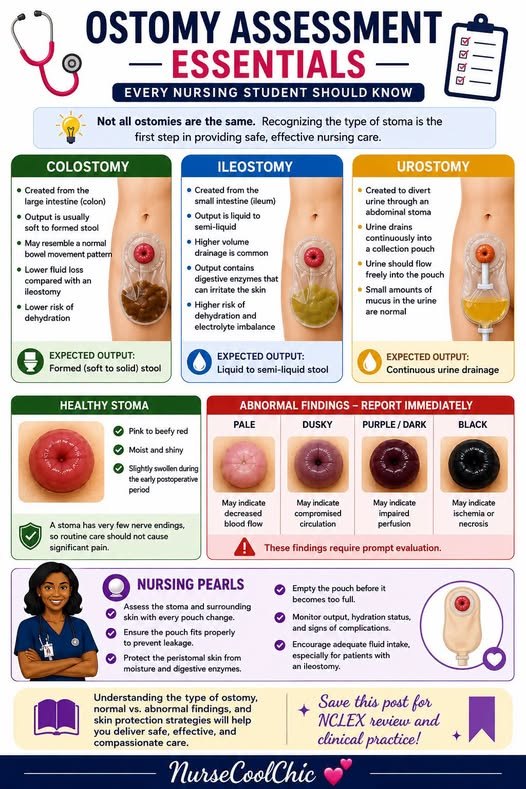
Colostomy, ileostomy and urostomy compared by output, plus the stoma color chart — pink to beefy red is healthy; pale, dusky, purple or black is reported now. — swipe it sideways if it is cut off, or tap to open it full size.
Saved study graphics from your own collection. Each one is someone else’s work — check anything clinical against your course materials before you rely on it.