Nursing Field Notes / Musculoskeletal · Bone Density & Metabolic Bone Disease
Osteoporosis 🦴
"Porous bone" — the silent thief of bone density
NG-125MusculoskeletalADHD-friendly visual edition
Bone resorption outruns bone formation — osteoclasts (the demolition crew) break down bone faster than osteoblasts (the construction crew) can rebuild it, leaving bones fragile, porous, and fracture-prone. It's called the silent disease because it has no symptoms until a bone breaks.
🏗️ Resorption > FormationOsteoclasts (break down) outpace osteoblasts (build up) → net bone loss.
🤫 Silent until it breaksNo symptoms — first sign is often a fracture or lost height.
🧪 T-score ≤ -2.5DEXA scan T-score of -2.5 or lower = osteoporosis.
💊 Rx = two other pagesBisphosphonates → NG-238. Calcium + alendronate pairing → NG-108.
🧨
CAUSE
STEP 1 · THE REMODELING IMBALANCE
Bone is living tissue that's constantly being torn down and rebuilt — osteoporosis is what happens when demolition wins.
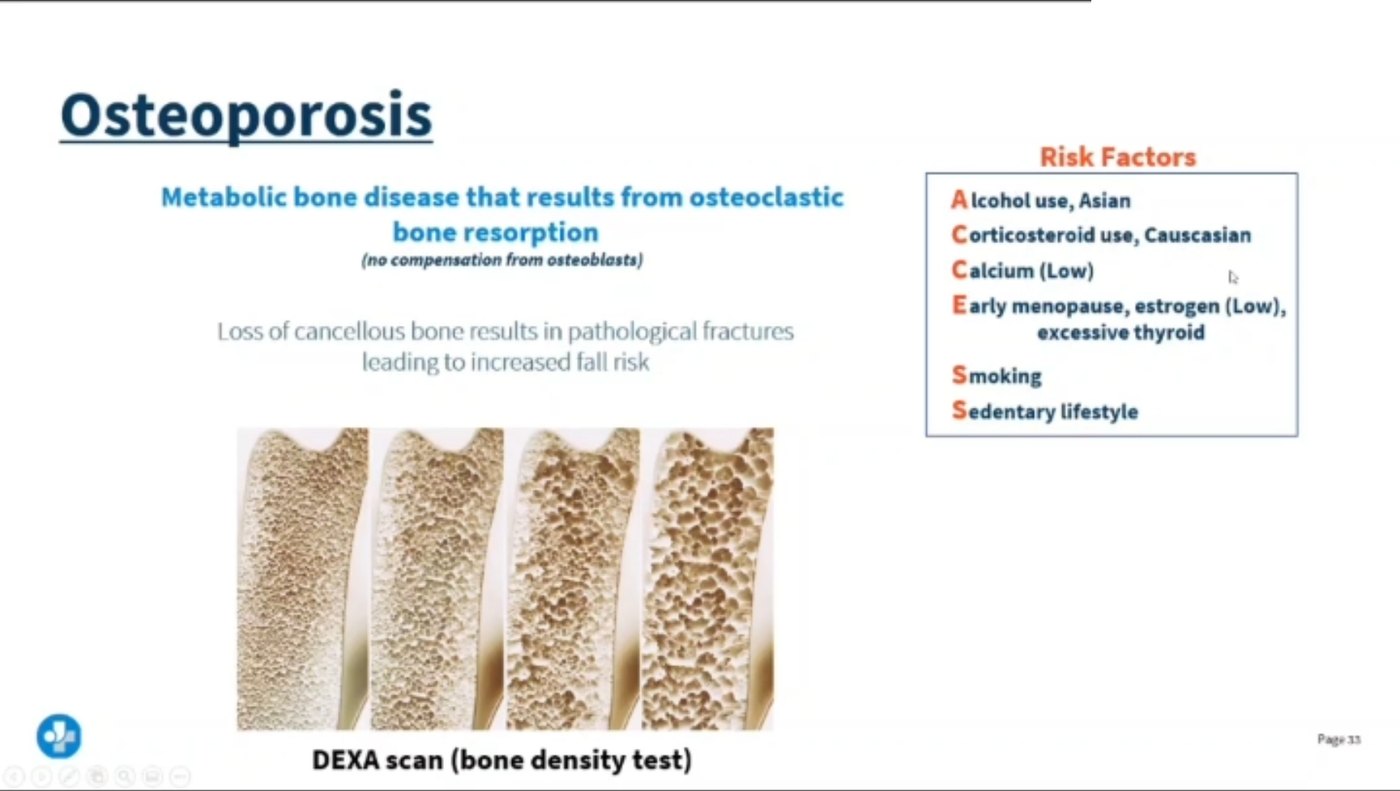
From your lecture. Their mnemonic is ACCESS: Alcohol, Corticosteroids, Calcium low, Early menopause, Smoking, Sedentary. Diagnosed on a DEXA scan.
🏗️ Normal bone remodeling vs. osteoporosis
MECHANISM Bone remodels constantly: osteoclasts resorb (dissolve) old bone, then osteoblasts lay down new bone in its place. Normally these stay balanced. In osteoporosis, osteoclast activity outpaces osteoblast activity — bone is resorbed faster than it's replaced, so total bone mass and density drop over time.
🧠 "PORus bones = OsteoPORosis." The word itself tells you the pathophysiology — the bone becomes full of pores (holes) because breakdown has outpaced building.
🔤 Know the three "osteo-" look-alikes
Term
What it means
Osteopenia
Lower-than-normal bone mass — the step before osteoporosis
Osteoporosis
Porous, fragile bone from low bone density — resorption > formation
Osteomalacia
Softening of bone from severe vitamin D deficiency — a mineralization problem, not a density problem
🧠 Osteo-mal-ACIA = mal (bad) + ACID-ish D. Malacia is about soft bone from missing vitamin D — different mechanism than porosis.
⚠️ Risk factors — who loses the seesaw
👩 Female, especially postmenopausal — estrogen normally restrains osteoclasts; losing it removes the brake
🎂 Older age, small/thin body frame
🌍 Caucasian or Asian ethnicity
👪 Family history of osteoporosis or fracture
🥛 Low calcium / vitamin D intake, low physical activity
🧠 "Thin white/Asian grandma" is the classic exam stem body type — low estrogen + low body mass + genetics all strip the bone's protection at once.
💊🏥 NCLEX TRAP — secondary causes: diseases & drugs that cause osteoporosis
Diseases
Hyperparathyroidism — too much PTH pulls calcium out of bone
Cushing syndrome — chronic excess cortisol
Diabetes mellitus
Hyperthyroidism
Medications
🚨 Corticosteroids ("-sone") — e.g. prednisone — the #1 tested drug-induced cause
Anticonvulsants (long-term use)
Long-term heparin
Long-term proton pump inhibitors ("-prazole")
🧠 "Predni-SONE thins the bone." If a stem asks which medication increases risk for osteoporosis, glucocorticoids like prednisone are almost always the answer.
🔎
CLUES
STEP 2 · SPOT IT
There are almost no early clues — the disease hides until a bone gives out or a scan catches it.
🤫 Clinical picture: the "silent disease"
🚨 Often asymptomatic — no pain, no warning, until a fracture happens
📉 Loss of height over time (vertebral compression)
🐫 Kyphosis — exaggerated rounded upper back ("dowager's hump"), common in elderly clients
🦴 Fragility fractures — break from a low-impact fall or even normal activity (classic sites: hip, vertebrae, wrist/Colles' fracture)
😖 Back pain, most often from a new vertebral compression fracture
🧠 "The hip that broke the fall, not the fall that broke the hip." In an osteoporotic client, ask which came first — often the bone fractures spontaneously and then the client falls.
🧍 Kyphosis & height loss — what it looks like
🧠 Dowager's hump = the rounded thoracic curve from multiple silent vertebral compression fractures stacking up over the years.
🧪 DEXA scan & T-score — the diagnostic clue
DEXA (Dual-energy X-ray Absorptiometry) measures bone mineral density and reports it as a T-score — how many standard deviations the client's bone density is from a healthy young adult's peak bone mass.
Standard WHO diagnostic categories — used to guide when to start treatment and to track response.
🧠 "Two-point-five and falling = disease." Remember one number: -2.5 is the osteoporosis cutoff on DEXA.
⭐ High-yield exam Q&A pulled straight from the source deck
Kaplan-style: "Which medication increases risk for osteoporosis?" → Prednisone (a corticosteroid).
HESI-style: "Which population has increased risk of osteoporosis?" → 60-year-old postmenopausal woman.
HESI-style (SATA): Risk factors include steroid use, high caffeine intake, being white or Asian, postmenopausal state, and anticonvulsant therapy.
Kaplan-style: Best prevention teaching for an at-risk client → walk (weight-bearing exercise) about 30 minutes, 4 times per week.
🩺
CARE
STEP 3 · BUILD & PROTECT THE BONE
Prevention leans on exercise, nutrition, and fall-proofing the environment — drug therapy is only briefly mentioned here.
✅ Prevention & general teaching ladder
1
🚶 Weight-bearing & resistance exercise — e.g. walking 30 minutes, 4x/week. Loading the bone stimulates osteoblasts.
2
🥛 Adequate calcium & vitamin D intake — through diet, sunlight, and/or supplements (see NG-108 for the calcium teaching detail)
3
☀️ Sun exposure — supports the skin's natural vitamin D synthesis
4
🚭 Stop smoking, decrease caffeine and alcohol — all accelerate bone loss
5
🚶♀️ Frequent ambulation to maintain bone stimulus and muscle strength
🧠 "Move it, feed it, sun it, quit it." Four verbs cover the whole prevention bundle: exercise, calcium/vitamin D, sunlight, and stopping the bad habits.
🚨 Fall precautions — the #1 nursing priority once diagnosed
🧼 Rubber mats in the shower/tub
💡 Well-lit hallways
❌ No throw rugs
👟 Non-skid footwear, clear walkways
🦯 Assistive devices as needed
🧠 A fragile bone means every fall is a potential fracture. Fall precautions are as much a treatment for osteoporosis as any medication.
📈 Fracture risk timeline — how the disease usually presents
🤫 Years of silent bone loss (no symptoms)
▼
📉 Gradual height loss, mild back pain from micro-fractures
▼
🚨 Fragility fracture — hip, spine, or wrist — often the first diagnosis clue
🧠 Screening exists to catch step 1 — a DEXA scan is how you diagnose osteoporosis before the fracture, not after.
💊 Drug therapy — brief overview only (full detail lives on two other pages)
Osteoporosis treatment centers on slowing bone resorption and supplying the raw materials for new bone. The two drug classes most tested with this topic are covered in depth elsewhere so this page can stay focused on the disease itself:
📍 Bisphosphonates (alendronate, risedronate) — mechanism, dosing, and the critical morning-administration teaching → see NG-238 Bisphosphonates.
📍 Calcium supplementation paired with alendronate — carbonate vs. citrate, vitamin D's role, and why the two must NOT be taken together → see NG-108 Calcium & Alendronate.
🧠 Think of osteoporosis management as three separate jobs: this page = why it happens and how to prevent it; NG-238 = the drug that slows the breakdown; NG-108 = the supplement that supplies the building blocks, and how to keep the two from canceling each other out.
⚡
QUICK RECALL
SAY IT OUT LOUD
🏗️ Osteoclasts > osteoblasts= net bone loss = osteoporosis
🤫 Silent disease= often no symptoms until fracture
🧪 T-score ≤ -2.5= diagnostic cutoff on DEXA
💊 Prednisone= classic drug-induced cause
🎯 Cover & check — 4 rapid-fire questions
Q1: In osteoporosis, which cell activity outpaces the other?
Osteoclast (bone resorption/breakdown) activity outpaces osteoblast (bone formation) activity, causing net bone loss.
Q2: What T-score on DEXA diagnoses osteoporosis?
A T-score of -2.5 or lower. -1.0 to -2.5 is osteopenia; ≥ -1.0 is normal.
Q3: A client asks which of her medications raised her fracture risk. She takes prednisone for asthma — what do you tell her?
Corticosteroids like prednisone are a well-known drug-induced cause of osteoporosis — this is the classic NCLEX answer for "which medication increases osteoporosis risk."
Q4: What's the single best exercise teaching point for osteoporosis prevention?
Weight-bearing exercise (e.g., walking about 30 minutes, 4 times a week) — mechanical loading stimulates osteoblast bone-building activity.