Amputations 🦿
Below- & Above-Knee Limb Loss — Perioperative & Residual Limb Care
Amputation = surgical removal of a limb, most often for peripheral arterial disease & diabetic gangrene that no longer has enough blood flow to heal. The nurse's job splits into three windows: before (vascular status, prep), right after (bleeding, pain as a red flag, positioning), and rehab/home (residual limb shaping, phantom pain, contracture prevention). Positioning is the single most tested piece — get it right for the first 24 hours, then get it right for every day after that.
📄 Simple Nursing original — opens in Drive →
BEFORE
STEP 1 · WHY & WHEREAmputation is almost always a circulation problem first — knowing the "why" explains every choice that follows.
🦵 The two levels — and why the exam always picks BKA
KAPLAN LOGIC A client with type 1 diabetes gets a right BKA for gangrenous toes and asks why it's "so extensive." The answer: a below-the-knee amputation results in better circulation and healing than trying to save more distal, poorly-perfused tissue.
⚠️ Who ends up here — causes & risk factors
- 🩸 Peripheral arterial disease (PAD) — poor blood flow to the limb
- 🍬 Diabetes mellitus — the classic exam scenario: sugary blood → poor healing → infection → gangrene
- 🦠 Severe/uncontrolled infection that won't clear with antibiotics or debridement
- 💥 Trauma — crush injury, severe burns, frostbite
- 🎗️ Malignant bone tumor (e.g., osteosarcoma)
🖐️ Pre-op vascular assessment — the same 6 P's
Before surgery, the nurse documents baseline circulation, motion & sensation distal to the planned incision using the same neurovascular check covered on the Fracture page in this series.
| Check | What it tells you |
|---|---|
| Pain, Pallor, Pulselessness | Circulation to the limb |
| Paresthesia, Paralysis | Nerve function |
| Poikilothermia (temp change) | Perfusion / skin viability |
💬 Psychosocial prep — grieving a body part before it's gone
Limb loss triggers a real grief response — anticipate anger, denial, depression before & after surgery. Assess body image, involve the client in decisions, and set the expectation early that phantom limb sensations are normal so the client isn't blindsided by them later.
RIGHT AFTER
STEP 2 · THE FIRST 24–48 HOURSImmediately post-op, the nurse is hunting for bleeding and watching how pain behaves — not just treating pain.
🚨 Priority concern: pain that persists or climbs at the operative site
KAPLAN LOGIC Immediately following a right BKA, the nurse is most concerned when the client reports persistent pain at the operative site — not routine surgical soreness that responds to analgesia. Persistent or worsening pain is the earliest clue to hemorrhage, hematoma, or impaired circulation to the residual limb.
- 🩹 Assess the dressing frequently — note any increase in drainage, and mark & time the outline of new bleeding
- 🔧 Keep a large clamp or tourniquet at the bedside for the first 24 hours in case of sudden hemorrhage — standard trauma/ortho precaution
- 🌡️ Also assess for expected findings: redness & irritation at the incision are watched, but escalating pain out of proportion is the priority red flag
⏫ Positioning, part 1: elevate for 24 hours only
Elevating the residual limb on a pillow for the first 24 hours reduces post-op edema. This is time-limited on purpose — continue to the next card.
🩹 Dressing & drain care
- Rigid or soft compression dressing shapes the residual limb & controls edema
- Monitor a surgical drain (if present) for amount & character of output
- A dressing that hasn't been changed/dated appropriately (e.g., dated two days prior with no reassessment) is a finding the nurse should intervene on, not ignore
REHAB & HOME
STEP 3 · SHAPE, PROTECT, TEACHOnce bleeding risk passes, the whole game shifts to preventing contractures, shaping the limb for a prosthesis, and validating phantom pain.
❌ NEVER: prolonged elevation or keeping the limb flexed
Do not elevate the residual limb past the first 24 hours and do not let it rest flexed against pillows. Both habits shorten the hip or knee flexors, and the client ends up with a permanent hip or knee flexion contracture that can make an eventual prosthesis impossible to use.
✅ Residual limb ("stump") daily care
🩹 Wrapping/shrinker technique — shaping for a prosthesis
An elastic bandage or shrinker sock applied in a figure-8 pattern with even, decreasing distal-to-proximal pressure shapes the residual limb into a cone for a future prosthesis. Circular wrapping is never used — it constricts like a tourniquet and cuts off circulation.
👻 Phantom limb pain — real, neurological, not psychological
Phantom limb sensation/pain is a genuine neurological event — cut peripheral nerves keep firing, and the brain's cortical map for that limb hasn't updated yet. It is not a psychological complaint and should never be dismissed as "not real."
- 💊 Managed with gabapentin/pregabalin, sometimes low-dose antidepressants or opioids for breakthrough pain
- 🪞 Mirror therapy — client watches the reflection of the intact limb moving to "retrain" the brain
- ⚡ TENS unit, massage, and early prosthetic use can reduce frequency
- 🗣️ Validate it. Telling the client it's "just in their head" damages trust and delays treatment of a real pain source
📊 BKA vs AKA at a glance
| Feature | Below-Knee (BKA) | Above-Knee (AKA) |
|---|---|---|
| Circulation to the cut edge | Better — most tested choice | Used when BKA vasculature won't support it |
| Knee joint | Preserved | Removed |
| Energy to walk w/ prosthesis | Lower | Higher — more energy expenditure |
| Contracture risk to prevent | Knee flexion | Hip flexion |
QUICK RECALL
SAY IT OUT LOUD🎯 Cover & check — 4 rapid-fire questions
STUDY SHEETS
FROM YOUR SAVED SET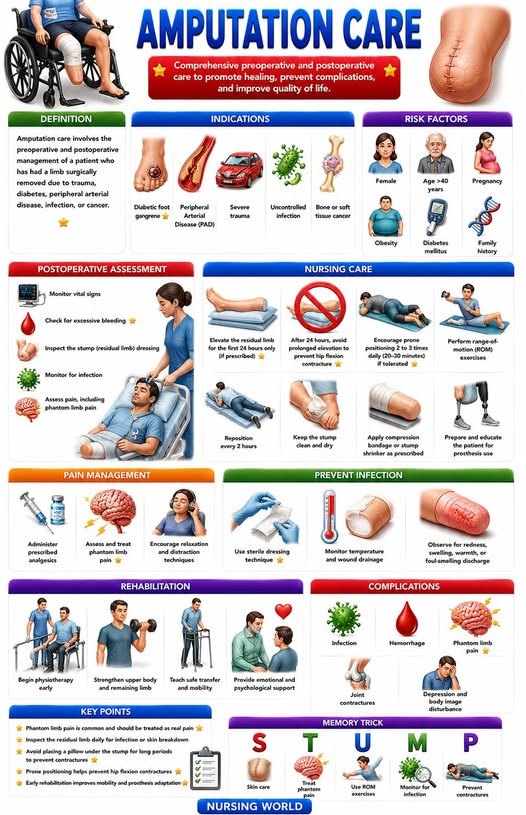
Saved study graphics from your own collection. Each one is someone else’s work — check anything clinical against your course materials before you rely on it.