Osteomalacia & Rickets 🦴
Soft bone · Vitamin D · The one that is not osteoporosis
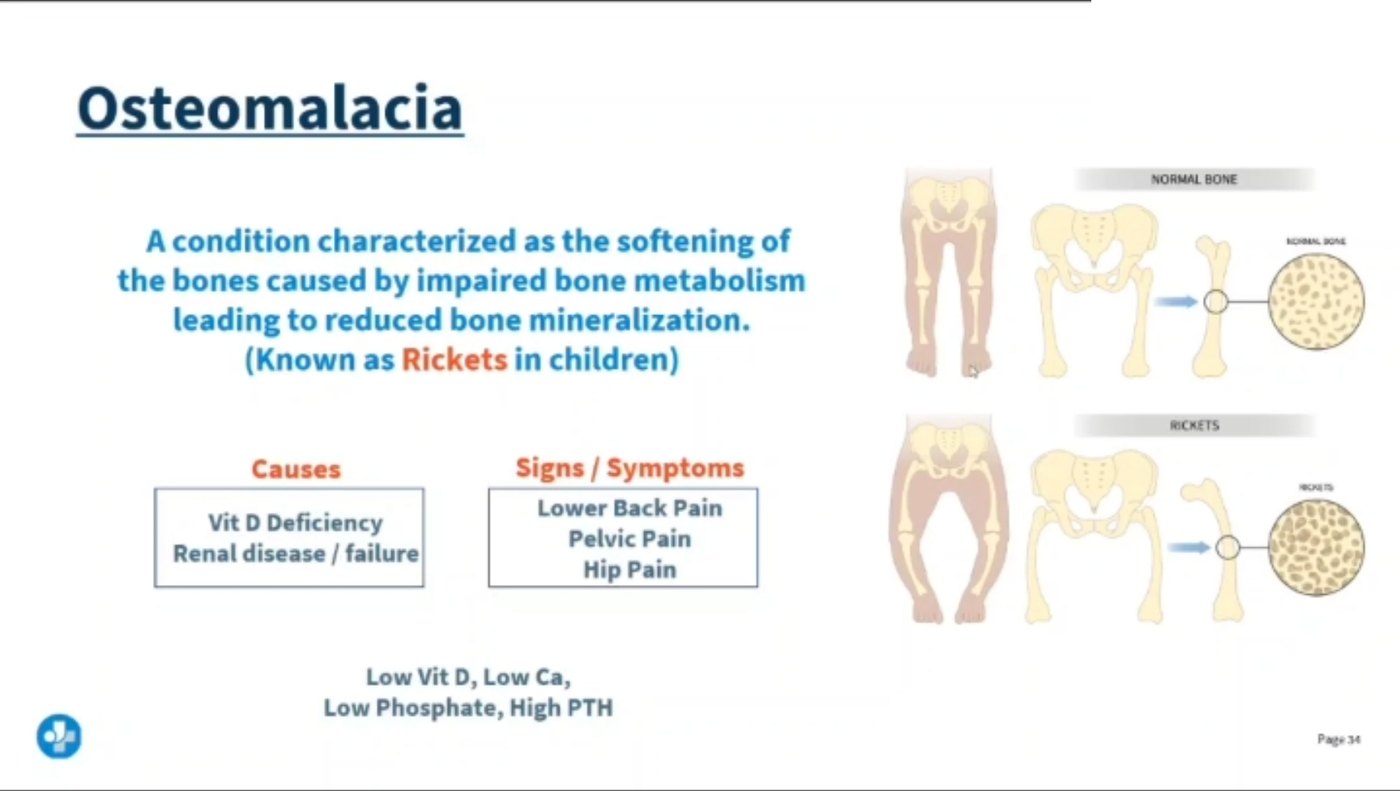
Osteomalacia is softening of bone: the amount of bone is normal, but it is poorly mineralised. In a child, whose growth plates are still open, the same problem is called rickets and bends the legs. Osteoporosis is too little bone; osteomalacia is enough bone, badly made.
🧨 What starts it
- Not enough sun, dark skin, covered skin, northern latitude, housebound.
- Malabsorption — celiac disease, Crohn’s, bariatric surgery, chronic pancreatitis.
- Renal disease — the kidney does the final activation step, so failure means no active vitamin D.
- Liver disease, and drugs that speed vitamin D breakdown (phenytoin, carbamazepine).
No vitamin D → no calcium absorbed from the gut → serum calcium falls → PTH rises to defend it → PTH pulls calcium out of bone and dumps phosphate in the urine. The bone ends up soft.
A high PTH with a low calcium is the fingerprint. In osteoporosis these are all normal.
🔎 What you will see
- Lower back, pelvic and hip pain — a deep, aching bone pain, worse on weight-bearing.
- Muscle weakness, especially the hips — trouble rising from a chair or climbing stairs, and a waddling gait.
- Pathologic fracture, and pseudofractures (Looser zones) on X-ray.
- Bowed legs once they start to walk.
- Widened wrists and ankles, rachitic rosary along the ribs.
- Delayed fontanelle closure, delayed teeth, short stature.
Low vitamin D · low calcium · low phosphate · high PTH · high alkaline phosphatase. Alk phos is high because the bone is frantically trying to build.
🩺 What you do
- Vitamin D replacement is the center of it, with calcium and sometimes phosphate.
- In renal failure use the activated form (calcitriol) — the failing kidney cannot activate the ordinary one.
- Sensible sun exposure, and fortified foods, oily fish, egg yolk.
- Treat the cause — the celiac disease, the malabsorption, the renal failure.
- Safety: this bone breaks easily. Fall precautions until it remineralises.
Osteoporosis: normal labs, diagnosed on DEXA, treated with bisphosphonates.
Osteomalacia: abnormal labs, diagnosed on bloods, treated with vitamin D.
Pain improves over weeks; the bone takes months. Keep taking it after she feels better.