Septic Arthritis 🦠
One hot joint · Aspirate before antibiotics · Cartilage is on a clock
Bacteria have got inside a joint. It is usually one joint, usually the knee, and it is hot, red, swollen and too painful to move. Cartilage starts being destroyed within days, so this is an emergency, not a review-in-the-morning problem.
🧨 What starts it
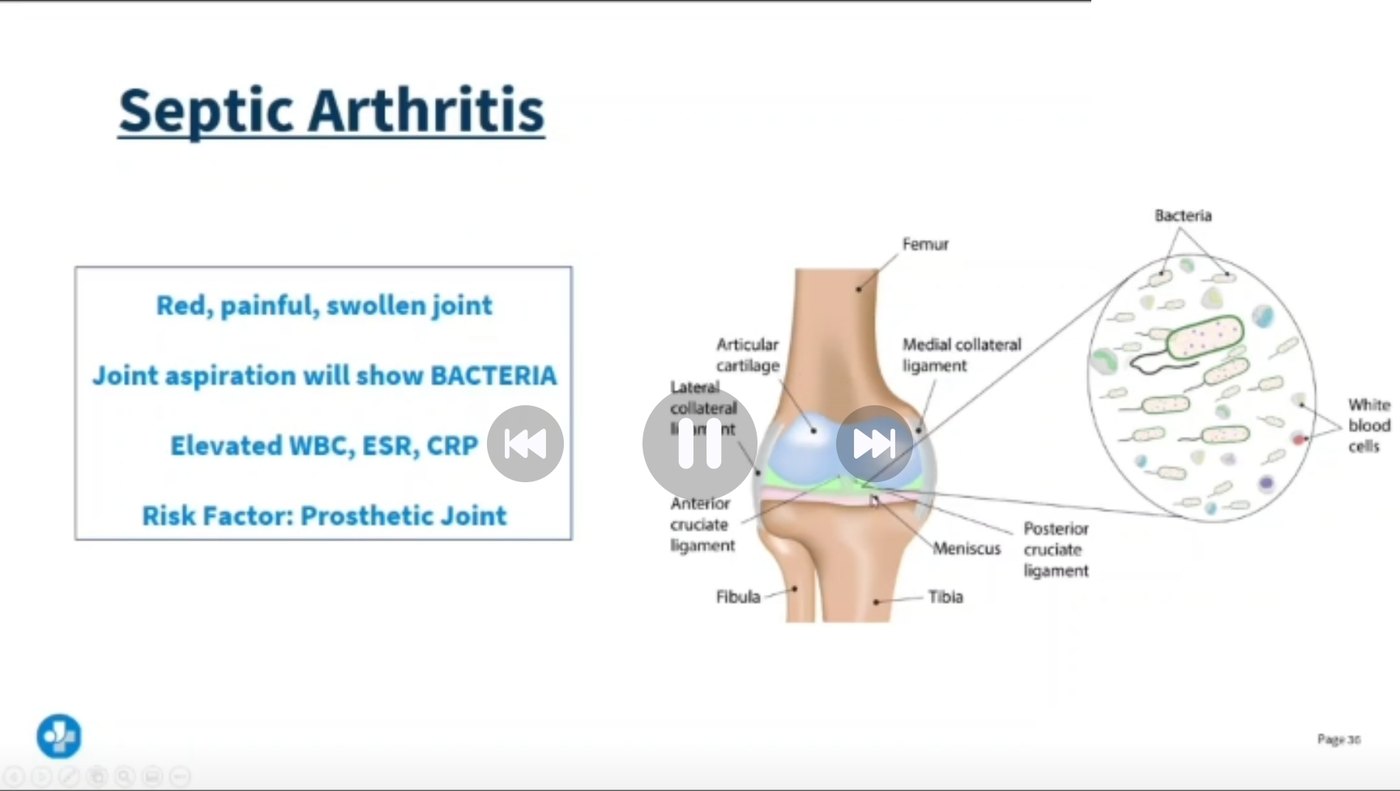
- Hematogenous spread — from a skin infection, pneumonia, endocarditis. This is the commonest route.
- Direct inoculation — a joint injection, arthroscopy, a penetrating wound.
- Spread from next door — osteomyelitis or cellulitis eroding into the joint.
Higher risk: prosthetic joint, rheumatoid arthritis, diabetes, immunosuppression, IV drug use, and age over 80.
S. aureus is the answer unless the stem points elsewhere. In a sexually active young adult think gonococcal — that one can hit several joints and comes with a rash and tenosynovitis.
The knee in about half. Then hip, shoulder, ankle. In a child with a limp and a fever, think hip.
🔎 What you will see
- One joint: hot, red, swollen, exquisitely tender.
- She will not move it, and passive movement is agony — that is the difference from a simple effusion.
- Fever, often with chills and malaise.
- Cannot weight-bear if it is a leg joint.
A child who refuses to walk and has a fever is septic arthritis until proven otherwise.
Raised WBC, ESR and CRP. Blood cultures before antibiotics. But the diagnosis is made in the joint, not the blood.
Cloudy or frankly purulent fluid, WBC over 50,000, Gram stain and culture positive. Crystals would point at gout instead — and the two can look identical from the doorway.
🩺 What you do
- Arthrocentesis first. Do not start antibiotics before the joint is aspirated — you sterilize the sample and lose the organism.
- IV antibiotics immediately after the aspirate, empirically, then narrowed to the culture.
- Drainage — repeated aspiration, or arthroscopic washout. A prosthetic joint usually needs surgery.
- Rest and splint in a position of function while it is acutely inflamed — then early passive range of motion to stop it stiffening.
- Analgesia, and monitor for sepsis.
Antibiotics run for weeks, often IV at home. Finish the whole course even once the joint feels normal.
Cartilage is destroyed, the joint fuses or becomes permanently arthritic, and the infection can seed the bloodstream. Function lost here does not come back.