Nursing Field Notes / Renal + Fluid · Pathophysiology Course
Renal Failure 🫘
Acute Kidney Injury vs. Chronic Kidney Disease → End Stage Renal Disease
NG-047Renal + FluidADHD-friendly visual edition
THE MASTER PAGE. Everything in one place: what the kidney does, what acute vs chronic failure actually means, every cause, and every number. Three sister pages go deeper — NG-264 = the phases & stages (how each one moves through time), NG-265 = the labs & symptoms side by side, NG-266 = the nursing care, diet & drugs. Start here, then pick the one you need.
⚡ Acute = SUDDENHours to days. Reversible if you catch the cause. Untreated → chronic.
🐌 Chronic = YEARSSlow, silent, permanent. Stage 5 = ESRD = dialysis or transplant to live.
🧪 The 4 numbersCreatinine >1.3 · BUN >20 · urine <30 mL/hr · pH <7.35
📉 GFR runs the stagesNormal >90. Stage 5 = <15 mL/min = kidney failure.
🫘
TWO FAILURES
STEP 1 · KNOW WHICH ONE
Same organ, two completely different stories — one is a sudden emergency you can reverse, one is a slow demolition you can only slow down.
🏭 First — what the kidney actually DOES (all 6 jobs fail together)
Every symptom on every one of these pages is one of these six jobs going offline. Learn the six and you can predict the symptom list instead of memorizing it.
🧠 “A WET BED” — Acid-base · Water balance · Electrolytes · Toxins & waste removed · BP (renin) · Erythropoietin · D vitamin activation. Kidneys quit → the patient is A WET BED: soaked in fluid, waste and acid.
⚡ ACUTE Kidney Failure (AKI / ARF)
Sudden, short-term loss of kidney function. Hours to days.
Sudden loss of kidney function from loss of circulation to the renal system, or from glomerular / tubular damage.
⏱️ Onset measured in hours–days
🔄 REVERSIBLE — if you find and fix the cause
⚠️ If not stopped & reversed it can lead to Chronic Renal Failure
🧠 Acute = “A cute little emergency.” Small window, fixable — find the cause today.
🐌 CHRONIC Kidney Disease (CKD / CRF)
Long-term chronic damage to the kidneys — over years & years of destruction — resulting in permanent damage.
📆 Onset measured in months–years
🚫 IRREVERSIBLE — you can only slow it
🏁 Endpoint = Stage 5 = End Stage Renal Disease (ESRD) = needs treatment to live
🧠 Chronic = CHRONO = clock. Years on the clock, and the clock does not run backwards.
📈 Watch the two shapes — this is the whole difference in one picture
🧠 Acute is a POTHOLE 🕳️ — chronic is a LANDSLIDE 🏔️. You can drive out of a pothole. Nobody drives back up a landslide.
⚖️ Acute vs. Chronic — the side-by-side you will be tested on
Feature
⚡ ACUTE (AKI / ARF)
🐌 CHRONIC (CKD / CRF)
Onset
Sudden — hours to days
Gradual — months to years
Reversible?
YES — if the cause is fixed
NO — permanent damage
Course
4 phases → recovery (see NG-264)
5 stages → ESRD (see NG-264)
Urine output
Usually drops hard — oliguria <400 mL/24 hr, then a big diuresis
May stay normal for years, then falls late
Kidney size on imaging
Normal size
Small, shrunken, scarred
Anemia
Usually not early
Expected — no erythropoietin
Bones
Normal
Renal osteodystrophy — high phos, low Ca
Goal of care
Find & fix the cause, support until it recovers
Slow the decline, prep for dialysis/transplant
Ending
Recovery… or it becomes chronic
ESRD — dialysis or transplant to live
🧠 Small kidney = long story. Shrunken kidneys on ultrasound + anemia + high phosphorus = this has been going on for years, not days. That combo is the classic "is it acute or chronic?" giveaway.
🧨
CAUSES
STEP 2 · WHERE IS THE PROBLEM
Acute failure is a plumbing question: is the problem BEFORE the kidney, INSIDE it, or AFTER it? Chronic failure has its own top-tested list.
🚰 The plumbing map — PRE · INTRA · POST
Blood comes in → the kidney filters → urine drains out. Break any of the three and the kidney fails. Name the zone first, then the cause follows automatically.
🧠 Say it as a road trip:PRE = can't get there (no perfusion) · INTRA = the place is trashed (toxins) · POST = can't get home (blocked drain). Ask "which zone?" before you ever ask "which cause?"
📉 Low blood pressure = low perfusion (shock, hypovolemia, dehydration from blood or volume loss); low MAP <65
💀 Shock = severely low BP
🫀 Low cardiac output — heart failure: the heart fails to pump
EXAM TIP Prerenal is the most common cause of AKI and the most fixable — restore volume/pressure fast and the kidney recovers.
🧠 PRE = PERFUSION. Both start with P. No pressure → no filtering. "PRE-fusion" is the whole word you need.
💉 2 · INTRARENAL — INside the renal
Answer first: the kidney tissue itself is damaged or poisoned.
🧫 Nephrotoxins — the #1 tested group
💊 Antibiotics:Vancomycin · Gentamicin
☢️ CT contrast dye — Contrast kills the kidney!
🦠 Acute kidney infection / inflammation
Result: creatinine over 1.3 = bad kidney.
🧠 “Vanc, Gent & Dye — kidneys die.” Three words, three killers. Before contrast: check the creatinine, hydrate, and ask about metformin.
🚧 3 · POSTRENAL — think PAST the renal
Answer first: urine is being made — it just can't get out.
🪨 Kidney stones
🎗️ Tumor
🧔 Benign prostatic hyperplasia (BPH) — big swollen prostate
Classic picture: bladder distention, urgency, dribbling, then sudden anuria. Relieve the blockage (catheter, stent) and output returns.
🧠 POST = the mail can't be delivered 📮. Letters are written (urine is made), the mailbox is jammed. Unjam it and the kidney is fine.
🐌 Causes of CHRONIC kidney disease — Top Tested Causes
🍬Uncontrolled DIABETESuncontrolled high sugar · #1
🩸Long-term HYPERTENSIONuncontrolled high BP · #2
🪢Nephrosclerosisscarring of the kidneys
🫧Polycystic kidney diseasePKD — inherited cysts
🛡️Unchecked autoimmune diseasebody attacks the kidney
👴Older ageat risk for ESRD
Diabetes and hypertension are the two MOST commonly tested — together they cause most dialysis in the U.S. Both damage the tiny glomerular vessels: sugar caramelizes them, pressure blows them out.
🧠 “Sugar & Squeeze” 🍬 + 🩸 — the two things that quietly destroy a kidney over 10–20 years. Every CKD question starts with one of them until proven otherwise.
🔢
THE NUMBERS
STEP 3 · GFR & THE LABS
GFR sets the stage. Creatinine, BUN, urine output and pH tell you how bad today is.
📉 GFR — Glomerular Filtration Rate · Over 90 mL/min = normal
GFR = how many mL of blood the kidneys clean every minute. It is the single number that defines the 5 stages of CKD as the kidney gradually loses function.
🧠 Count DOWN by the same shape: 90 · 60 · 30 · 15. Halve it, halve it, halve it. 90 normal → 60 mild → 30 moderate → 15 severe → below 15 you need a machine.
🧪 KEY NUMBERS — memorize these four cold
Value
Normal (adult)
Renal failure says…
Creatinine 🧪
0.6–1.2 mg/dL
Over 1.3 = bad kidney — the most specific kidney lab
BUN 🧪
10–20 mg/dL
Over 20 — but BUN also rises from dehydration, GI bleed & high protein
Best indicator of GOOD renal function: 1500 mL of urine in 24 hours — if the option list has a urine volume, that's the healthy one.
🧠 “1-3, 2-0, 3-0, 7-3-5.” Creat 1.3 · BUN 20 · urine 30 · pH 7.35. Say it like a phone number until it's automatic.
🫙 The creatinine clearance test — the 24-hour jug
Answer first: creatinine clearance estimates GFR, so it is more accurate than a single blood draw — but only if not one drop is missed.
🕛 24 hours — collect all urine in a container
❌ Discard the FIRST urine specimen (it was made before the clock started)
✅ Save the LAST specimen at the 24-hour mark
❄️ Keep the container refrigerated / on ice unless your facility says otherwise
🚫 One missed void invalidates the whole test — start over
🧠 “Dump the first, keep the last.” Picture flushing the first cup down the drain to start the clock at zero, then guarding the jug like a bouncer for 24 hours.
🧫 Urine studies that go with it
🫙 Sterile container for a routine specimen / culture
🔬 Urinalysis (UA) — protein, blood, casts, specific gravity
💧 Specific gravity: high (concentrated) in prerenal · fixed ~1.010 when tubules are damaged
🥚 Protein / albumin in urine = early sign of diabetic kidney damage
🧠 Thirsty kidney = concentrated urine. A prerenal kidney is still working, so it hoards water. A damaged kidney can't concentrate at all — the urine goes flat.
⭐ BUN:creatinine ratio — the free hint
Answer first: a ratio over 20:1 points PRERENAL (dehydration/low perfusion). A ratio near 10:1–15:1 points to damage inside the kidney.
Why: when the kidney is just dry, it reabsorbs urea back into the blood — so BUN climbs faster than creatinine.
🧠 Big ratio = big thirst. BUN way out ahead of creatinine means give fluid, not blame the kidney.
🩺
THE BIG PICTURE OF CARE
STEP 4 · WHAT WE DO
A 30-second overview — the full management, diet and drug detail lives on NG-266.
✅ The universal renal priorities — in order
1
🫀 Potassium & the heart first. K⁺ over 5.0 with ECG changes is the thing that kills today — see NG-265.
2
💧 Fluid balance. Strict I&O + daily weight — 1 kg = 1 L of fluid.
3
🔎 Find & fix the cause. Fluid for prerenal · stop the nephrotoxin for intrarenal · unblock for postrenal.
4
🚫 Stop hurting it. No NSAIDs, no contrast dye, no magnesium antacids, renally dose everything.
5
🍽️ Renal diet. Low sodium · low potassium · low phosphorus · protein per stage.
6
🩸 Dialysis when the numbers or the symptoms demand it.
🧠 “Heart, Water, Cause, Harm, Food, Filter.” Six rungs, always this order. If a question asks "which first?", the answer lives at the top of this ladder.
🚨 When is dialysis urgent? “AEIOU”
A — Acidosis that won't correct (pH <7.35, low bicarb)
E — Electrolytes: refractory hyperkalemia
I — Intoxications / dialyzable poisons
O — fluid Overload not responding to diuretics (pulmonary edema)
U — Uremia: pericarditis, encephalopathy, asterixis, uremic frost
🧠 Vowels dialyze: A-E-I-O-U. Any one vowel showing up = the machine, not another dose.
Q1: Define acute vs. chronic renal failure in one sentence each.
ACUTE = sudden, short-term loss of kidney function; reversible if stopped, but if not stopped & reversed it leads to chronic. CHRONIC = long-term damage over years & years of destruction resulting in permanent damage, ending in ESRD.
Q2: A client is hypotensive and dehydrated after a GI bleed and the creatinine rises. Which category of AKI?
PRERENAL — decreased tissue "PRE-fusion." Volume loss → low BP → low perfusion (MAP <65). Fix the volume and the kidney recovers.
Q3: Name the four key numbers.
Creatinine over 1.3 = bad kidney · BUN over 20 · urine output 30 mL/hr or less = kidneys in distress · metabolic ACIDosis with pH below 7.35.
Q4: What GFR defines each CKD stage?
Stage 1: 90+ (damage, normal function) · Stage 2: 89–60 (mild loss) · Stage 3: 59–30 (moderate to severe loss) · Stage 4: 29–15 (severe loss) · Stage 5: under 15 = kidney failure, needs treatment to live = ESRD.
Q5: The client asks how to do the 24-hour creatinine clearance collection. What do you teach?
Collect ALL urine for 24 hours in one container — but DISCARD the FIRST specimen to start the clock, and save the last one at 24 hours. Keep it cold. A single missed void means starting over.
Q6: Which single urine volume in 24 hours is the best indicator of good renal function?
1500 mL in 24 hours. (Contrast: oliguria is less than 400 mL in 24 hours.)
📌
STUDY SHEETS
FROM YOUR SAVED SET
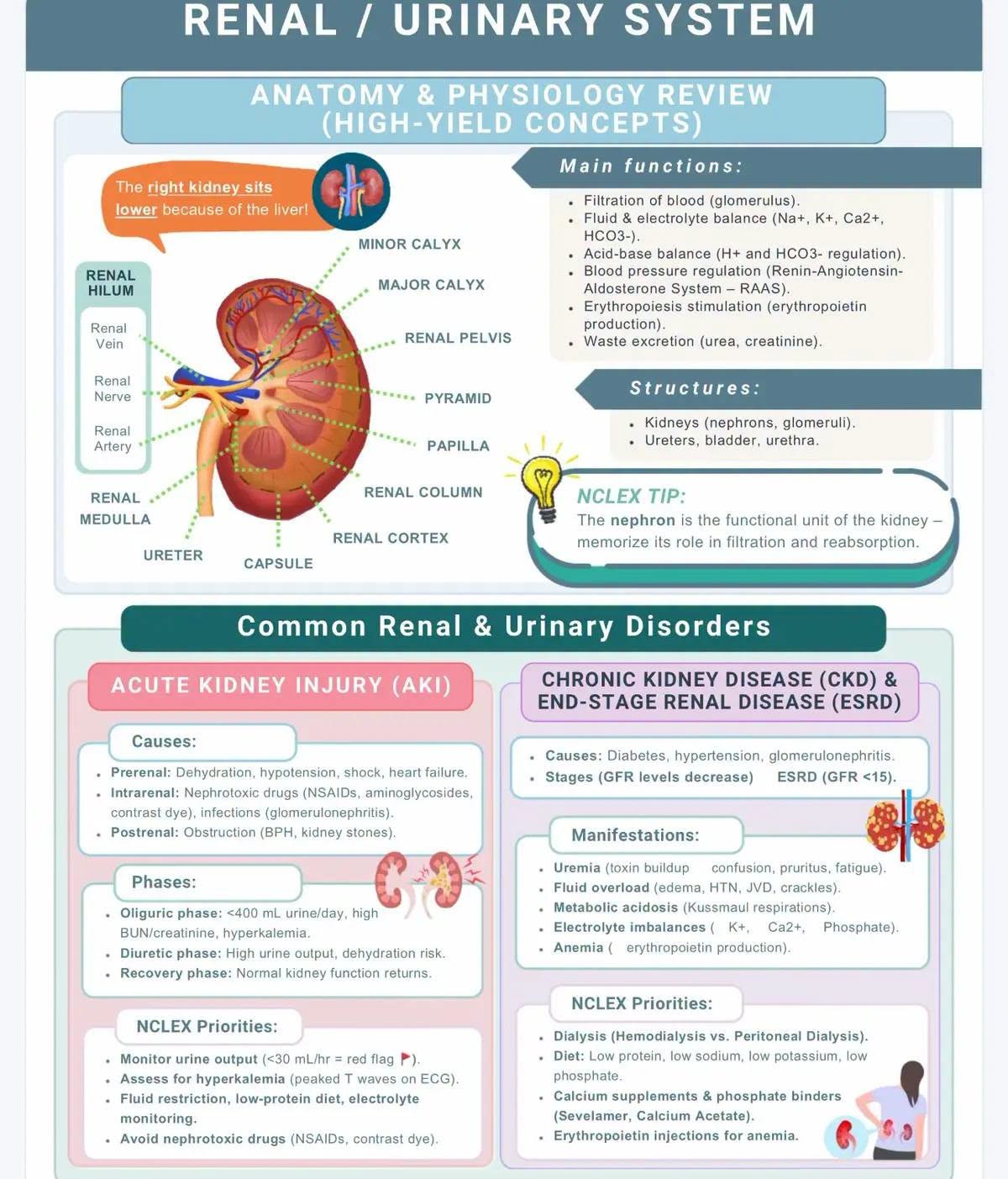
Renal anatomy and physiology on top, then AKI and CKD underneath — causes, phases, manifestations and NCLEX priorities for each. — swipe it sideways if it is cut off, or tap to open it full size.
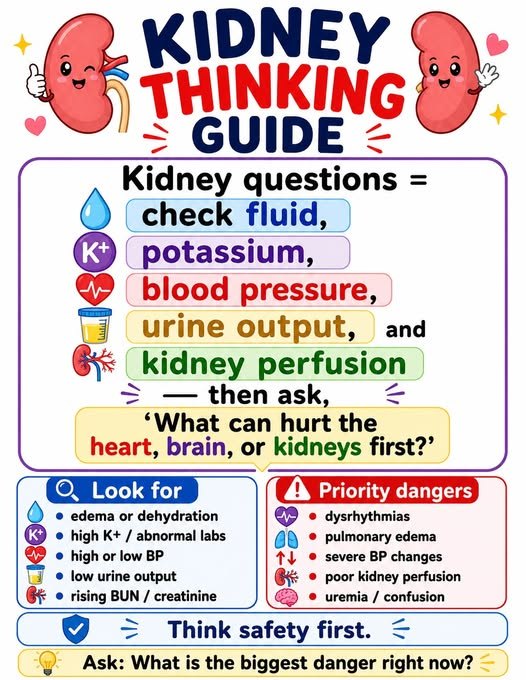
How to think through a kidney question: fluid, potassium, blood pressure, urine output, perfusion — then ask what can hurt the heart, brain or kidneys first. — swipe it sideways if it is cut off, or tap to open it full size.
Saved study graphics from your own collection. Each one is someone else’s work — check anything clinical against your course materials before you rely on it.