Nursing Field Notes / Renal + Fluid · Med-Surg Course
Hemodialysis 🩸
The machine version of the kidney · AV fistula care · DDS
NG-248RenalADHD-friendly visual edition
Hemodialysis is a machine version of the kidney. Blood leaves the body, runs past a filter, and comes back clean — it removes waste, excess fluid & electrolytes the failed kidney can no longer clear. Almost every test question is about the access arm 🖐️ or pulling fluid off too fast 🧠.
🧼 “DIAL” = the soapAny word with DIAL — think Dial soap. It cleans the blood.
🖐️ Thrill + BruitFEEL the vibration, HEAR the whoosh. Every shift, every visit.
🧠 DDS is the killerSolutes pulled too fast → brain swells → ↑ICP. Slow or stop it.
🚫 The fistula armNo BP · no sticks · no watch · no lotion · no purse (>5 lb).
🧼
WHAT IT IS
STEP 1 · THE CIRCUIT
Blood out, through a filter, back in — and the whole thing runs through one precious arm.
🩸 The hemodialysis circuit — follow one drop of blood
Blood out ➜ pump ➜ dialyzer ➜ air trap ➜ blood back. The dialyzer is the artificial kidney. It does not "make urine" — it lets waste diffuse out of the blood into a fluid called dialysate running the other direction.
🧠 “DIAL the soap.” Any time you see the word DIAL — dialysis, dialyzer, dialysate — picture a bar of Dial soap scrubbing the blood clean. Soap in, dirt out.
🔬 Inside the dialyzer — 2 forces, 2 jobs
Diffusion — solutes move from high to low: urea, creatinine, K⁺ leave the blood.
Ultrafiltration — pressure pulls water off. That's how fluid comes off.
🧠 Diffusion cleans, ultrafiltration dries. One takes the trash, the other takes the water.
🚪 Three ways in — pick the right access
Access
What it is
Ready to use
AV fistula ⭐ best / longest life
Surgeon sews the client's own artery to vein
Needs weeks to mature — commonly 6 wk–4 mo(varies)
AV graft
Synthetic tube bridges artery → vein
Sooner than a fistula, but clots & infects more
Central venous catheter
Large tunneled/temporary line in a central vein
Immediate — but highest infection risk; short-term
🧠 “Fistula First.” Own vessels > plastic graft > catheter. The catheter is the fastest and the most dangerous.
🖐️ The AV fistula — feel the THRILL, hear the BRUIT
No thrill + no bruit = the fistula has clotted. That is not "wait and see" — report it immediately.
🧠 “Thrill you Touch, Bruit you Blisten.” (Say it wrong on purpose — Bruit = listen with the Bell.) Thrill = Touch. Teach her to check it several times a day at home.
💪 Help the new fistula mature
🎾 Squeeze or grip a “rubber ball” or sponge — exercise enlarges the vein.
💧 Keep the arm warm, keep the client hydrated and not hypotensive — low BP clots a new fistula.
👀 Look at the site daily for redness, warmth, drainage.
🧠 Ball in the hand, blood in the vein. Squeezing is the fistula's workout.
🩺
BEFORE DIALYSIS
STEP 2 · SET THE BASELINE
Weight, vitals, fistula, and the meds you must NOT give — this is where the exam lives.
✅ The pre-dialysis checklist
1
⚖️ Weigh the client — current AND previous weight. Weight is the #1 measure of fluid status. 1 kg = 1 L of fluid.
2
🌡️ Full vital signs — especially BP (baseline for the hypotension that follows) and temp (infection screen).
3
🖐️ Assess the fistula — FEEL a thrill, HEAR a bruit, inspect for infection & bleeding.
💊 HOLD the meds that will be washed out or drop the BP.
🧠 “W-V-F-F-M” → Weigh · Vitals · Fistula · Fluid · Meds. Say it as “We Very Fully Fix Meds.”
💊 HOLD antihypertensives — dialysis already drops the BP
Dialysis pulls volume off. Give a BP pill on top of that and you get hypotension during the run — the most common complication of hemodialysis.
🧠 “A-B-C-D-D” — ACE/ARB · Beta blocker · Calcium channel blocker · Diuretic · Dilator. Five letters, five held bottles.
🧪 “Washed out” meds — the dialyzer eats them NCLEX TIP
Small, water-soluble molecules cross the membrane and get thrown away with the dialysate. Giving them before the run wastes the dose — give them AFTER dialysis.
Washed out
Examples
Antibiotics 💉
Penicillins, cephalosporins
Digoxin ❤️
Narrow therapeutic range — and a low K⁺ after dialysis makes dig toxicity worse
Water-soluble vitamins 🍊
B vitamins, C, folic acid — replaced daily in dialysis clients
🧠 “A-D-V goes down the drain” — Antibiotics · Digoxin · Vitamins (water-soluble). Picture them swirling down the dialysate drain 🌀. Fat-soluble vitamins (A, D, E, K) stay put — fat floats.
🧪 Labs that drive the treatment STANDARD ADULT RANGES
Lab
Normal
In renal failure
BUN
10–20 mg/dL
📈 HIGH
Creatinine
0.6–1.2 mg/dL
📈 HIGH (best kidney marker)
Potassium
3.5–5.0 mEq/L
📈 HIGH ⚠️ peaked T waves
Phosphorus
3.0–4.5 mg/dL
📈 HIGH
Calcium
8.6–10.2 mg/dL
📉 LOW (mirror of phosphorus)
Hgb / Hct
12–18 g/dL
📉 LOW (no erythropoietin)
🧠 Phosphorus and calcium are on a see-saw ⚖️ — one up, the other down. Every time.
💊 The take-home renal meds
Phosphate binders (calcium acetate, sevelamer) — give WITH meals, not between. They bind the phosphorus in the food.
Epoetin alfa — replaces the erythropoietin the kidney no longer makes; treats the anemia. Monitor BP and Hgb.
Active vitamin D (calcitriol) — the failed kidney can't activate vitamin D, so calcium can't be absorbed.
🧠 Binders eat with you. If the client swallows it away from food, there's no phosphorus there to bind — wasted dose.
⚙️
DURING DIALYSIS
STEP 3 · WATCH THE BRAIN & THE BP
Everything that goes wrong during the run goes wrong because something was pulled off too fast.
🚨 DEADLY: Dialysis Disequilibrium Syndrome (DDS)
Definition: solutes are removed too quickly from the blood. Urea stays high inside the brain cells, so water rushes into the brain — the cells swell, and ICP rises. Untreated it goes to seizures, coma & death.
🔎 KEY SIGNS
😵 Restless & disoriented(first change = LOC)
🤢 Vomiting
🤕 Headache
➕ later: twitching, seizures, ↓LOC
🚑 PRIORITY ACTION NCLEX TIP
1️⃣ STOP or SLOW the dialysis — fix the cause first.
2️⃣ Report to the provider.
3️⃣ Seizure precautions · protect the airway · reorient.
🧠 “Fast dialysis = swollen brain.” Any new confusion, headache or vomiting during a run is DDS until proven otherwise. The fix is always slow it down — never speed it up to "finish faster." Most likely in the FIRST few treatments and in clients with very high BUN.
📉 Hypotension — the MOST common complication
Why: volume is coming off faster than the vessels can refill.
😵💫 Dizzy, nauseated, pale, diaphoretic, cramping
✅ Slow/stop ultrafiltration, lay flat & raise the legs (Trendelenburg per policy)
✅ Give normal saline bolus per order · recheck BP
🧠 Water out too fast = pressure down. Same fix as DDS: slow the machine.
🫧 Air embolism — rare but instant
Signs: sudden dyspnea, chest pain, cyanosis, ↓LOC
1️⃣ Clamp the line · stop the pump
2️⃣ Place left side-lying, head down (traps air in the right atrium)
3️⃣ 100% oxygen · call for help
🧠 “Clamp · Left · Low · O₂.” Air floats — so put the air where it can't reach the lungs.
🩸 Bleeding — heparin is running
The circuit is heparinized to stop clotting, so during and just after a run the client bleeds easily.
Watch: gums, GI bleed, bruising, the needle sites
Hold pressure longer after any stick
Antidote to heparin: protamine sulfate
🧠 Heparin in the tubing = thin blood in the client.
💪 Muscle cramps & nausea
From rapid fluid and sodium shifts, usually late in the run.
✅ Slow the ultrafiltration rate
✅ Normal saline per order
📉 Often a sign the client gained too much between treatments
🧠 Big gain = rough run. Cramping is the body's receipt for skipping the fluid restriction.
✅
AFTER + TEACHING
STEP 4 · PROTECT THE ARM
Weigh, watch the BP, guard the access — and the four NO-NOs she has to know by heart.
⚖️ Post-dialysis assessment — weight tells the story
🧠 The scale is the kidney's report card.1 kg = 1 L = 2.2 lb. A client who gains 2 kg between runs drank 2 L more than they should have.
🚫 The fistula arm NO-NOs — never on that arm
🩺NO blood pressureuse the other arm
💉NO IVs or lab drawsno venipuncture
⌚NO tight clothingor watches / jewelry
😴NO sleeping on itcompression clots it
🧴NO creams or lotionsskin breakdown + infection
👜NO lifting >5 lbno purse on that arm
Every one of these does the same thing: it squeezes the fistula shut or lets bacteria in. A clotted fistula means surgery.
🧠 “No BP, no needles, no bling, no bag, no bed, no balm.” Six NOs — say them in one breath while pointing at your own arm.
🚨 Report to the HCP — the 5 P's distal to the shunt NCLEX TIP
Pallor — pale skin below the fistula
Paresthesia — numbness or tingling
Pulses diminished
Poor cap refill (over 3 seconds)
Pain distal to the shunt
These mean the fistula is stealing blood from the hand. ✅ Mild pitting edema of that arm is NORMAL.
⚖️ 1 kg = 1 LWeigh before AND after. The scale is the fluid record.
🍗 Protein UPOn dialysis, protein increases — K⁺, Na⁺, phosphorus & fluid go DOWN.
🎯 Cover & check — 6 rapid-fire questions
Q1: You assess the fistula and feel nothing and hear nothing. Now what?
No thrill + no bruit = the fistula has clotted. Report to the provider immediately — do not use the access.
Q2: Two hours into dialysis the client is restless, disoriented, vomiting and has a headache. Priority?
Dialysis disequilibrium syndrome — solutes removed too fast, brain cells swell, ICP rises. STOP or SLOW the treatment first, then report to the provider. Seizure precautions.
Q3: Which meds are held before dialysis, and which are just given after?
HOLD antihypertensives (ACE/ARBs, beta blockers, calcium channel blockers, diuretics, nitroglycerin) — dialysis already drops the BP. Give AFTER the run: antibiotics (penicillins, cephalosporins), digoxin, and water-soluble vitamins (B, C, folic acid) — they get washed out through the dialyzer.
Q4: The client's hand below the fistula is pale, numb and has a cap refill of 4 seconds. Expected or report?
REPORT — that's the 5 P's (pallor, paresthesia, pulses diminished, poor cap refill, pain) = the access is stealing blood from the hand. Mild pitting edema of that arm, on the other hand, is expected.
Q5: The client weighed 72 kg before and 69 kg after. How much fluid came off?
3 L. 1 kg = 1 L = 2.2 lb.
Q6: Name four things that must never happen to the fistula arm.
No blood pressure cuff, no IVs/venipuncture/lab draws, no restrictive clothing or jewelry (watches), no sleeping on it, no creams or lotions, no lifting over 5 lb (no purse).
📌
STUDY SHEETS
FROM YOUR SAVED SET
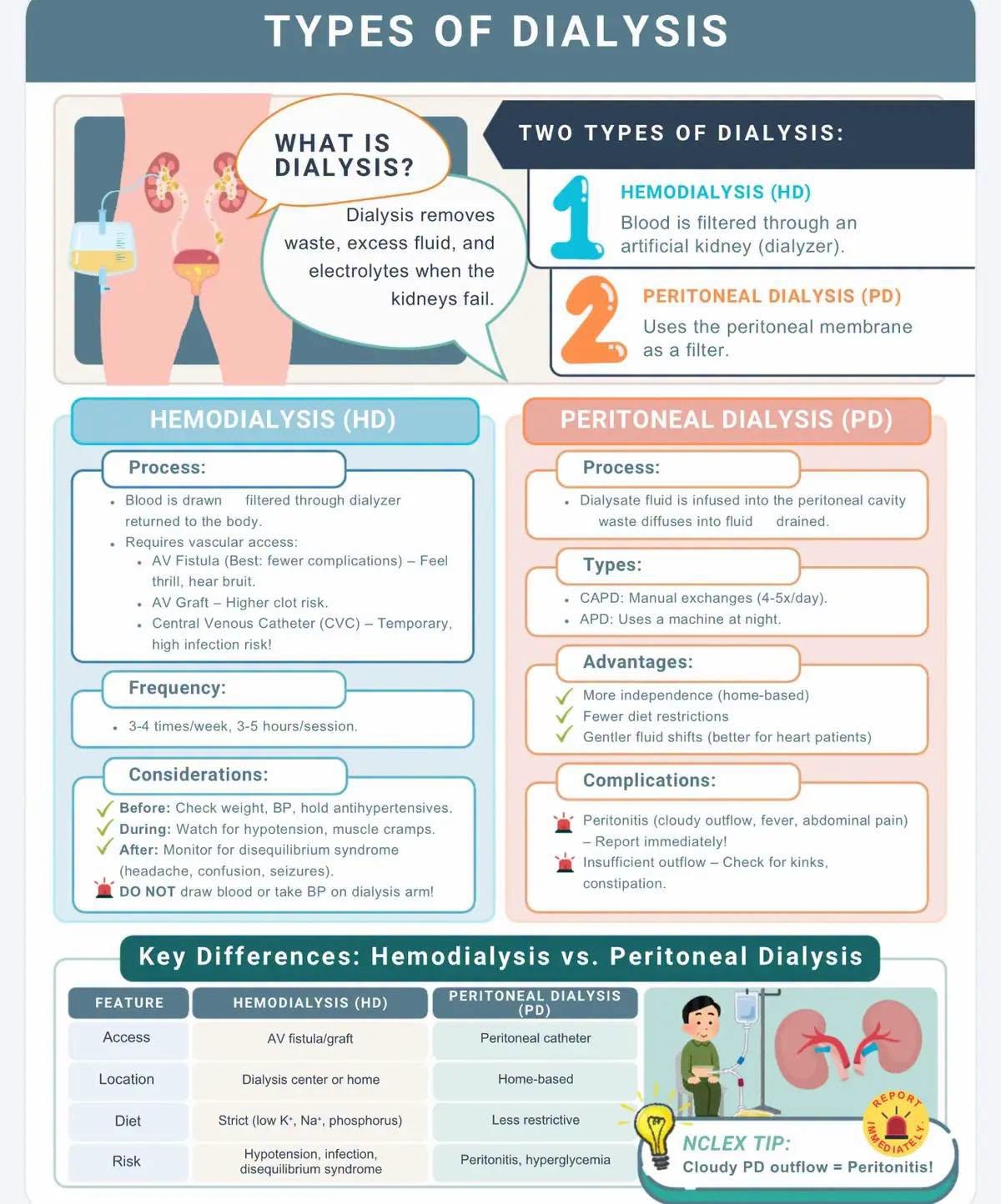
Hemodialysis versus peritoneal dialysis — access, location, diet, risks and complications, with the cloudy-outflow-means-peritonitis rule. — swipe it sideways if it is cut off, or tap to open it full size.
Saved study graphics from your own collection. Each one is someone else’s work — check anything clinical against your course materials before you rely on it.