Renal A&P 🫘
Renal Anatomy & Physiology — the nephron, top to bottom
The kidneys work like 2 washing machines 🌀 — they wash the blood of waste by filtration, regulate fluid volume by reabsorption, and stimulate red blood cell production by making erythropoietin. Every renal disease on your exam is one of those three jobs breaking.
📄 Simple Nursing original — opens in Drive →
ANATOMY
STEP 1 · THE PARTSYou cannot reason about renal failure until you can point to the piece that broke — so learn the map first.
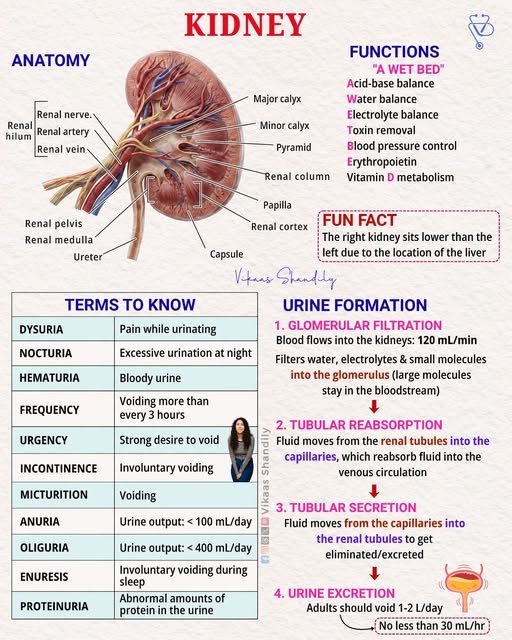
🫘 The kidney, sliced in half — every part labeled
Blood comes in through the renal artery, gets scrubbed in the cortex, the waste water drains down the pyramids into the calyces and renal pelvis, and leaves as urine down the ureter. Cortex filters · medulla concentrates · pelvis collects.
🔬 The nephron is the functional unit
- About 1 million nephrons per kidney.
- Inside each one sits the glomerulus — a network of small blood vessels that filters the blood of waste.
- Kidneys take about 20–25% of cardiac output — roughly 1,200 mL of blood every minute.
- They make about 180 L of filtrate a day and give back ~99% of it — only 1–2 L leaves as urine.
🩸 Follow the blood — artery to vein
⭐ The nephron — every segment and the one job it does
HIGH YIELD Learn this and you get diuretics, electrolytes and renal failure for free. Each segment moves a different thing, so each one has its own drug and its own lab.
🚰 Where the urine goes once it leaves
PHYSIOLOGY
STEP 2 · THE JOBSThree phases make urine — and seven jobs make you alive. Say them out loud.
⭐ Three phases of urine formation HESI
Q: What are the three phases of urine formation? A: Filtration, reabsorption, and secretion.
🧠 “FRE the PEE” — the source mnemonic, unpacked
- F — Filtration of medications & waste
- R — Reabsorption, run by ADH (Anti-Diuretic Hormone)
- E — Erythropoietin (stimulates RBC production in bone marrow)
And the three things filtration is supposed to dump:
- H — Hydrogen ions (too much = high acidity = metabolic acidosis)
- U — Urea → the BUN (Blood Urea Nitrogen)
- C — Creatinine (over 1.3 = bad kidney)
⭐ All 7 kidney jobs: A WET BED
- A — Acid–base balance (dumps H⁺, keeps HCO₃⁻)
- W — Water balance
- E — Electrolytes (Na⁺, K⁺, Ca²⁺, PO₄³⁻, Mg²⁺)
- T — Toxin & drug removal
- B — Blood pressure control (renin → RAAS)
- E — Erythropoietin → red blood cells
- D — vitamin D activation → calcium absorption
💧 ADH — “Add Da H₂O”
ADH is made in the hypothalamus, stored in the posterior pituitary, and works on the collecting duct. More ADH = more water pulled back into the blood = less urine, darker and more concentrated.
🩸 Erythropoietin — why kidney patients are anemic
📈 Blood pressure: the RAAS chain
Why it matters: a failing kidney thinks it is dry even when the body is drowning, so it keeps firing RAAS — that's why renal patients are hypertensive and fluid-overloaded at the same time.
🦴 Vitamin D & calcium — the quiet job
- The proximal tubule converts vitamin D to its active form (calcitriol).
- Active vitamin D lets the gut absorb calcium.
- Failing kidney → no activation → low calcium → parathyroid pulls calcium out of bone.
- Failing kidney also can't dump phosphate → high phosphate, which drives calcium down further.
NUMBERS & NURSING
STEP 3 · WHAT THE LABS MEANFour numbers tell you how a kidney is doing. Learn the bars, not the paragraphs.
🧪 The four kidney numbers — low · normal · high
🧪 What each lab is actually telling you
| Lab | Normal (adult) | If it's HIGH, think… |
|---|---|---|
| GFR | >90 mL/min | LOW is the bad direction — <60 for 3 months = CKD |
| Creatinine | 0.6–1.2 mg/dL | Kidney damage — >1.3 = bad kidney |
| BUN | 10–20 mg/dL | Dehydration, GI bleed, high protein, kidney |
| BUN : Creatinine | 10:1 – 20:1 | >20:1 = pre-renal (dry) 💧 |
| Potassium | 3.5–5.0 mEq/L | Kidney can't excrete K⁺ → cardiac arrest risk 🚨 |
| Urine output | ≥30 mL/hr | LOW is bad — oliguria = kidneys in distress |
⏳ Half-life — and why renal patients overdose
Half-life = the time it takes for half of the medication to be eliminated from the body.
Bad kidney = long half-life = drug stacks up. That is why renally-cleared drugs get dose reductions in CKD.
🚨 Nephrotoxic — protect the kidney you have
Never give an NSAID to a client in acute kidney injury — it constricts the afferent arteriole and drops the GFR further.
✅ Do instead: hydrate before and after contrast, check creatinine & GFR before nephrotoxic drugs, monitor strict I&O and daily weights (1 kg = 1 L).
✅ Daily weight is the best fluid monitor
- Same time, same scale, same clothes, after voiding.
- 1 kg = 1 L = 2.2 lb of fluid.
- New, sudden, rapid weight gain = fluid retention, not fat.
- Report >1 kg (2.2 lb) gain in a day, or >2 kg in a week.
QUICK RECALL
SAY IT OUT LOUD🎯 Cover & check — 6 rapid-fire questions
STUDY SHEETS
FROM YOUR SAVED SET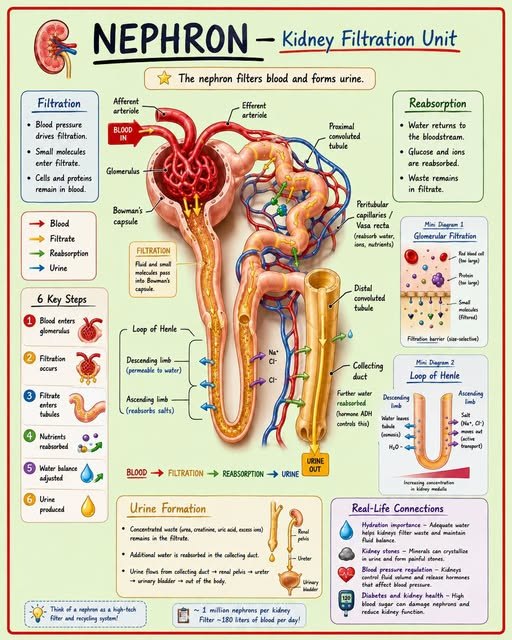
Saved study graphics from your own collection. Each one is someone else’s work — check anything clinical against your course materials before you rely on it.