UA — Urine Analysis · read every line on the strip
NG-269RENAL + FLUIDADHD-friendly visual edition
A UA is a picture of the kidney taken through the toilet 🚽. Each pad on the strip answers one question: how hydrated? · is there infection? · is there bleeding? · is protein or sugar leaking? Learn the normal band for each line and abnormal jumps off the page.
🧠 Look for the “N”Nitrites → pyelonephritis (kidney infection).
🥩 Protein HIGH= Nephrotic syndrome — Nasty protein loss. Glucose high = diabetes.
🧫
COLLECT IT RIGHT
STEP 1 · A DIRTY SAMPLE IS A WRONG ANSWER
Half of UA test questions are not about the result at all — they are about how you got the specimen.
✅ Clean-catch midstream — the standard specimen
Never collect a specimen from the urine drainage bag — that urine is old, warm and not sterile. It will grow bacteria that were never in the client.
🧠 “Clean, Skip, Catch, Ship.” Clean the area · skip the first squirt · catch the middle · ship it to the lab in an hour. First morning void is the most concentrated and the best sample when you get a choice.
⭐ Sterile specimen from a Foley — the exact 4 steps KAPLAN
🧠 “Clamp · Chill · Cleanse · Collect.” Four C's in order. Forget the clamp and there is nothing at the port to draw; forget to unclamp and you just gave the client urinary retention.
🕐 24-hour urine collection
Discard the first void and write down the time — that's the start.
Save every drop for the next 24 hours.
At the end time, have the client void one last time and add it in.
Keep the container on ice or refrigerated.
One missed void = start over. ❌
🧠 “Toss the first, keep the last.” The one you throw away is the urine made before the clock started — it doesn't belong to your 24 hours.
🔬 What a full UA actually reports
Physical: color · clarity · odor · specific gravity
Chemical (the dipstick): pH · protein · glucose · ketones · blood · nitrites · leukocyte esterase · bilirubin
🧠 Look · Dip · Scope. Three layers, in that order — and the exam question almost always lives in the dip layer.
🔎
READ THE STRIP
STEP 2 · LOW · NORMAL · HIGH
Every line gets a bar. Find where the client's number lands, and the diagnosis walks up to you.
🎨 COLOR — the fastest hydration read in nursing
🧠 Think lemonade → iced tea. Lemonade urine = well watered. Iced-tea urine = dry as a bone. Cola-colored is a whole different alarm — that's blood or myoglobin.
⭐ Every UA component on a low–normal–high bar
HIGH YIELD Green band = normal. Anything outside it has a name.
🧠 “Nothing should be in pee but pee.” Protein, glucose, ketones, blood, nitrites and leukocytes should all read negative. The moment one turns positive, it names its own disease.
🩸 RBC in urine = hematuria — the big three causes
🪨 Kidney stones — the stone scrapes the tract on the way down.
🎗️ Bladder cancer — classic clue is painless hematuria.
🔪 Post-operative TURP — some pink drainage is expected; bright red with clots is not.
Also on the list: trauma, glomerulonephritis, anticoagulants, and a menstruating client (recollect).
🧠 “Stones, Suspicious growth, Surgery.” Three S's that put blood in the bowl (the growth is bladder carcinoma). Painful hematuria = stone. Painless hematuria = cancer until proven otherwise.
Infection is up in the kidney, not just the bladder
🧠 Bladder burns, kidney BLOWS UP. Cystitis = burning + frequency. Pyelonephritis adds fever, chills, and CVA/flank tenderness — that's the one you escalate.
🔬 Under the microscope — casts tell you WHERE the damage is
🧠 Casts are molds of the tubule. Whatever was sitting in the tubule got shaped like a tube and washed out — so a cast proves the problem is inside the kidney, not the bladder.
🧫 Urine Culture & Sensitivity — two different answers
⏱️ Order of operations: Draw the culture BEFORE the first dose of antibiotic. Then start the broad-spectrum drug; narrow it when sensitivities return.
🧠 “Culture = WHO. Sensitivity = WHAT KILLS IT.”Culture the criminal, sentence it with the sensitivity.
🩺
ACT ON IT
STEP 3 · MATCH THE PATTERN
Test questions never give you one value — they give you a panel and dare you to pick the one that matters.
⭐ NCLEX exhibit — read the whole UA, then answer
Client with a history of diabetes. The UA reads:
Component
Result
Normal?
Specific gravity
1.030
🚩 top of range — concentrated / dry
Protein
None
✅ normal — rules OUT nephrotic syndrome
Glucose
High
🚩 abnormal — diabetes / hyperglycemia
Red blood cells
None
✅ normal — rules OUT stones & bladder CA
Leukocytes
Medium
🚩 abnormal — infection
What does the nurse suspect? Dehydration from low fluid intake, plus a possible UTI.
The high specific gravity says dry; the leukocytes say infection; the glucose just confirms the diabetes we already knew about — and sugar in the urine feeds bacteria, which is exactly why diabetics get UTIs.
🧠 “Sweet pee = happy bacteria.” Diabetes + concentrated urine + leukocytes is a UTI setup every single time. The normal lines (protein, RBC) are doing work too — they cross diagnoses OFF.
🧪 Common NCLEX blood panel — which value is the kidney red flag?
🧠 Creatinine is the kidney's own handwriting. BUN can be raised by dehydration, steroids, a GI bleed or a steak dinner — creatinine only climbs when the filter is broken.
🚨 UA findings you escalate, not chart
🩸 Gross hematuria with clots — especially after TURP or biopsy.
🥩 New heavy proteinuria + edema → nephrotic syndrome workup.
💧 Urine output under 30 mL/hr → kidneys in distress.
🟤 Cola / tea-colored urine after crush injury or a statin → rhabdomyolysis.
🧠 Color + fever + output. Three things you can assess without a lab — and any two of them together buy a phone call to the provider.
🗣️ Teach the client
💧 Fluids2–3 L/day unless fluid-restricted for renal or cardiac disease.
🚽 Void every 2–4 hours and always after intercourse.
🧻 Wipe front to back, cotton underwear, no bubble baths or douches.
💊 Finish the entire antibiotic course even after the burning stops.
⚠️ Tell them phenazopyridine turns urine bright orange — it's harmless and it stains clothing.
🧠 “Flush, wipe, finish.” Water flushes bacteria out, wiping keeps them from getting in, and finishing the antibiotic keeps them from coming back stronger.
⚡
QUICK RECALL
SAY IT OUT LOUD
💧 1.003 vs 1.030liquidy body vs dry body
🩸 RBC in urine= stones · bladder cancer · post-op TURP
🦠 WBC = UTI · N = pyeloNephritisnitrites climb to the kidney
🥩 Protein high = Nephrotic🍬 Glucose high = Diabetes
🎯 Cover & check — 6 rapid-fire questions
Q1: Specific gravity is 1.003. Wet or dry?
Wet — a liquidy body. Dilute urine from over-hydration, diuretics or diabetes insipidus. 1.030 is the dry, concentrated end.
Q2: Nitrites are positive. What are you thinking?
Look for the “N” — Nitrites means pyeloNephritis, a kidney infection. Bacteria convert nitrates to nitrites.
Q3: List the exact steps to get a sterile specimen from a Foley.
1) Clamp the drainage tube below the port. 2) Wait 15–30 minutes. 3) Scrub the port with an antiseptic swab. 4) Attach a sterile, needleless access device and aspirate through the port. Then unclamp. Never take it from the drainage bag.
Q4: High protein in the urine — which syndrome?
Nephrotic syndrome — “Nasty protein loss.” Also consider glomerulonephritis and preeclampsia.
Q5: What is the difference between a culture and a sensitivity?
Culture identifies WHICH bacteria is causing the infection. Sensitivity identifies WHICH antibiotic that bacteria is sensitive to, so you know what will kill it. Collect the specimen before the first antibiotic dose.
Q6: BUN 19, glucose 155, creatinine 1.9, WBC 14,500. Which one screams kidney?
Creatinine 1.9 — normal is 0.6–1.2 and over 1.3 means a bad kidney. The WBC of 14,500 signals infection; BUN 19 is still within the normal 10–20.
📌
STUDY SHEETS
FROM YOUR SAVED SET
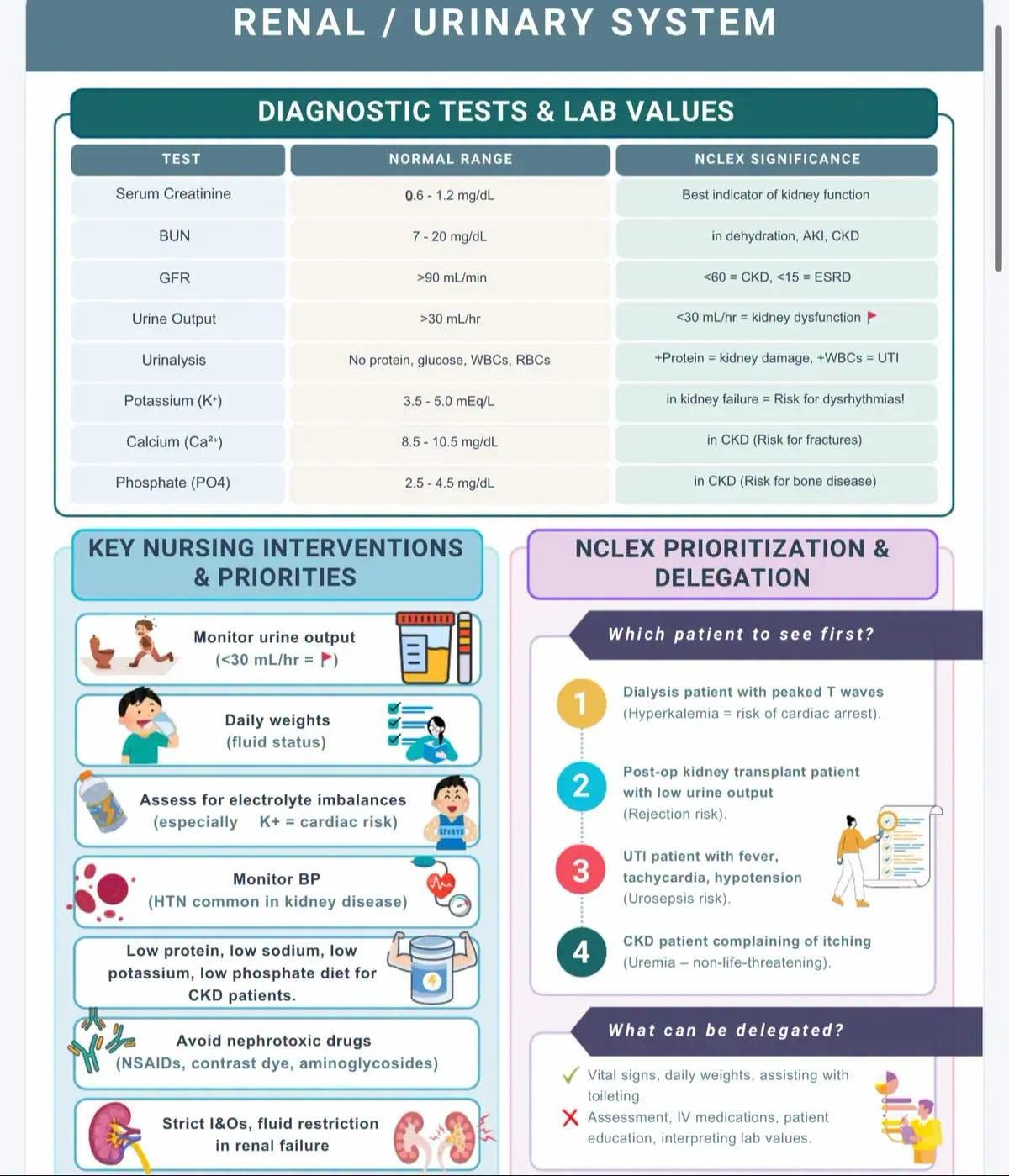
Renal diagnostic tests with normal ranges and NCLEX significance, plus a which-patient-first prioritization panel and what can be delegated. — swipe it sideways if it is cut off, or tap to open it full size.
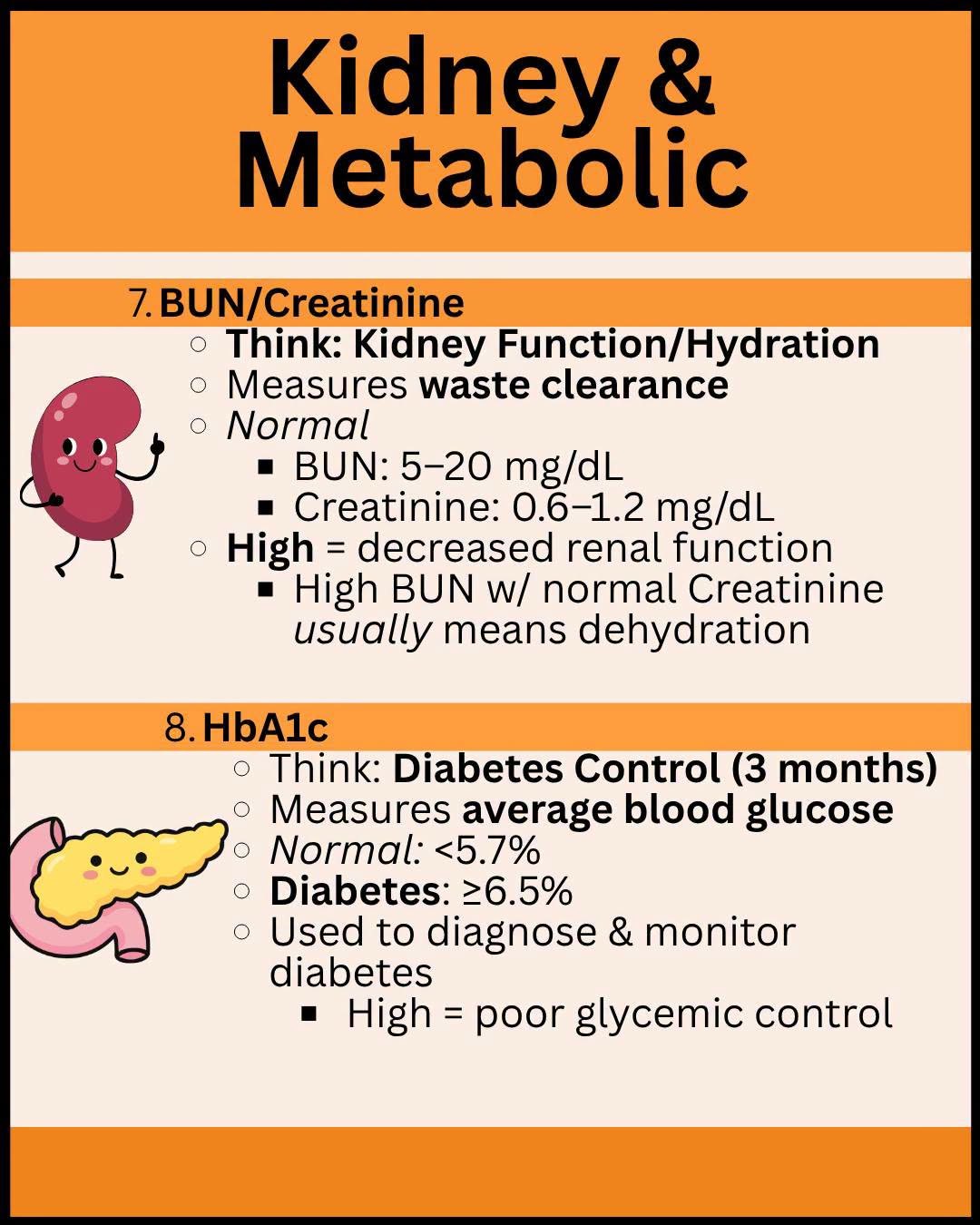
BUN and creatinine together, plus HbA1c — including the clue that a high BUN with a normal creatinine usually means dehydration, not kidney failure. — swipe it sideways if it is cut off, or tap to open it full size.
Saved study graphics from your own collection. Each one is someone else’s work — check anything clinical against your course materials before you rely on it.