Urinary retention = clients RE-tain urine in the bladder so that it can't get out. The kidneys keep making urine, the bladder keeps stretching, and the exit is blocked, asleep, or drugged. Your job on every question: assess first 🤲, scan second 📟, catheterize last 🩺.
🤲 Assess FIRSTPalpate/percuss the suprapubic area before anything else. Never jump to the catheter.
📟 Over 100 mLBladder scan residual over 100 mL = report to HCP. NCLEX TIP
👴 Highest risk65-year-old man with BPH — big prostate holds back urine.
🪣 Bag BELOW the bladderAlways. Never on the back of a wheelchair.
🧨
CAUSE
STEP 1 · WHY IT STAYS IN
Three ways a bladder gets stuck: the door is blocked 🚧, the nerve is asleep 😴, or a drug hit the brakes 💊.
🚽 Say the word — it defines the disease
RE-tention = to RE-tain = to hold onto. Clients retain urine in the bladder so that it can't get out.
The kidneys never stop. They keep filtering ~1 mL/kg/hr of urine down the ureters no matter what the bladder is doing — so a blocked bladder just keeps stretching.
🧠 “The bladder is a balloon under the belt.” A normal bladder hides behind the pubic bone. If you can feel or see it rising toward the umbilicus, it is holding roughly 500 mL+ — that is retention until proven otherwise.
🚧 Cause 1 — the door is BLOCKED (obstructive)
👴 BPH — benign prostatic hyperplasia · the #1 cause in men
🎗️ Prostate cancer · prostatitis
🧵 Urethral stricture or scarring
🪨 Stone or blood clot plugging the outlet
💩 Fecal impaction pressing on the urethra
🚼 Pelvic organ prolapse (women), pregnancy
🧠 Big Prostate Holds back urine = BPH. Say the letters as the sentence and you never lose it.
😴 Cause 2 — the nerve is ASLEEP (neurogenic)
🧠 Spinal cord injury, MS, Parkinson's, stroke
🍬 Diabetic neuropathy — the classic “bladder that lost its signal”
💉 Spinal / epidural anesthesia — the bladder wakes up last
🔪 Pelvic surgery that nicked the nerves
The detrusor muscle can't feel full and can't squeeze — this is the flaccid / atonic neurogenic bladder.
🧠 No signal = no squeeze. Neurogenic retention is a muscle-strength problem, not a blockage — that is why the drug for it (bethanechol) makes the muscle squeeze, not the prostate shrink.
🚨 Cause 3 — the two situations the NCLEX loves
🔪 AFTER SURGERY — post-op
Anesthesia + opioids put the bladder to sleep
Pain, immobility, flat positioning, no privacy
Assess if no void within 6–8 hours of surgery or of catheter removal
🩺 AFTER THE FOLEY IS D/C'd
The urethra is swollen and the detrusor has lost tone
Expect the first void within 6–8 hours
No void by then → assess & bladder scan, don't wait it out
NCLEX TIP “Which client is at MOST risk for urinary retention?” → the 65-year-old man with BPH. Older + male + prostate beats every other option.
🧠 “Cut, cath, or catheter-out.” The three retention setups: just got cut (surgery), just got drugged, or just got the catheter out.
🔎
CLUES
STEP 2 · SPOT IT
A full bladder is loud in a young client and silent in an old one — so you look, you feel, and then you scan.
⭐ What you SEE and FEEL
🎈 Suprapubic distention — firm, rounded, tender bulge above the pubic bone
🥁 Dull to percussion (fluid) instead of tympanic (air)
😣 Restlessness, agitation, new confusion in the elderly
💧 Frequent small voids< 50 mL — the bladder overflows without emptying
🚿 Weak stream, hesitancy, straining, dribbling
📉 Output far less than intake · under 30 mL/hr
💓 Rising HR and BP, diaphoresis from the pain of stretch
🧠 Small frequent voids ≠ fine. That is overflow incontinence — the bladder is so full it spills over the top like a bathtub. It is a retention sign, not a bladder-emptying sign.
⚠️ Acute vs chronic — they don't look alike
🚨 ACUTE
🐢 CHRONIC
Onset
Sudden, over hours
Months to years
Pain
Severe suprapubic pain, agitation
Often painless — bladder stretched slowly
Void?
Cannot void at all
Voids small amounts, never empties
Volume
500–1000+ mL
High residual after every void
Status
Urologic emergency
Silent kidney damage risk
🧠 Acute screams, chronic sneaks. The painless chronic one is the dangerous one on the kidneys — it backs pressure all the way up.
📟 The bladder scanner — non-invasive, does NOT need an order in most facilities
A bladder scan is an ultrasound, not a catheter. Scan before you ever cath. Measure the post-void residual (PVR) within 10–15 minutes of the client voiding.
🧠 “One hundred = phone the provider.”100 has two zeros like two eyes on a phone screen 📱. Under 50 = fine · over 100 = report · over 300 = drain it.
🧪 What retention does to the labs & kidneys
Urine that can't get out backs up the plumbing — pressure travels bladder → ureters → kidneys.
🎈 Bladder full & high pressure
▼
🔙 Urine refluxes up the ureters → hydroureter / hydronephrosis
▼
🧪 POST-RENAL AKI — ↑ BUN, ↑ creatinine
Also: UTI (stagnant urine breeds bacteria), bladder stones, and — rarely — bladder rupture.
🧠 Backed-up plumbing floods the upstairs. The bladder is the drain, the kidneys are upstairs. Retention is a post-renal cause of AKI — fix the drain and the labs come back down.
🎯 NCLEX Q1 — first action
“A client taking hydromorphone is suspected of urinary retention. What is the nurse's FIRST action?”
✅ Palpate the client's suprapubic area
❌ Check the chart for I&O
❌ Offer a bedpan
❌ Insert a catheter
Why: Assessment comes before intervention — and hands-on beats chart-reading when the client is right in front of you.
🧠 Hands before hardware. Palpate 🤲 → scan 📟 → cath 🩺. If “palpate the suprapubic area” is an option in a retention question, it is almost always the answer.
💊
DRUG CAUSES
STEP 3 · CHECK THE MAR
Four drug families slam the brakes on a bladder — and every one of them shows up in test questions.
🧠 How a drug locks the bladder
To pee you need two things at once: the detrusor muscle must squeeze (acetylcholine on muscarinic receptors) and the internal sphincter must relax. Drugs break either half.
🧠 “No ACh, no pee.” Anything that blocks acetylcholine or tightens the sphincter causes retention — and the drug that treats non-obstructive retention (bethanechol) is the exact opposite: it adds cholinergic stimulation.
💊 Opioids — “low & slow”
Morphine · Hydromorphone · oxycodone · fentanyl
They make the whole body low & slow: ↓ RR, ↓ HR, ↓ BP, ↓ bowel (constipation) and ↓ bladder
🧠 Look for the O's. Morphine · Hydromorphone — the round O's are the shape of a full round bladder that won't empty.
💊 Anticholinergics — the classic
Can't SEE, can't PEE, can't SPIT, can't POOP — blurred vision, urinary retention, dry mouth, constipation. Add: hot as a hare, dry as a bone, red as a beet, mad as a hatter.
🫁 Ipratropium(respiratory) — you can't Pee with a tro-PIUM
💓 Atropine(↑ HR) — it's hard to Pee with atro-PINE
🧠 “-PIUM and -PINE can't make you go.” Both end in a hard “P” sound — and both take the P away.
❌ Never give these to a man with known BPH without thinking
🤧Antihistaminesdiphenhydramine
🫗Decongestantspseudoephedrine
😔TCAsamitriptyline
🚽Anticholinergicsoxybutynin
💊Opioidsmorphine
🫁Ipratropiuminhaled
An over-the-counter cold pill can put a BPH client into ACUTE retention overnight. Teach every client with BPH to read cold-medicine labels and ask the pharmacist first.
🧠 “Cold aisle = ER visit.” Picture a 65-year-old man buying a cold-and-flu combo before bed and arriving at the ED at 3 a.m. unable to void. That is the whole drug section in one image.
🩺
CARE
STEP 4 · WHAT YOU DO
Assess, then help them try the easy way, then scan, then drain — in that exact order.
✅ The priority ladder — memorize this order
1
🤲 ASSESS FIRST — palpate & percuss the suprapubic area, ask when they last voided, check I&O
▼
2
🚶 NORMAL POSITION — “Help the client out of bed”: men stand, women sit upright on a toilet or commode
▼
3
💧 TRIGGER THE REFLEX — privacy, running water, warm water over the perineum, warm sitz bath, hand in warm water, ambulate
▼
4
📟 BLADDER SCAN — over 100 mL residual = report to HCP
▼
5
🩺 IN & OUT (straight) CATH per order/protocol — intermittent beats indwelling every time
🧠 “A-N-T-S-C” — Assess · Normal position · Trigger the reflex · Scan · Cath. The client has ANTS in their pants — do them in order.
🎯 NCLEX Q2 — 18 hours post-op, no urination
“Which intervention for a client who has not urinated 18 hours after surgery?”
✅ Help the client out of bed to a normal standing position.
Anatomy beats equipment: a man voids standing, and lying flat in bed fights both gravity and habit. Try the least invasive thing that could work before you reach for a catheter.
🧠 “Normal position before invasive procedure.” If one option is get them up to pee and another is insert a catheter, the bed rail comes down before the catheter comes out.
💧 Bedside tricks that actually work
🚪 Privacy + unhurried time — nobody voids with an audience
🚿 Run water in the sink · pour warm water over the perineum
🛁 Warm sitz bath relaxes the sphincter
🔁 Double voiding — void, wait 2–5 min, void again
⏰ Timed voiding every 2–3 hours, don't wait for urge
🚶 Ambulate · treat pain · relieve constipation
💊 Review the MAR and ask the HCP about stopping the offending drug
🧠 Warm + private + upright. Three free interventions that beat a catheter and carry zero infection risk.
🚨 NCLEX Q3 — after urgent catheterization, what is the PRIORITY sign?
“A client has urgent catheterization for acute urinary retention. The nurse places priority on which signs & symptoms?”
✅ HYPOTENSION low BP — the pressure that was squeezing the pelvic vessels is suddenly gone
✅ BRADYCARDIA slow HR — a vagal response to rapid bladder decompression
So the answer is NOT tachycardia and NOT “risk for infection.” Infection is real but it is later; the vitals are now. ABC / acute beats chronic
🧠 “Empty fast, drop fast.” The bladder goes down and so do the numbers — BP down, HR down. Some facilities cap the first drainage (commonly around 500–1000 mL) — practice varies, so check policy.
💊 The drug that treats non-obstructive retention
Bethanechol — a cholinergic agonist that makes the detrusor squeeze. Used for neurogenic bladder / urinary atony.
Never give bethanechol when the retention is caused by a mechanical obstruction — squeezing against a closed door can damage or rupture the bladder.
Watch for bradycardia, hypotension, bronchospasm — hold in asthma. Keep the bedpan/urinal within reach; it works fast.
🧠 Bethan-echol = Bladder Control. Full detail (plus the BPH drugs) lives on NG-052.
⭐ Intermittent beats indwelling
🩺 Straight / in & out cath — drain and remove, lowest infection risk
🏠 Clean intermittent self-cath at home for neurogenic bladder — clean technique at home, sterile in the hospital
🚫 An indwelling Foley is a last resort — every day it stays in raises CAUTI risk
📅 Ask daily: “Does this catheter still need to be here?”
🧠 In-and-out, then out of there. The safest catheter is the one that leaves the same minute it arrived.
🪣
FOLEY RULES
STEP 5 · SIDE NOTE THAT'S ALWAYS TESTED
Gravity is the whole lesson: urine only flows downhill, and it must never flow back.
🚨 CAUTION — the two absolute positioning rules
Always keep the drainage bag BELOW the level of the bladder.NEVER hang the bag on the back of a wheelchair.
🧠 “Urine only runs downhill.” Bag above bladder = urine runs back = bacteria delivered straight to the bladder. If you can see the bag over the client's lap, you are looking at a CAUTI in progress.
✅ The rest of the Foley checklist
🔗 Secure the tubing to the thigh/abdomen — no tugging on the urethra
🧼 Peri-care with soap & water daily and after every bowel movement
🚫 Never let the bag touch the floor; empty into the client's own graduate
🔒 Keep the closed drainage system intact — don't disconnect to move the client
💧 Encourage fluids 2–3 L/day unless restricted
⬆️ Lift the bag when transferring? No — clamp only if policy allows, briefly
🧠 “Below · Secured · Closed · Clean.” Four words cover every Foley question you will ever see.
📈 After the catheter comes out — what's expected
⏱️ First void expected within 6–8 hours
💧 Temporary dribbling / urgency is normal for a day or two
👴 BPHBig Prostate Holds back urine — #1 male cause
🕗 6–8 hoursNo void post-op or post-Foley = assess now
🎯 Cover & check — 6 rapid-fire questions
Q1: A client on hydromorphone may be retaining urine. First action?
Palpate the client's suprapubic area. Assessment before intervention — hands before hardware.
Q2: A client has not urinated 18 hours after surgery. Best intervention?
Help the client out of bed into a normal standing (or upright sitting) position — the least invasive option that could work.
Q3: The bladder scan reads 240 mL. Now what?
Over 100 mL — report to the HCP. Follow facility protocol for straight catheterization (commonly at 300 mL or more).
Q4: Priority signs after urgent catheterization for acute retention?
Hypotension and bradycardia — a vagal response to rapid bladder decompression. Not tachycardia; infection risk is a later concern.
Q5: Which client is at MOST risk for urinary retention?
The 65-year-old man with benign prostatic hyperplasia (BPH). Big Prostate Holds back urine.
Q6: You are transferring a client with a Foley to a wheelchair. Where does the bag go?
On the wheelchair frame BELOW the level of the bladder — never on the back of the chair, which puts it above the bladder and causes backflow and CAUTI.
📌
STUDY SHEETS
FROM YOUR SAVED SET
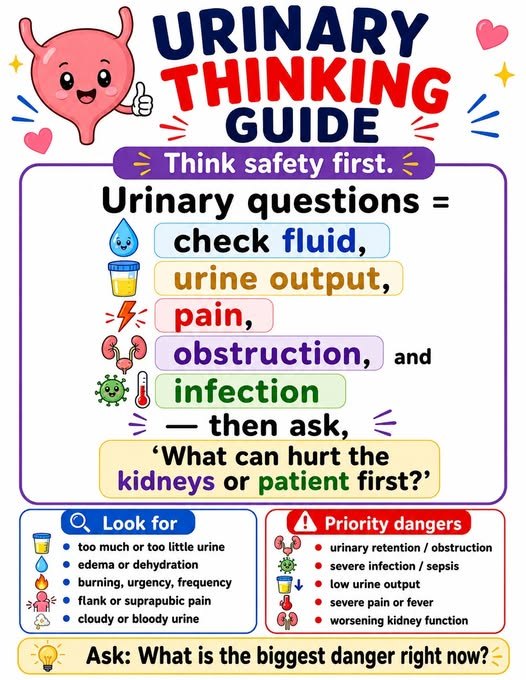
How to think through a urinary question: fluid, urine output, pain, obstruction, infection — then ask what can hurt the kidneys or the patient first. — swipe it sideways if it is cut off, or tap to open it full size.
Saved study graphics from your own collection. Each one is someone else’s work — check anything clinical against your course materials before you rely on it.