UTI & Pyelonephritis 🦠
Lower tract infection · and what happens when it climbs
One infection, two addresses. A UTI lives low — urethra and bladder (cystitis). If it gets bad enough it climbs the ureters and infects the kidney — that is pyelonephritis, and it is the serious one. Same bugs, same burning… plus fever and flank pain.
📄 Simple Nursing original — opens in Drive →
CAUSE
STEP 1 · THE CLIMBBacteria almost never fall into the kidney from above — they walk in the front door and climb.
⬆️ The ascending path — urethra ➜ bladder ➜ ureters ➜ kidney
EXAM TIP Bacteria enter at the urethra and climb upward — so every level of the urinary tract has its own infection name, and the higher it goes the sicker the client gets.
🏷️ Name the level, name the disease
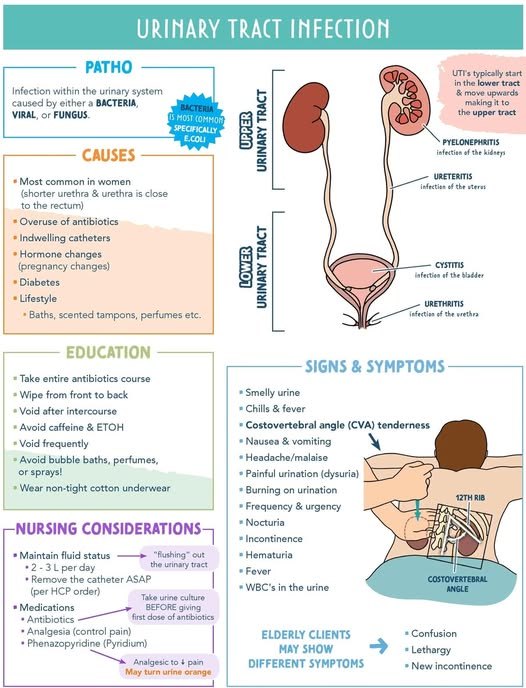
- Urethritis — infection of the urethra 🚪
- Cystitis — infection of the bladder 🫙 (“cyst-” = bladder)
- UTI — the umbrella term for the lower tract: urethra + bladder
- Pyelonephritis — infection of the kidney 🫘 — more serious
- Urosepsis — the infection is now in the blood 🩸 — emergency
🦠 E. coli is the #1 cause — and anatomy is why
Escherichia coli from the bowel/perineum causes roughly 80–85% of uncomplicated UTIs. It only has to travel a short distance in a female.
⚠️ Risk factors — anything that pools urine or plants bacteria
- 🚻 Female anatomy · sexual activity · spermicide/diaphragm
- 🧻 Wiping back to front · bubble baths · douching
- 🩹 Indwelling catheter — the single biggest hospital risk
- 🚽 Urinary retention / incomplete emptying · “holding it”
- 🪨 Stones, strictures, BPH, tumors — anything obstructing flow
- 🍬 Diabetes — sugary urine feeds bacteria + neuropathy
- 🤰 Pregnancy — ureters dilate and drain slowly
- 🌸 Postmenopause — low estrogen thins the tissue
- 🛏️ Immobility · dehydration · immunosuppression
🩹 CAUTI — the catheter is a highway
Catheter-Associated UTI. Risk climbs with every single day the catheter stays in. The device gives bacteria a straight, protected road into the bladder.
- ✅ Remove it as early as possible — day one is the goal
- ✅ Keep a closed sterile system — do not disconnect to transport
- ✅ Bag below bladder level, never on the floor
- ❌ Never irrigate or change a catheter just to “treat” a UTI without an order
CLUES
STEP 2 · SPOT ITBurning and frequency say bladder. Fever and flank say kidney. Confusion says older adult.
🔥 Lower UTI (cystitis) — the classic four
Key distinction: a simple bladder infection makes you miserable — it usually does not make you systemically ill. High fever, chills, nausea and back pain mean it has moved up.
🚨 Pyelonephritis — “like a UTI, but worse” · the key difference is pain LOCATION
Everything above, plus a systemically sick patient:
- 🌡️ High fever — often >101°F (38.3°C), with shaking chills (rigors)
- 👊 Costovertebral angle (CVA) tenderness — the hallmark finding
- 🫸 Dull flank pain, extending around toward the umbilicus
- 🤢 Nausea & vomiting, malaise, body aches
- 🧪 WBC casts in the urine — proof the infection is in kidney tissue
⚖️ Tell them apart — lower UTI vs pyelonephritis
| Feature | 🫙 Lower UTI / Cystitis | 🫘 Pyelonephritis |
|---|---|---|
| Where | Urethra & bladder | Kidney & renal pelvis |
| Fever | Low-grade or none | High >101°F + shaking chills |
| Pain location | Suprapubic — low, front, over the bladder | Flank / CVA — back, radiating toward the umbilicus |
| How sick | Uncomfortable, walking around | Systemically ill — N/V, malaise, may need admission |
| Urine clue | WBCs, bacteria, nitrites | Same + WBC casts (formed in the tubules) |
| Typical treatment | Short oral course, 3–7 days | Longer course 7–14 days; often IV first |
| Worst outcome | Ascends to the kidney | Urosepsis, renal scarring, chronic kidney disease |
👵 ⭐ The older adult presents differently
Answer first: in an older adult, new-onset confusion — not burning — is often the only sign of a UTI.
- 🧠 Acute confusion / delirium, agitation, personality change
- 🤸 New falls or sudden unsteadiness
- 💧 New incontinence in someone previously continent
- 🍽️ Poor appetite, lethargy, “just not themselves”
- 🌡️ Often afebrile — a blunted immune response hides the fever
🧪 Urinalysis (UA) — read the dipstick
- ☁️ Cloudy & foul-smelling = bacteria & pus in the urine
- ⚪ WBCs / leukocyte esterase + = inflammation & infection
- 🟣 Nitrites + = gram-negative bacteria (E. coli) converting dietary nitrates
- 🦠 Bacteria seen on microscopy
- 🩸 RBCs may be present (hematuria)
- 🧬 WBC casts = the infection is in kidney tissue = pyelonephritis
🔬 Normal urine vs infected urine — side by side
🧫 Urine culture & sensitivity — culture FIRST, then antibiotics
Growth threshold: the source uses >10,000 organisms/mL as significant. Many labs report ≥100,000 CFU/mL for an asymptomatic clean-catch and accept lower counts in a symptomatic patient — follow your lab's reference range.
- 🧼 Teach: cleanse front to back, start the stream, then catch mid-stream
- 🌅 First morning void is the most concentrated and the best sample
- 💉 From a catheter: sterile syringe at the sampling port — never take the specimen from the drainage bag
- ⏱️ A specimen left at room temperature >1 hour overgrows with bacteria and gives a false result
🚨 Urosepsis — the complication that kills
Bacteria cross from the kidney into the bloodstream. This is the reason pyelonephritis gets admitted.
- 🌡️ Fever or hypothermia · shaking chills
- 💓 HR >90 · RR >20 · SBP <90 mmHg
- 🧠 Altered mental status — often the very first sign
- 💧 Urine output <30 mL/hr · rising lactate
- 🩸 Blood cultures ×2 sites before antibiotics, then broad-spectrum IV fast
CARE
STEP 3 · TREAT & PREVENTKill the bug, flush the tract, and teach the habits that keep it from coming back.
💊 Antibiotics — typical adult choices
| Drug | Where it fits | Key nursing point |
|---|---|---|
| Trimethoprim/ sulfamethoxazole (TMP-SMX, Bactrim) | First-line uncomplicated cystitis | Sulfa allergy! Watch for rash → Stevens-Johnson. ↑ bleeding with warfarin. Push fluids. |
| Nitrofurantoin (Macrobid, Macrodantin) | Uncomplicated bladder infection only | Take with food or milk. Brown urine is normal. Not for pyelonephritis — it does not reach kidney tissue. |
| Fosfomycin (Monurol) | Acute uncomplicated cystitis | One 3 g packet, dissolved in 90–120 mL cool water. |
| Fluoroquinolones (ciprofloxacin, levofloxacin) | Pyelonephritis / complicated UTI | Tendon rupture & neuropathy risk. Separate from antacids, calcium, iron by 2–6 hr. |
| Ceftriaxone IV | Inpatient pyelonephritis | Give with IV fluids; reassess for oral step-down once afebrile. |
| Methenamine (Hiprex, Urex) | Prevention of recurrent UTI | Needs acidic urine to work — avoid excess citrus & milk. |
Universal rule: finish the entire course even after symptoms disappear — stopping early is how resistant organisms are born.
💊 Phenazopyridine (Pyridium) — numbs, does not cure
- 🎯 It is a dye with a topical analgesic effect on the urinary lining — no anti-infective activity at all
- 🟠 Turns urine and tears reddish-orange; stains fabric and contact lenses — this is normal
- 🍽️ Take after meals
- ⏱️ No more than 2 days when combined with an antibiotic — longer can mask the symptoms of a more serious disorder
✅ Prevention teaching — the habits that matter
Avoid: ☕ caffeine · 🍺 alcohol · 🥤 carbonation · 🌶️ spicy foods · 🫧 bubble baths, douches & scented feminine products — all bladder irritants.
🛏️ Foley drainage set-up — the picture the exam draws wrong
⭐ NCLEX / HESI traps from the source
| Question stem | Answer |
|---|---|
| A cloudy urine specimen is an indication of… | Bacteria in the urine |
| Client reports dysuria and frequency — which test does the nurse anticipate? | Urine culture |
| Mid-stream specimen was collected 2 hours ago and left sitting in the bathroom. Priority action? | Discard it and obtain a new specimen |
| Temp 102.5°F (39°C), grabbing her left side, dull pain, concentrated cloudy urine. This is… | Pyelonephritis |
The master rule for this whole topic: Assess 1st · Interventions 2nd. If both an assessment and an action look right, the assessment comes first — unless the client is unstable.
QUICK RECALL
SAY IT OUT LOUD🎯 Cover & check — 6 rapid-fire questions
STUDY SHEETS
FROM YOUR SAVED SET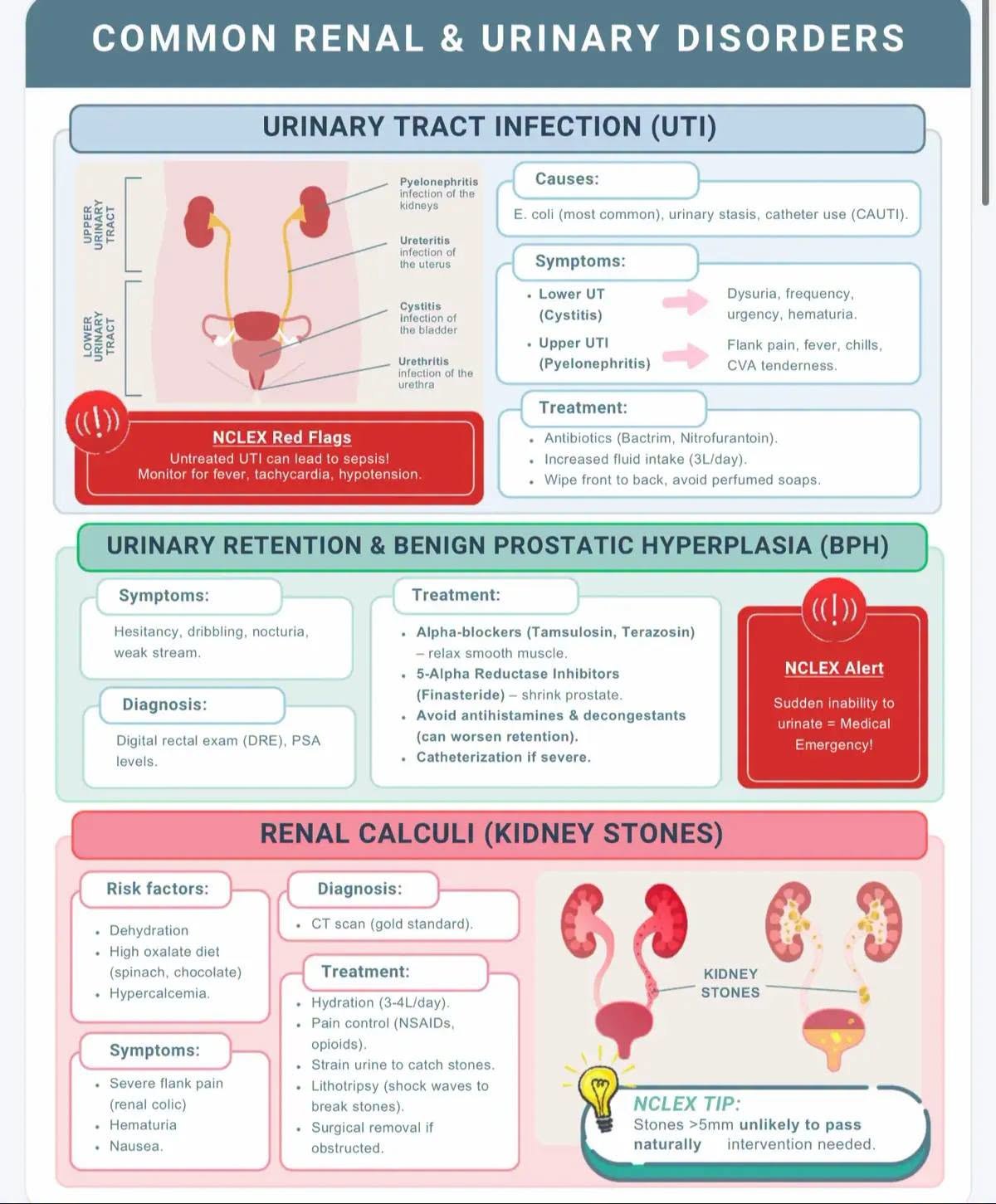
Saved study graphics from your own collection. Each one is someone else’s work — check anything clinical against your course materials before you rely on it.