Nursing Field Notes / Musculoskeletal · Fracture & Trauma Care Series · Page 3 of 4
Fat Embolism 🫁
& Osteomyelitis — Two Fracture Complications That Aren't the 6 P's
NG-061MusculoskeletalADHD-friendly visual edition
Both of these hide behind a "routine" fracture. Fat embolism syndrome (FES) is a systemic emergency — marrow fat escapes into the bloodstream and lodges in the lungs, brain, or heart. Osteomyelitis is a bone infection that follows an open fracture, surgery, or puncture. Neither one is caught by the 6 P's from the Fracture page — those check the limb's blood flow; FES and osteomyelitis are whole-body problems layered on top.
🫁 The classic triadRespiratory distress + mental status change + petechial rash = FES until proven otherwise.
⏱️ 24–72 hoursFES classically shows up 1–3 days after a long-bone or pelvic fracture.
🌡️ 103°F + yellow drainageHigh fever + purulent drainage at a puncture/surgical site = think osteomyelitis.
🏠 PICC + weeks of antibioticsOsteomyelitis treatment goes home with the patient — IV antibiotics for weeks to months.
🫁
FAT EMBOLISM
STEP 1 · THE CLOT THAT ISN'T A CLOT
Marrow fat, not a blood clot, blocks the vessel — but the destinations are just as deadly: lung, brain, heart.
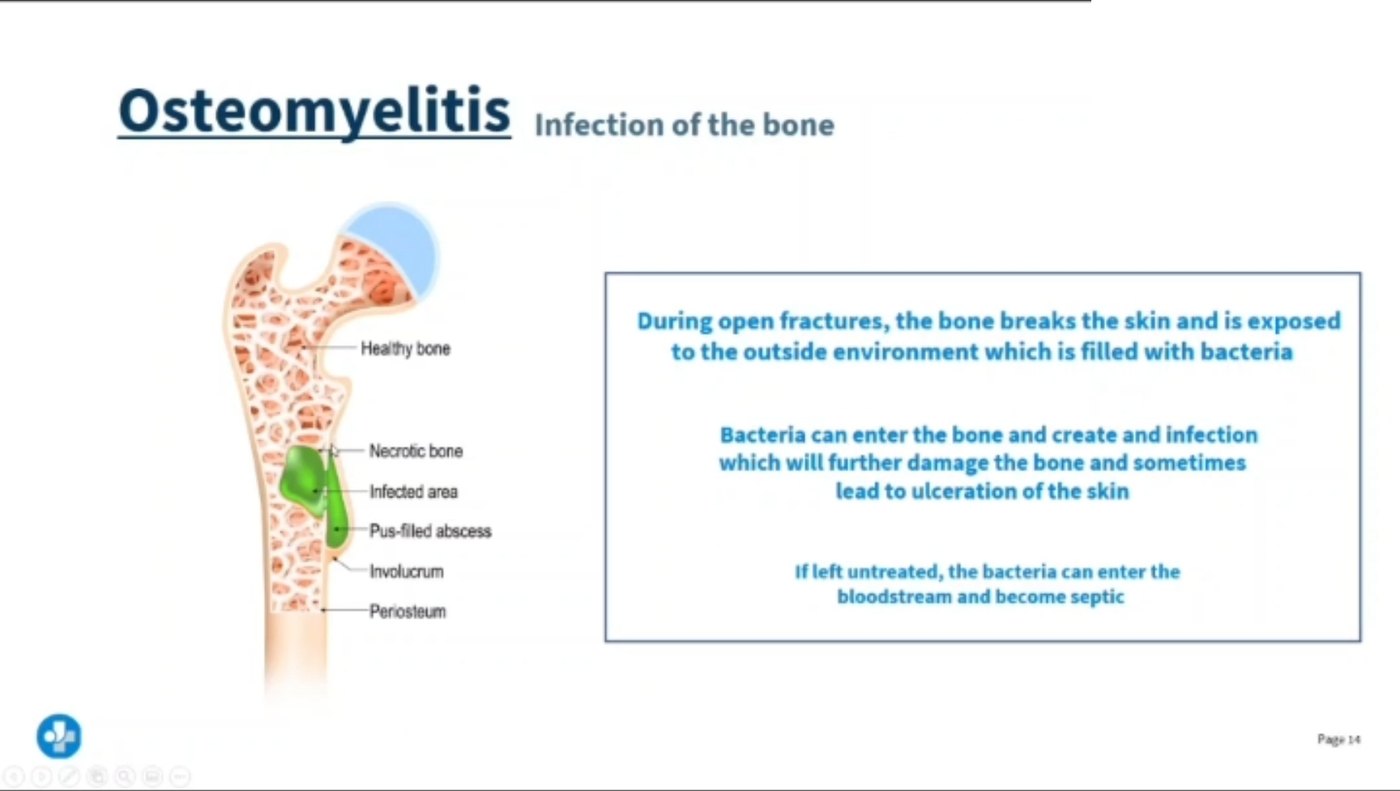
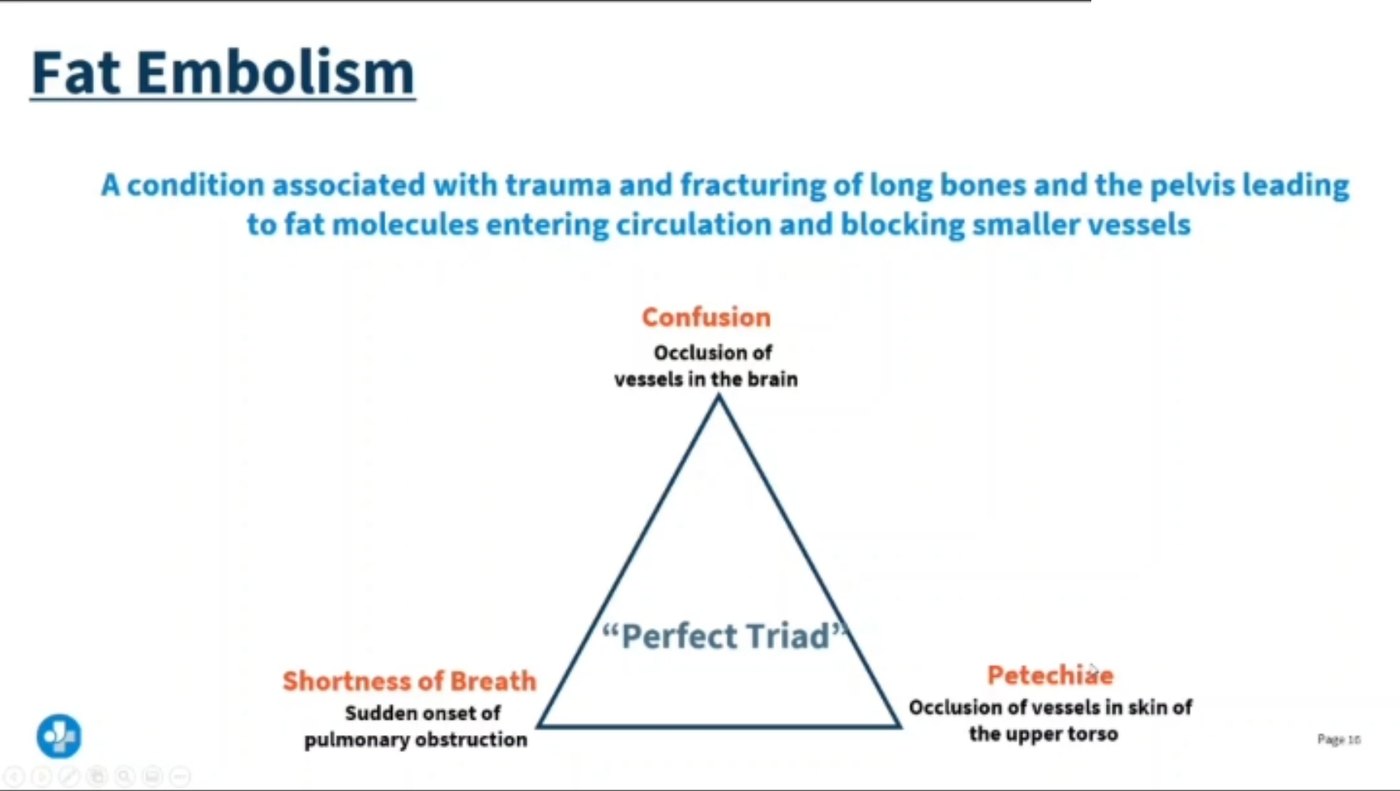
From your lecture. Follow the route: an open fracture exposes bone → bacteria enter → ulceration → if left untreated, septicemia.From your lecture. The perfect triad — confusion, sudden shortness of breath, petechiae over the upper torso — after a long-bone or pelvic fracture.
🩻 Pathophysiology — bone marrow escapes into the bloodstream
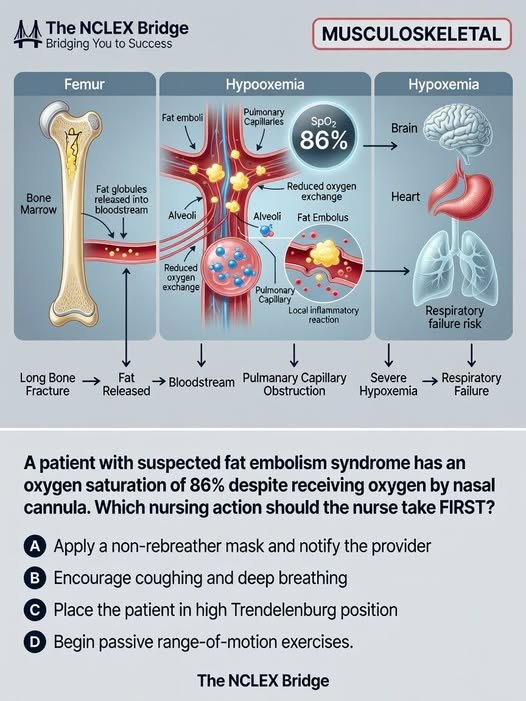
Fat embolism syndrome is a major complication of crushing fractures & long-bone injuries — femur, pelvis, and hip fractures carry the highest risk. The injured bone releases fat globules from the marrow directly into torn venous sinusoids. Those globules travel through the bloodstream and — just like a blood clot — can lodge somewhere far from the fracture, causing a deadly blockage in the lung (respiratory failure), brain (stroke-like picture), or heart (MI-like picture).
🧠 "Fat travels like a clot but comes from bone, not blood." Any long-bone or pelvic fracture, or the IM rod surgery used to fix one, can release marrow fat — think of it as an embolism with a different source, same deadly destinations.
🚨 The classic triad — memorize this exact set of three
🧠 "Confused, can't breathe, covered in dots." All three don't have to appear at once — mental status change is often the earliest clue, before the rash ever shows up. Petechiae are the most specific finding but frequently arrive last.
⚠️ Risk factors & timing
🦴 Long-bone fractures — femur is the classic culprit
🩹 Pelvic fractures
💥 Multiple fractures / crush injuries
🔩 Orthopedic surgery, especially IM rod/nail placement
🧠 Closed fractures can carry higher FES risk than open ones — the marrow pressure has nowhere to release except into the bloodstream.
🧪 Supporting clues
📉 Low pulse ox — hypoxia often precedes the rash
🩸 Thrombocytopenia — platelets consumed with fat globules
🌡️ Fever & tachycardia
💓 Tachypnea, chest pain, crackles
KAPLAN An older adult client is diagnosed with a fractured femur. Which observation is an early sign of fat embolism?
Answer: altered mental status — it can precede the dyspnea and the rash.
🦴
OSTEOMYELITIS
STEP 2 · BONE INFECTION
Bacteria gets INTO the bone through a break in the barrier — then the immune response and the infection both damage the bone.
🚪 Pathophysiology — four doors bacteria use to reach bone
Osteomyelitis is a bone infection, most often caused by Staphylococcus aureus, that enters the bloodstream — and then the bone — through one of these routes:
🧠 "If it breaches the skin near a bone, it can breach the bone." Open fracture, surgery, puncture, or needle — all four are just different doors to the same infection.
🌡️ Signs & symptoms
🔥 High fever — often high-grade (a commonly used exam example is ~103°F / 39.4°C)
😣 Localized bone pain, constant, worse with movement
🟠 Swelling, warmth, erythema over the site
💛 Pus or yellow drainage from a wound or puncture site
🧠 Fever + yellow drainage days after a procedure = infection, not just "normal healing." Report it — don't wait it out.
🧪 Labs & diagnostics
KAPLAN Several days after a bone marrow aspiration, the nurse notes a client's temp of 103°F (39.5°C) and yellow drainage from the aspiration site. Most accurate interpretation?
Answer: the client has developed osteomyelitis.
🩺
CARE
STEP 3 · TREAT & MONITOR
FES is stabilized and supported; osteomyelitis is fought with weeks of antibiotics and, if needed, surgery.
💊 Osteomyelitis treatment ladder
1
IV antibiotics for weeks to months — targeted to the organism found on culture
2
Discharge home with a PICC line — a home-health nurse continues the long IV antibiotic course
3
Surgical debridement — drains abscesses and removes necrotic/dead bone tissue
4
Amputation — only if the infection doesn't respond to therapy
🧠 "PICC line goes home too." Osteomyelitis is one of the classic reasons a patient is discharged still on IV antibiotics — teach PICC site care, flushing, and signs of line infection before they leave.
🫁 FES management — supportive & preventive
🩹 Minimize movement of the fracture — immobilize/splint early, this is the #1 prevention step
🫁 Oxygen — may progress to mechanical ventilation if severe
💧 IV fluids to maintain hemodynamic stability
🛏️ Bed rest, continuous pulse ox & LOC monitoring
🧠 Prevention beats treatment here. There's no antidote for fat emboli once released — the nursing priority is keeping the fracture still so fewer globules ever enter the bloodstream.
🚨 FES — recognize fast, and know what "getting better" looks like
The classic triad (respiratory distress + mental status change + petechial rash) after a long-bone or pelvic fracture is a medical emergency — notify the HCP immediately.
SAUNDERS What is the most favorable indication of resolution of the fat embolism?
Answer: clear mentation. Improving mental status — not the rash fading — is the reassuring sign that oxygenation and cerebral perfusion are recovering.
🖐️ Not the same checklist as the 6 P's
The 6 P's from the Fracture page (pain, pallor, pulselessness, paresthesia, paralysis, poikilothermia) assess local blood flow and nerve function in the injured limb itself.
FES and osteomyelitis are different problems — FES is a systemic embolic event hitting lungs/brain/heart; osteomyelitis is a localized bone infection with systemic fever. Keep running the 6 P's on the limb and watching for these two complications — they aren't mutually exclusive.
🧠 One patient, three checklists: 6 P's for the limb, the triad for FES, fever + drainage for osteomyelitis.
⚔️ Tell them apart — side by side
Fat Embolism Syndrome
Osteomyelitis
Onset: 24–72 hrs after fracture
Onset: days after fracture, surgery, or puncture
Marrow fat blocks vessels (lung/brain/heart)
Bacteria infects bone tissue
Triad: respiratory distress, mental status change, petechiae
High fever, localized pain, yellow drainage
PRIORITY: O2, immobilize, notify HCP now
PRIORITY: IV antibiotics, wound/PICC care, notify HCP
⚡
QUICK RECALL
SAY IT OUT LOUD
🫁 FES triadrespiratory distress + mental status change + petechiae
⏱️ 24–72 hrsafter a long-bone or pelvic fracture
🌡️ 103°F + yellow drainage= think osteomyelitis
🏠 PICC line homeweeks-to-months of IV antibiotics
🎯 Cover & check — 4 rapid-fire questions
Q1: What are the three findings in the classic fat embolism triad?
Respiratory distress, altered mental status, and a petechial rash (chest/neck/axilla/conjunctiva). Mental status change is often the earliest.
Q2: What is the single best way to prevent fat embolism syndrome after a fracture?
Minimize movement of the fracture — immobilize/splint it early so less marrow fat is released into the bloodstream.
Q3: How does bacteria typically reach bone to cause osteomyelitis?
Open fracture, after surgery, a puncture wound (e.g., dog bite), or a contaminated needle such as bone marrow aspiration.
Q4: A patient with osteomyelitis is being discharged. What should the nurse expect to teach?
PICC line care — the patient goes home on weeks-to-months of IV antibiotics with home-health nursing visits.
📌
STUDY SHEETS
FROM YOUR SAVED SET
How a long-bone fracture becomes respiratory failure — marrow fat into the bloodstream, pulmonary capillary obstruction, hypoxemia. Practice question underneath. — swipe it sideways if it is cut off, or tap to open it full size.
Saved study graphics from your own collection. Each one is someone else’s work — check anything clinical against your course materials before you rely on it.