Exam 1 · Week 2 · Standalone study page
M2 · Infectious Diseases & HIV
This page keeps all of the original course information, while reducing the decision to one module: isolation, exposure response and immune defense.
▸M2Infectious Diseases & HIVWeek 2
💡 The one idea
HIV is a CD4 disease. The virus destroys helper T cells, and every complication follows from how few are left. Learn the CD4 ladder and the opportunistic infections fall into place.
🚨 The number that defines AIDS
CD4 < 200 That is the diagnostic threshold, regardless of how well the patient looks. Below it, Pneumocystis jirovecii pneumonia (PCP) becomes the classic killer — and prophylaxis with Bactrim starts at that same number.
| Precaution | Room | You wear | Classic examples |
|---|---|---|---|
| Airborne | Negative pressure, door shut | N95 | Measles, TB, Varicella |
| Droplet | Private, door may be open | Surgical mask | Influenza, pertussis, meningitis, mumps |
| Contact | Private | Gown + gloves | C. diff, MRSA, VRE, scabies |
⭐ Two mnemonics that carry the table
Airborne = “My Tiny Vampire” — Measles, TB, Varicella.
C. diff needs soap. Alcohol gel does not kill C. diff spores. Wash with soap and water, and use bleach to clean the room.
✅ Antiretroviral teaching, in one card
Adherence is the whole treatment. Missed doses breed resistance faster than any other drug class.
Therapy is lifelong, continues in pregnancy (it prevents transmission to the baby), and an undetectable viral load means untransmittable sexually.
⭐ High-yield — what the exam actually asks
Show 5 moreHide these 5
- CD4 is the monitoring lab, not WBC. CD4
<200or an AIDS-defining condition = AIDS. Viral load tracks how well ART is working. - HIV testing sequence: antigen/antibody combination screen first, then a confirmatory differentiation assay.
- PEP: start as soon as possible, ideally within hours, never beyond 72 hours. Continue
28 days. - Neutropenic precautions: private room, reverse isolation/positive pressure, no fresh flowers or plants, limited visitors, daily cleaning, dedicated equipment. The sign goes up at ANC
≤1,000— but a client can be neutropenic above that. - Airborne (TB, measles, varicella) = negative pressure, door closed, N95. Droplet (flu, bacterial meningitis, pertussis) and contact (C. diff, MRSA, VRE) = door may stay open.
Show 4 moreHide these 4
- Doff gown and gloves inside the room and do hand hygiene before you leave, not in the hall. One exception: an N95 comes off after you step out and close the door — then hand hygiene again.
- C. diff: bleach cleaning, contact precautions. Priority problem is dehydration, then electrolytes.
- HAI prevention: pull lines and catheters the moment they are not needed, scrub the hub
15 secwith friction, chlorhexidine30 secat dressing changes (2 minonly on a moist site — groin or femoral) and let it dry, dressingsq7 days. - Emerging infectious disease: isolate at the most protective level available until the route is confirmed, then report to public health.
🎧 From the LSC exam-prep recording
What the faculty actually said in the review session for this week — their numbers, their worked calculations, their priority rulings. On an exam, this beats the textbook.
Show 5 moreHide these 5
- For both CLABSI and CAUTI the most effective action is do not place the device unless it is necessary. Sterile insertion is the runner-up — the question asks for most effective, and several options are effective. Femoral central lines infect far more than subclavian.
- Prophylactic antibiotics are never the answer for a line or a catheter. Antibiotics are for a known infection.
- Needlestick from an HIV-positive source: wash with soap and water first — express the blood if it was deep — then report, PEP, baseline draw. All four are correct actions; only the order is being tested.
- VAP prevention is HOB at least 30°, semi-Fowler's, so stomach contents cannot be aspirated. Scheduled q2h suctioning is the wrong answer — suction on need, or you traumatize the trachea. Add chlorhexidine oral care and a PPI for stress-ulcer prophylaxis.
- MRSA home teaching: keep the area covered with a clean, dry dressing. No petroleum jelly, no warm compresses, do not leave it open to air. MRSA spreads skin to skin — which is why it runs through wrestling and football teams.
Show 7 moreHide these 7
- Their numbers: CD4 normal 500–1,200, CD4 under 200 = AIDS. WBC 5,000–10,000. ANC 1,500–8,000, with 500 = neutropenic. ART is typically 3–4 drugs daily.
- ART goals, their SATA: it lowers viral load (target undetectable), raises CD4 — not lowers — and prevents opportunistic infections. It does not cure, and it does not prevent transmission — it reduces it. Their warning: never tell a client with HIV they cannot transmit it.
- Poor ART adherence leads to drug resistance and treatment failure. Not "immediate" opportunistic infections, not "complete loss within days", not "rapid" progression — those take years. Watch the absolute words.
- Their fewest-steps heuristic: when several options could eventually follow, count the steps. The option you can reach in one step is usually the answer. If you had to talk yourself through four links to get there, it is not it.
- Acute HIV infection = flu-like illness with lymphadenopathy, then years of latency while CD4 falls silently. Kaposi's sarcoma, Pneumocystis pneumonia and wasting are late-stage opportunistic disease.
- The bow-tie: CD4 180 is AIDS by definition — nothing else drops CD4 that far — and bilateral infiltrates mean pneumonia. Priorities: patent airway, medication adherence, nutrition. Complications: respiratory failure, sepsis, malnutrition. They ruled out TB (no night sweats, no hemoptysis) and asthma (no wheeze).
- Be very careful ever choosing "promote fluid restriction." Their words — it is right in heart failure and chronic renal failure and almost nowhere else.
Show 7 moreHide these 7
- Airborne is four things: TB, measles, varicella, disseminated herpes zoster. Their rule — learn those four, then essentially every other respiratory bug is droplet, and fecal-oral is contact.
- Varicella is airborne, not contact. The virus causes respiratory symptoms too, not just the skin lesions.
- From that same question: influenza is droplet; HIV and hepatitis B are standard precautions — you do not catch them by standing in front of someone.
- The physical difference: a droplet is larger and falls faster; airborne particles are tiny and travel further. That is the whole distinction. Know the precautions themselves too — N95 fit, door closed — not just which condition gets which.
- C. diff: about 80% follow antibiotic use in the past month, and the organism survives a long time on surfaces. Assess for dehydration before giving antibiotics — rehydrate first. Treatment is oral vancomycin first-line, metronidazole second.
- Neutropenic vs isolation precautions, their decision rule: ask who is at greatest risk. Infected client → everyone else, so you cover up on the way out. Neutropenic client → the client, so you cover up on the way in.
- Neutropenic precautions, their test: if you cannot disinfect it, it does not enter the room — no fresh flowers, plants or fruit, no stuffed animals. Nobody sick enters; the client masks to leave.
Show 3 moreHide these 3
- Select-all-that-apply is plus/minus scored — a correct pick earns a point, a wrong pick loses one. Their strategy: pick only what you are confident about. Better to leave a point on the table than lose one. Same for every next-generation item where you may pick many.
- Psychosocial items: throw out what is never therapeutic first — "avoid emotional concerns", "your feelings are irrational" — then choose between what is left. Their point: the diagnosis is usually not what is being tested, the feelings are.
- Calc: acetaminophen 650 mg from 160 mg/5 mL → 650 ÷ 160 × 5 =
20.3 mL→4 teaspoonsat 5 mL each. The instructor stopped at 20 mL on the recording and had to catch herself. Convert to the unit they asked for, and round only at the end.
⚠️ Exam traps
- Drawing blood from a central line does not itself cause CLABSI — bad technique does.
- An incontinent VRE client transmits far more than one with a closed Foley system.
- Viral infections get supportive care, not antibiotics.
🎬 Your instructor’s extra videos — Week 2
The list posted for this week. They open on YouTube.
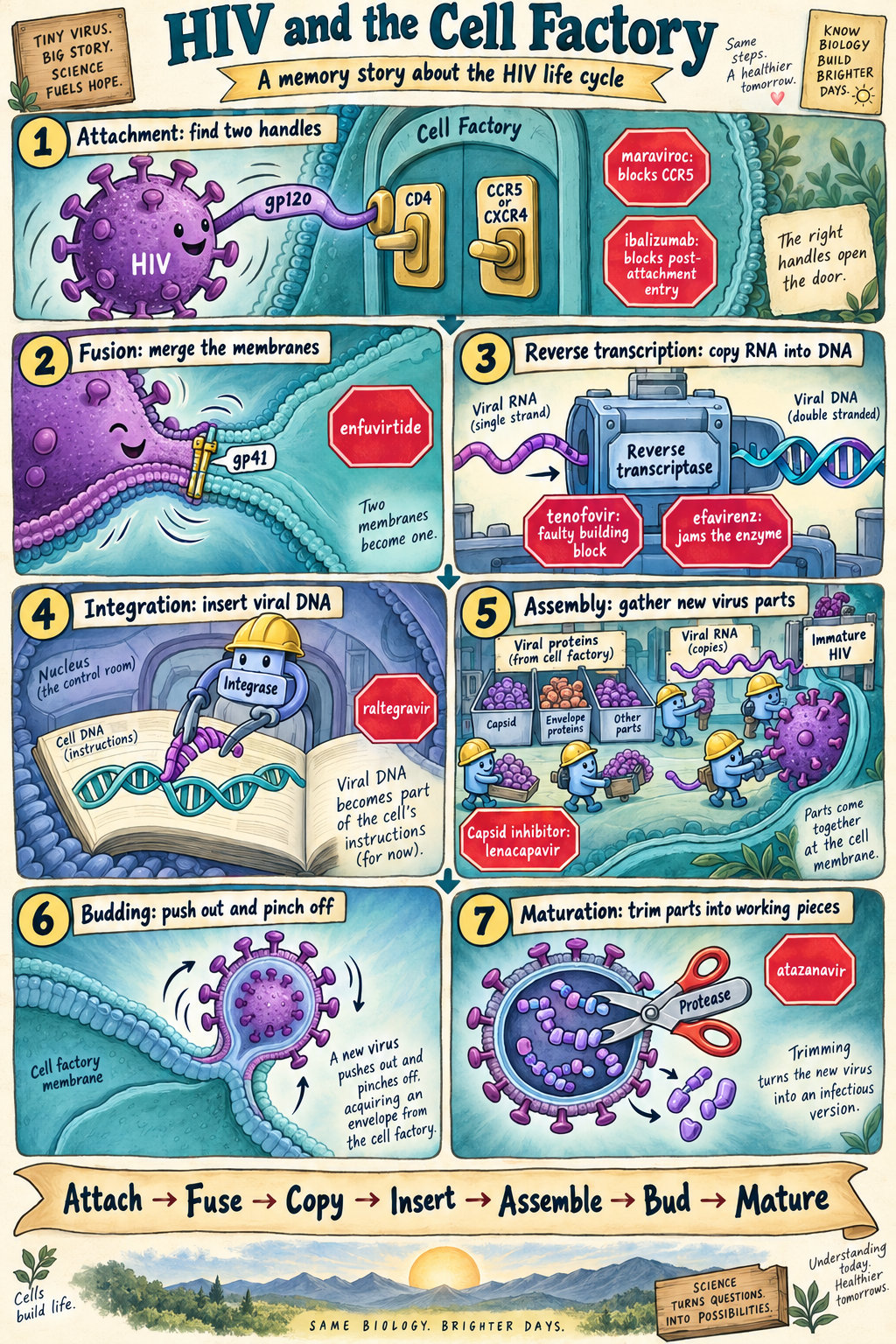
🧬 HIV up close — the virus, the lifecycle and where the drugs hit
The disorder card below is the clinical picture. This is the layer underneath it: what the virus is made of, the seven steps it takes inside a cell, and which drug class blocks each step. Get this and the antiretroviral classes stop being a list to memorise.
Two protein spikes, two strands of RNA, three enzymes. Every one of them is a drug target.
🧼 The target cell
HIV binds the CD4 receptor, so its target is the CD4+ T-helper cell — the cell that coordinates immunity. It releases cytokines and directs other cells; it does not kill anything itself. The killing is done by CD8+ cytotoxic T cells. That is why losing CD4 cells takes down the whole response at once.
💧 What transmits it — and what does not
Transmits: blood, semen, vaginal and rectal secretions, breast milk.
Does not transmit: tears, sweat, saliva, urine. Hugging, sharing a bathroom, sharing cutlery and kissing are safe — which is the teaching families most often need to hear out loud.
🎭 First — who is in this story?
Every strange name below is either a weight or a catalogue number. None of them mean anything clever. Once you know that, they stop being intimidating and start being labels.
Envelope
the outer coat — stolen from a cellThe bag the virus travels in. HIV does not build it: it takes a piece of your cell membrane on the way out. That is part of why your immune system has such trouble spotting it.
gp120
glycoprotein, 120 units heavyThe knob on the tip of every spike — the virus’s hand. gp only means “a protein with sugar stuck to it”. 120 is only how heavy it is. The name tells you nothing clever, so do not let it scare you.
gp41
the same, 41 units heavyThe stalk underneath the knob, and a grappling hook. It springs out, sinks into the cell membrane, then folds back and hauls the two membranes together.
CD4
cluster of differentiation, marker no. 4A protein on the surface of a helper T cell — the cell that directs your whole immune response. CD is just a catalogue of cell-surface markers, and this is number 4. Normally it is how a T cell shakes hands with other immune cells. HIV uses it as a doorknob.
CCR5 and CXCR4
chemokine receptors — the second lockAntennae the cell uses to smell out inflammation and walk toward it. HIV has to grab one of these as well as CD4 — two keys for one door. A few people are born with a broken CCR5 and are very hard to infect, which is exactly where the drug maraviroc came from.
Capsid
the cone-shaped coreThe hard cone inside the envelope that carries the genes and the enzymes. When you see the cone drawn inside the virus in the pictures below, that is the capsid. It is a drug target in its own right now — lenacapavir is a capsid inhibitor.
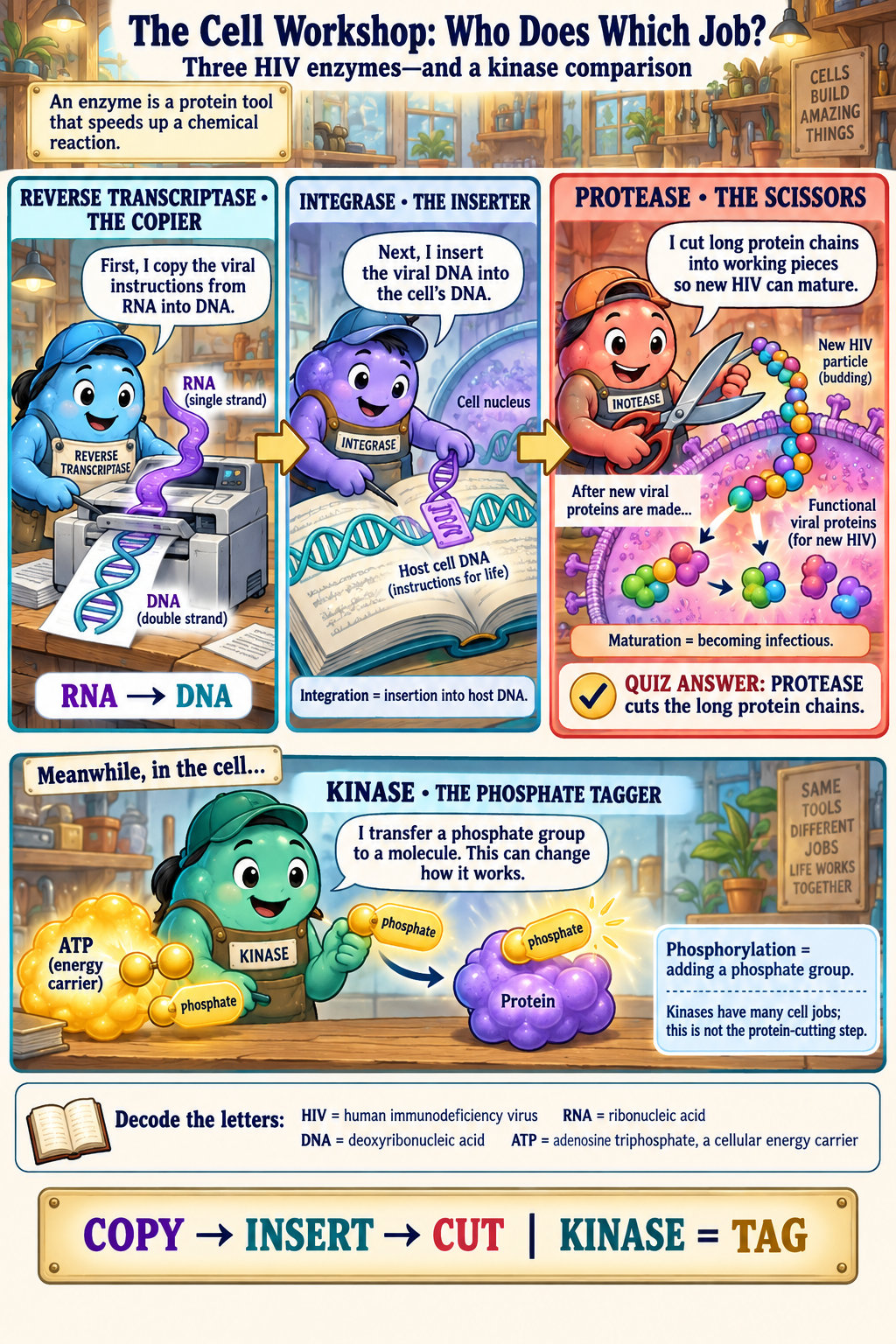
Reverse transcriptase
the backwards copierNormal biology runs DNA → RNA. This enzyme runs it backwards — hence “reverse”. It turns the virus’s RNA into DNA so your cell can read it. It is careless, and that carelessness is where drug resistance comes from.
Integrase
the staplerCarries the new HIV DNA into the nucleus and splices it into one of your own chromosomes. Once it has done that, the HIV DNA has a new name: provirus.
Protease
the scissorsCuts one enormous protein into the individual working parts. Until it does, the new virus particle is harmless.
Provirus
HIV DNA once it is inside your chromosomeThis is the reason HIV is lifelong. It sits inside the cell’s own instruction manual and is copied every time that cell divides. Medication stops the virus replicating; nothing available lifts that DNA back out.
📖 The story, in seven scenes
One virus, one T cell, seven moves. Each scene says what happens, why it matters, and which drug class is standing in that particular doorway.
The knock at the door
HIV drifts along in the blood until it bumps into a helper T cell — of all the cells it could meet, the one that directs your entire immune response.
The knob on one of its spikes, gp120, grabs the CD4 doorknob. One grab is not enough. gp120 then has to reach sideways and catch a second lock as well — CCR5 or CXCR4. Two keys, one door.
Why it matters: HIV can only get into cells that carry CD4. That is not bad luck — it is why the disease works. The virus destroys precisely the cell you need to fight it.
The grappling hook
Under each knob is a stalk called gp41. The moment gp120 has hold, gp41 springs open like a harpoon, buries its tip in the cell membrane, and then folds back on itself — dragging the two membranes together until they melt into one.
The cone-shaped capsid slides straight into the cytoplasm. Notice that nothing was broken into. The cell was pulled shut around the virus.
The sloppy photocopier
HIV’s genes are written in RNA. Your cell can only read DNA. So the virus brings its own copier: reverse transcriptase, called “reverse” because ordinary biology goes DNA → RNA and this runs the other way.
The copier is fast and careless. It makes typos constantly, and every typo is a slightly different virus. That is exactly where drug resistance comes from.
And that is why HIV is treated with three drugs at once. A virus can get lucky and dodge one drug. It does not get lucky three times in the same cell.
Stapled in, for life
There is now a DNA copy of HIV loose in the cell. The second enzyme, integrase, carries it into the nucleus and splices it into one of your own chromosomes. From this moment it has a new name: provirus.
It is no longer a passenger. It is part of the cell’s own instruction manual, and it is copied every single time that cell divides.
This one step is why HIV is lifelong and why there is still no cure. It is also why treatment is never stopped — the provirus waits quietly in resting cells, and the day the drugs stop, it starts making virus again.
Your own cell becomes the factory
Nothing in this scene belongs to the virus. Your cell reads the provirus exactly like any other gene, sends the message out of the nucleus as mRNA, and your own ribosomes build whatever it says.
What comes off the production line is not a set of finished parts. It is one absurdly long protein with every part still joined end to end — like flat-pack furniture that has not been cut apart yet. Hold on to that image; it is the whole point of scene 7.
It leaves wearing your coat
The long protein chains and two copies of viral RNA gather just under the cell membrane, push outward, and pinch off. On the way out the new particle wraps itself in a piece of your membrane — that becomes its envelope.
Two things to keep: the cell is not blown apart on the way out, it is worn out by doing this over and over, which is how the CD4 count slides down over years. And what has just left cannot infect anything yet.
The scissors that make it dangerous
Floating outside the cell is an immature particle stuffed with uncut protein. Its last enzyme, protease, gets to work like a pair of scissors, cutting the long chain into the individual working pieces.
The pieces snap into position, the cone-shaped capsid forms, and only now — after it has already left the cell — can the virus infect anything.
So here is the neat part. A protease inhibitor does not stop virus getting out. It stops whatever got out from ever working. That is why blocking step 7 quietly takes care of steps 5 and 6 as well.
⭐ The whole story in one line
Grab (gp120 → CD4 + CCR5) → pull (gp41) → copy backwards (reverse transcriptase) → staple in (integrase) → build (your ribosome) → bud out → cut to size (protease).
And the two suffixes that do most of the work on an exam:
–tegravir = integrase. –navir = protease.
🔢 And the initials, plainly
ART — antiretroviral therapy. The whole regimen, usually three drugs from two
different classes, taken for life.
NRTI — nucleoside reverse transcriptase inhibitor (the fake
building block).
NNRTI — the non-nucleoside version: same target, different trick.
INSTI — integrase strand transfer inhibitor.
PI — protease inhibitor.
Capsid inhibitor — the newest class, and the only one that works at both ends of the cycle. One drug so far: lenacapavir.
Viral load — how much virus is in a millilitre of blood. The goal is
undetectable, and undetectable means untransmittable.
CD4 count — how many helper T cells are left. This is the one that says how sick she is.
Under 200 is AIDS.
📋 Show me all seven as a table instead
| Step | What does the work | Drug class that blocks it | Example |
|---|---|---|---|
| 1 Attachment | gp120 → CD4 + CCR5 or CXCR4 | CCR5 antagonist Post-attachment inhibitor | maraviroc ibalizumab |
| 2 Fusion | gp41 merges the membranes | Fusion inhibitor | enfuvirtide — subcut |
| 3 Reverse transcription | Reverse transcriptase: RNA → DNA | NRTI (fake building block) NNRTI (jams the enzyme) | tenofovir efavirenz |
| 4 Integration | Integrase splices into host DNA | Integrase inhibitor | raltegravir |
| 5 Assembly | Capsid protein builds the new core | Capsid inhibitor | lenacapavir subcut, 6-monthly |
| 6 Budding | the new particle pushes out | no class targets this | — |
| 7 Maturation | Protease cuts the long chain | Protease inhibitor | atazanavir |
🔬 Testing — and why “test me today” is not simple
The window period is the gap between catching HIV and a test being able to see it. It is not one number — it depends on what the test looks for.
| Test | What it detects | Detects from about |
|---|---|---|
| Nucleic acid test (NAT) | the virus itself (RNA) | 10–33 days — earliest |
| Antigen/antibody (4th gen) | p24 antigen + antibodies | 18–45 days (lab draw) |
| Antibody only | antibodies | 23–90 days |
| CD4 count | nothing — it stages, it does not diagnose | — |
🚨 Two days after an exposure
No test can rule HIV in or out this soon. Draw a baseline test now, arrange re-testing, and — this is the part that gets forgotten — PEP still has a 72-hour window and should be discussed today.
📊 The three stages
| Stage | CD4 | Viral load | How it looks |
|---|---|---|---|
| 1 Acute | dips, often <500 | very high | flu-like: fever, sore throat, rash, nodes. No opportunistic infections. Antibody tests may still be negative |
| 2 Chronic | 500 → 200, slowly | low but present | Asymptomatic — years, or decades on treatment |
| 3 AIDS | <200 | high | Or any AIDS-defining illness, whatever the count |
✅ The CD4 numbers worth memorising
Normal 500–1500. Under 200 = AIDS, and the same number starts Pneumocystis prophylaxis. Either a CD4 under 200 or an AIDS-defining illness makes the diagnosis — you do not need both.
🦠 What appears, and at what count
| CD4 | What shows up | Class |
|---|---|---|
| <500 | Oral candidiasis (thrush), tuberculosis, shingles | fungal / bacterial / viral |
| <200 | Pneumocystis jirovecii pneumonia | fungal |
| <150 | Histoplasmosis, coccidioidomycosis | fungal |
| <100 | Toxoplasmosis, cryptococcal meningitis | parasite / fungal |
| <50 | CMV retinitis, Mycobacterium avium complex | viral / bacterial |
👀 Four look-alikes the exam keeps using
Kaposi’s sarcoma — purple-brown lesions on skin or mouth. AIDS-defining on its own.
Oral hairy leukoplakia — white patches on the side of the tongue that will not scrape off. Epstein-Barr. A sign the disease is advancing.
Candidiasis — creamy white film that does wipe away. That is the discriminator.
CMV retinitis — floaters, blurring, field loss. Blindness from it is permanent, so any visual change goes straight to ophthalmology.
🐟 Toxoplasmosis vs histoplasmosis — do not swap them
Toxoplasmosis is a parasite from cat faeces, and causes brain lesions — headache, confusion, focal signs. Teaching: someone else empties the litter tray.
Histoplasmosis is a fungus, inhaled from bird and bat droppings. Teaching: do not disturb soil under roosts, or clean out barns and attics.
🛡️ PrEP and PEP — before and after
| PrEP | PEP | |
|---|---|---|
| Who | HIV negative, ongoing risk | HIV negative, one specific exposure |
| When | Before exposure, taken continuously | Within 72 hours, then 28 days |
| Example | regular high-risk activity | needlestick, assault, shared equipment |
💉 Three ways to take PrEP
A daily tablet — tenofovir with emtricitabine. The original, and still the commonest.
An injection every 2 months — cabotegravir, given by a clinician.
An injection every 6 months — lenacapavir, approved for prevention in June 2025. Two subcutaneous injections plus oral loading doses to start, then twice a year.
PrEP is only for someone who is HIV negative. Test before starting and at every visit — giving PrEP to someone already infected is giving them too few drugs, and that breeds resistance.
🍼 Mother to baby
Antiretroviral therapy continues through pregnancy and after it. The newborn receives antiretroviral medication for about 4–6 weeks, and formula replaces breastfeeding where safe formula and clean water are available — breast milk transmits. Holding and kissing the baby carry no risk at all.
💊 Antiretroviral therapy — the teaching that gets tested
Three drugs, at least two classes, started as soon as HIV is diagnosed, whatever the CD4.
Lifelong and continuous. It is never started at symptoms and tapered off. Missed doses breed resistance faster than in any other drug group.
Undetectable = untransmittable. Viral load usually becomes undetectable within about six months.
St John’s wort is contraindicated — it induces liver enzymes and strips antiretroviral levels. Ask about every herbal product, not just prescriptions.
⭐ Screening
The CDC recommends everyone aged 13 to 64 be tested at least once as part of routine care, regardless of risk factors. Risk questions cover substance use, sexual practice and previous STIs — not mood or intrusive thoughts, which screen for something else entirely.
⚠️ What it turns into — the complication for each one
The disorder cards below run definition, causes, signs, diagnostics, management and nursing. This is the part they do not have, and it is where the exam lives: so what happens if this is missed or left? Two threads: an untreated infection spreads — locally, then to the blood — and an interrupted course of treatment breeds resistance.
| Disorder | What it turns into |
|---|---|
| HIV and AIDS | Opportunistic infection once CD4 falls — PCP pneumonia, esophageal candidiasis, CMV retinitis, TB. Kaposi sarcoma and lymphoma. Wasting syndrome and HIV-associated neurocognitive disorder. Poor ART adherence breeds resistance, and the regimen stops working |
| Tuberculosis | Miliary (disseminated) TB and TB meningitis, pleural effusion and empyema, massive haemoptysis, permanent lung scarring. Stopping treatment early creates multidrug-resistant TB — which is why directly observed therapy exists |
| Transmission-based precautions | Breaking them causes outbreaks and healthcare-associated infection, and exposes staff and other clients. The opposite harms too: isolation brings depression, delirium and fewer assessments, because people go in less often |
| Clostridioides difficile | Severe dehydration and electrolyte loss, toxic megacolon, bowel perforation and peritonitis, sepsis. Recurrence is common. Alcohol gel does not kill the spores — soap, water and friction do |
| Multidrug-resistant organisms | Infection with nothing left to treat it, sepsis, longer admissions, and silent colonisation carried between clients on hands and equipment |
| Influenza | Pneumonia, viral or secondary bacterial. Decompensation of COPD, asthma and heart failure. Myocarditis and encephalopathy. Most dangerous at the two ends of life and in pregnancy |
| Viral hepatitis | Fulminant hepatic failure acutely. Then chronic hepatitis with B and C, leading to cirrhosis, portal hypertension and hepatocellular carcinoma. A and E do not go chronic |
| Sepsis and septic shock | MODS, ARDS, acute kidney injury, DIC, death. Mortality climbs with every hour that antibiotics are delayed — but cultures come first, or you never learn what it was |
🦠 The infectious disorders, section by section
Eleven conditions in the same six sections, in the same order, so the part you want is always in the same place. They stay closed until you open them.
HIV and AIDSCD4 under 200 = AIDSOpenClose
🖼️ InfographicsImmunologic (HIV) & Infectious Diseases
Definition and Overview
A retrovirus that destroys CD4 T-helper cells, the cell that coordinates the whole immune response. HIV is the infection; AIDS is a stage of it. The diagnosis of AIDS is made when the CD4 count drops below 200 cells/mm³ or an AIDS-defining opportunistic infection or cancer appears — whichever comes first, and once it is made it is not undone by the count going back up.
Causes and Risk Factors
Transmitted by blood, semen, vaginal secretions and breast milk. Unprotected sex, shared needles, occupational needlestick, and perinatal transmission in pregnancy, birth or breastfeeding. It is not spread by hugging, sharing food, toilet seats, insects or casual contact — that sentence is a test item every single year.
Clinical Manifestations
Early: a flu-like seroconversion illness — fever, sore throat, rash, swollen nodes. Then years with no symptoms at all while the CD4 count falls. Later: persistent lymphadenopathy, night sweats, unexplained weight loss, chronic diarrhea, oral thrush, fatigue. Advanced disease shows itself as the opportunistic infections — Pneumocystis jirovecii pneumonia, candidal oesophagitis, CMV retinitis, TB, cryptococcal meningitis — and as Kaposi sarcoma.
Assessment and Diagnostic Findings
Fourth-generation antigen/antibody immunoassay first, then an antibody differentiation assay to confirm; a nucleic acid (viral load) test settles an indeterminate result and is what is used in newborns, because a baby carries the mother's antibodies for up to 18 months. CD4 count tells you how much immune system is left; viral load tells you how well treatment is working. Undetectable viral load is the treatment goal.
Medical Management
Antiretroviral therapy for everyone with HIV, started as soon as the diagnosis is made, regardless of CD4 count — usually three drugs from at least two classes in a single combination tablet. Prophylaxis against opportunistic infection is added by CD4 threshold (trimethoprim–sulfamethoxazole for PJP below 200). PrEP for people at high risk; PEP within 72 hours of an exposure, and the sooner the better.
Nursing Management and Client Education
Standard precautions for every client, every time — that is what protects you, not knowing someone's status. Teach that doses must be taken on time and never skipped, because missed doses breed resistance; a client who stops when they feel well is the classic wrong answer. Watch for and report fever, cough, new headache, visual change or diarrhea. Nutrition, immunisations, safer sex and clean needles. Confidentiality is a legal duty. Never disclose an HIV diagnosis to family, visitors or another department without the client's consent.
TuberculosisAirborne precautionsOpenClose
🖼️ InfographicsTuberculosis - Patho, Signs & Diagnostics
Definition and Overview
Infection with Mycobacterium tuberculosis, an acid-fast bacillus that settles in the lungs. Latent TB means the organism is walled off — the person has a positive test, no symptoms, and is not infectious. Active TB means the organism is multiplying, the person is symptomatic, and is infectious. Telling those two apart is most of what the exam asks.
Causes and Risk Factors
Crowded or poorly ventilated living conditions, homelessness, incarceration, long-term care, recent immigration from a high-prevalence country, injection drug use, malnutrition, and anything that suppresses immunity — HIV, corticosteroids, chemotherapy, TNF inhibitors, diabetes, chronic kidney disease. Health care workers are exposed at work.
Clinical Manifestations
A cough lasting more than three weeks, sputum that becomes purulent or blood-streaked, night sweats, low-grade afternoon fever, unintentional weight loss, anorexia and fatigue. The onset is gradual, which is why it gets missed. Chest pain on breathing and dyspnea come later.
Assessment and Diagnostic Findings
Mantoux (PPD) skin test read at 48 to 72 hours — measure the induration, not the redness. ≥5 mm is positive in HIV, recent contacts and the immunosuppressed; ≥10 mm in higher-risk groups; ≥15 mm in everyone else. An interferon-gamma release blood test (QuantiFERON) is used when the person has had BCG. A positive skin test means exposure, not active disease — chest x-ray plus three sputum specimens for acid-fast bacilli, collected on three different mornings, is what confirms it.
Medical Management
Multi-drug therapy for 6 to 12 months: rifampin, isoniazid, pyrazinamide and ethambutol for the first two months, then rifampin and isoniazid. Directly observed therapy when adherence is doubtful. Latent TB is usually treated with isoniazid alone to stop it becoming active.
Nursing Management and Client Education
Airborne precautions: negative-pressure room, and an N95 respirator for you, a surgical mask for the client whenever they leave the room. Teach that treatment is not finished when the symptoms stop — stopping early is how resistant TB is made. Warn about the drugs: rifampin turns urine, sweat and tears orange and ruins soft contact lenses, and it makes oral contraceptives fail; isoniazid needs vitamin B6 to prevent neuropathy and both it and rifampin are hepatotoxic, so no alcohol and report yellow eyes or dark urine; ethambutol affects vision, so report any change in color vision or acuity. Cover coughs, and expect the person to become non-infectious after about 2 to 3 weeks of therapy with three negative sputum smears.
Transmission-Based PrecautionsOpenClose
Definition and Overview
The extra layer used on top of standard precautions when an organism spreads in a way standard precautions alone will not stop. Standard precautions apply to every client, always; transmission-based precautions are added for a specific organism. There are three: contact, droplet and airborne.
Causes and Risk Factors
The route the organism travels decides the category. Contact — it survives on skin and surfaces (MRSA, VRE, C. difficile, RSV, scabies, draining wounds). Droplet — large droplets that fall within about 3 to 6 feet (influenza, pertussis, mumps, meningococcal meningitis, group A strep). Airborne — tiny nuclei that stay suspended and travel on air currents (tuberculosis, measles, varicella, disseminated zoster).
Clinical Manifestations
This one has no symptoms of its own — what you look for is the client whose findings should trigger it before the culture comes back: a productive cough with weight loss and night sweats, a new vesicular rash, explosive diarrhea on antibiotics, or a stiff neck with fever and photophobia. Act on the suspicion; do not wait for the result.
Assessment and Diagnostic Findings
Cultures, rapid antigen tests and the organism's known route. Assess whether the room, the equipment and the transport plan actually match the category — a client in airborne precautions being wheeled through a corridor without a mask is the failure the exam is testing for.
Medical Management
Isolate, then treat the underlying infection. The team decides when precautions can come off, usually on repeat cultures or a set time on effective therapy.
Nursing Management and Client Education
Contact: gown and gloves to enter, dedicated equipment, private room or cohort. Droplet: surgical mask within 3 to 6 feet, private room, mask on the client for transport. Airborne: N95 and a negative-pressure room, door closed, surgical mask on the client for transport. Two exceptions worth memorising: alcohol gel does not kill C. difficile spores — wash with soap and water, and a client with measles, varicella or disseminated zoster needs airborne and contact precautions together. Explain the isolation to the client and the family, and watch for the loneliness of it — that is real nursing care, not a footnote.
Clostridioides difficile InfectionSoap and water, not gelOpenClose
Definition and Overview
Overgrowth of a spore-forming bacterium in the colon after normal gut flora has been wiped out, usually by antibiotics. The toxins it releases inflame the bowel wall, producing watery diarrhea and, at its worst, pseudomembranous colitis and toxic megacolon.
Causes and Risk Factors
Recent or current antibiotics is the dominant risk — especially clindamycin, fluoroquinolones, cephalosporins and broad-spectrum penicillins. Add age over 65, hospitalisation or long-term care, immunosuppression, tube feeding, GI surgery and proton pump inhibitors. The spores survive on surfaces for months.
Clinical Manifestations
Three or more loose, watery stools in 24 hours with a distinctive foul odour, crampy abdominal pain, fever and leukocytosis. Severe disease brings dehydration, hypoalbuminaemia, a distended tender abdomen and a sudden stop in diarrhea with abdominal distension, which signals toxic megacolon and is an emergency, not an improvement.
Assessment and Diagnostic Findings
Stool tested for C. difficile toxin or its gene by PCR — on a liquid stool only, because testing formed stool just finds carriers. Watch the WBC, albumin, creatinine and electrolytes; a white count climbing past 15,000 marks severe disease. Monitor intake, output and daily weight.
Medical Management
Stop the offending antibiotic where possible, then treat with oral vancomycin or fidaxomicin (oral vancomycin is not absorbed, which is exactly why it works here). Fluid and electrolyte replacement. Recurrent disease may be treated with faecal microbiota transplant. Surgery for toxic megacolon or perforation.
Nursing Management and Client Education
Contact precautions in a private room, gown and gloves every time. Alcohol-based hand rub does not kill the spores — wash with soap and running water, and clean the room with a bleach-based product. Dedicated equipment. Do not give antidiarrhoeals — holding the toxin in the bowel makes it worse. Skin care for the perineum, because the stool is corrosive. Teach the family the same handwashing rule, and teach every client to finish antibiotics as prescribed and never take someone else's.
Multidrug-Resistant OrganismsOpenClose
Definition and Overview
Bacteria that no longer respond to the antibiotics that used to kill them — MRSA (methicillin-resistant Staphylococcus aureus), VRE (vancomycin-resistant Enterococcus), and gram-negative organisms such as ESBL producers and CRE. Colonisation is carrying the organism without illness; infection is the organism causing disease. Both are transmissible; only one is treated.
Causes and Risk Factors
Antibiotic overuse and incomplete courses above everything else. Then prolonged hospitalisation, ICU stay, indwelling lines and catheters, open wounds, surgery, dialysis, long-term care residence, and immunosuppression. Health care workers' hands are the usual vehicle.
Clinical Manifestations
Whatever the organism is infecting: a wound that will not heal with purulent drainage and surrounding redness, pneumonia, a line-site infection, a urinary tract infection, or bacteraemia with fever, chills and hypotension. MRSA skin infection often looks like a boil or an abscess and is frequently mistaken for a spider bite.
Assessment and Diagnostic Findings
Culture and sensitivity from the site — always obtain cultures before the first dose of antibiotic. Surveillance nares swabs for MRSA and rectal swabs for VRE on admission in high-risk units. Follow the WBC, temperature and the sensitivity report, which is what narrows the therapy.
Medical Management
Treat by sensitivity, not by habit: vancomycin, linezolid or daptomycin for MRSA; linezolid or daptomycin for VRE. Drain abscesses. Remove the infected line or catheter. Antibiotic stewardship — the narrowest effective drug, for the shortest effective time — is the real treatment for the problem as a whole.
Nursing Management and Client Education
Contact precautions, private room or cohort with the same organism, dedicated equipment, gown and gloves on entry. Hand hygiene before and after every contact is the single most effective intervention. With vancomycin, watch the trough level, the creatinine and the hearing — it is both nephrotoxic and ototoxic — and infuse it over at least an hour to avoid the flushing of infusion reaction. Teach the client and family why the precautions exist and that they continue at home for wound care.
InfluenzaDroplet precautionsOpenClose
Definition and Overview
An acute respiratory infection caused by influenza A or B. It is not a bad cold: the onset is abrupt, and the danger is in the complications — pneumonia (viral, or a secondary bacterial pneumonia a few days after the person seemed to be improving), and the decompensation of whatever chronic disease the person already had.
Causes and Risk Factors
Age over 65 or under 5, pregnancy, chronic lung, heart, kidney, liver or neurological disease, diabetes, obesity, immunosuppression, and residence in long-term care. Crowding and an unvaccinated household. The virus changes its surface antigens every year, which is why last year's immunity is not enough.
Clinical Manifestations
Sudden fever, chills, myalgia and headache, dry cough, sore throat and profound fatigue that outlasts the fever by a week or more. Worsening dyspnea, chest pain, confusion or a fever that returns after breaking are red flags for pneumonia and must be reported.
Assessment and Diagnostic Findings
Usually clinical during the season. Rapid influenza antigen or PCR on a nasopharyngeal swab when the result would change management. Pulse oximetry, respiratory rate and work of breathing; chest x-ray if pneumonia is suspected. In older adults, watch for the atypical presentation — confusion or a fall instead of a fever.
Medical Management
Antivirals (oseltamivir, zanamivir, baloxavir) work best started within 48 hours of the first symptom and shorten the illness by about a day — they are not a cure. Rest, fluids and antipyretics otherwise. Antibiotics only for a proven bacterial complication.
Nursing Management and Client Education
Droplet precautions and a surgical mask on the client for transport. Push fluids, cluster care so the client can rest, monitor oxygenation. Teach hand hygiene and covering coughs. Annual vaccination is the prevention — for everyone from 6 months up, and especially for health care workers and household contacts. Never give aspirin to a child or teenager with a viral illness — Reye syndrome. The live attenuated nasal vaccine is not given to pregnant or immunocompromised people.
Viral HepatitisOpenClose
🖼️ InfographicsHepatitis
Definition and Overview
Inflammation of the liver caused by one of five viruses. The one thing to hold onto is the route: A and E come in through the mouth — faecal–oral, food and water. B, C and D come in through blood and body fluids. Hepatitis A is acute and self-limiting; B and C can become chronic and lead to cirrhosis and liver cancer. D only exists alongside B.
Causes and Risk Factors
For A: contaminated food or water, shellfish, poor hand hygiene, travel, day-care and institutional settings. For B, C and D: unprotected sex, shared needles, needlestick injury, tattoos and piercings with unsterile equipment, blood products before screening, and perinatal transmission. Health care workers and dialysis clients are exposed at work.
Clinical Manifestations
A prodrome that looks like flu — anorexia, nausea, fatigue, low-grade fever, right upper-quadrant discomfort and a distaste for cigarettes — then the icteric phase with jaundice, dark urine, clay-colored stools and pruritus. Many people, especially with hepatitis C, have no symptoms at all until liver damage is advanced.
Assessment and Diagnostic Findings
Hepatitis panel serology is what names the virus and the stage. Two to know: anti-HAV IgM means current hepatitis A, and HBsAg means the person is infectious with hepatitis B — while anti-HBs alone means immunity, from the vaccine or from recovery. Anti-HCV screens for C and a viral load confirms it. Follow ALT and AST (high in the hundreds or thousands), bilirubin, albumin and PT/INR — a rising INR is the sign of failing liver function.
Medical Management
Hepatitis A and acute B are supportive: rest, nutrition and time. Chronic B is treated with antivirals such as tenofovir or entecavir; chronic C is now curable with 8 to 12 weeks of direct-acting antivirals. Vaccines exist for A and B, and the B vaccine also prevents D. Post-exposure prophylaxis with immune globulin plus vaccine after a known exposure.
Nursing Management and Client Education
Standard precautions; add contact precautions for hepatitis A in someone incontinent or in nappies. Rest matched to fatigue, small frequent meals, adequate calories. No alcohol, and no acetaminophen beyond what is prescribed — the liver cannot handle either. Check every other drug, including over-the-counter and herbal ones, against the liver. Teach hand hygiene and food safety for A; for B and C teach no sharing of razors, toothbrushes or needles, safer sex, and no donating blood. Cool baths and loose clothing for itching, and keep the nails short. Urge household contacts to be vaccinated.
Sepsis and Septic ShockCultures before antibioticsOpenClose
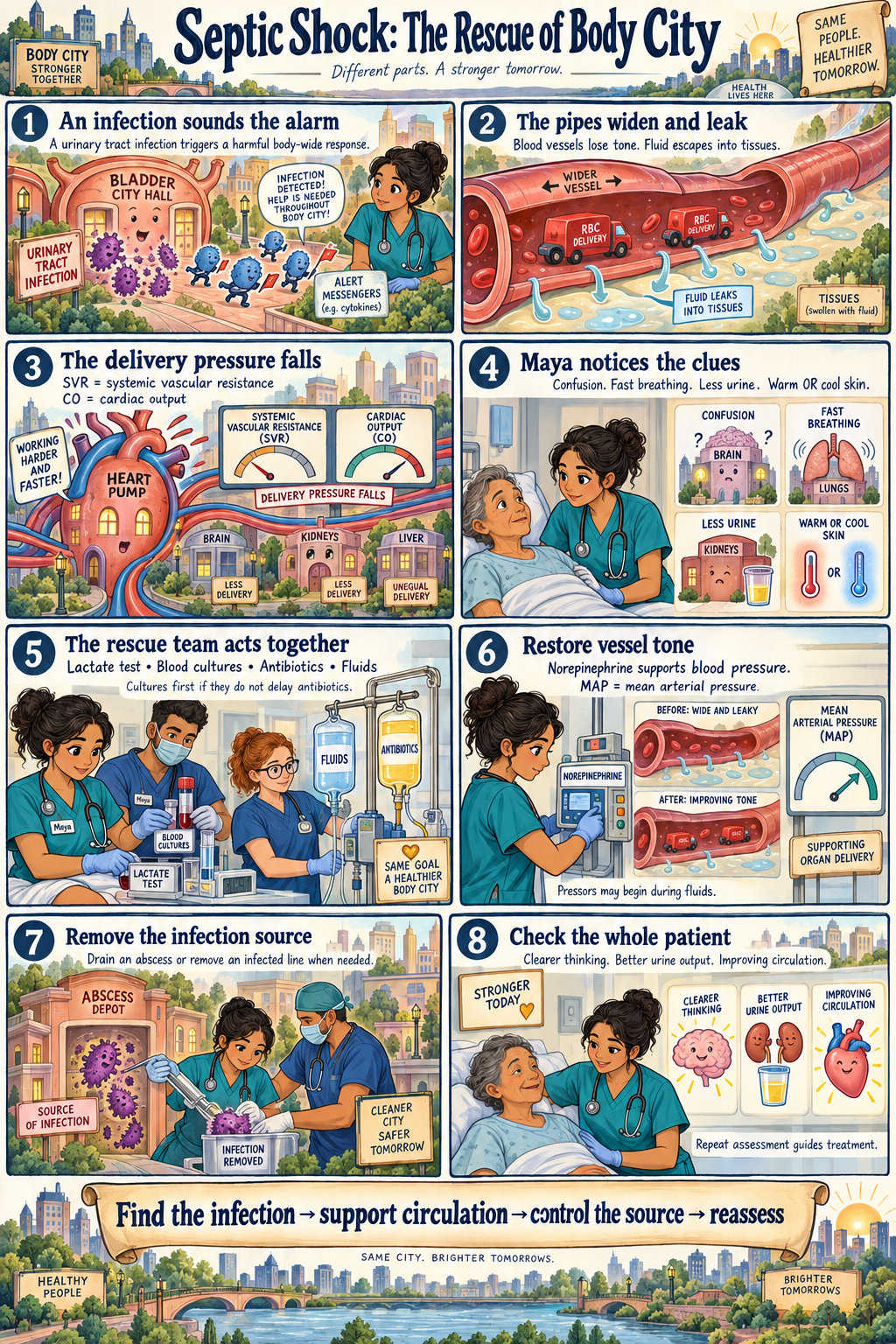
🖼️ InfographicsSeptic ArthritisSeptic Shock
Definition and Overview
Sepsis is a dysregulated response to infection that damages the body's own organs. Septic shock is sepsis plus circulatory failure — hypotension that persists after fluid resuscitation and needs vasopressors, with a rising lactate. It is a distributive shock: the volume is there, but the vessels have dilated and become leaky, so it is not reaching the tissues.
Causes and Risk Factors
Any infection can do it. Higher risk with age over 65 or under 1, immunosuppression, chemotherapy, diabetes, chronic kidney or liver disease, malnutrition, and indwelling devices — central lines, urinary catheters, ventilators, surgical wounds. Pneumonia, urinary tract infection, abdominal infection and skin infection are the usual sources.
Clinical Manifestations
Early (warm) phase: fever, tachycardia, tachypnoea, warm flushed skin, bounding pulse and a widening pulse pressure, with a normal or high cardiac output. Late (cold) phase: cold, mottled skin, weak thready pulse, falling blood pressure, oliguria and organ failure. In older adults the first sign is often new confusion or a fall, with no fever at all — a normal temperature does not rule sepsis out.
Assessment and Diagnostic Findings
Lactate is the key number — over 2 mmol/L is concerning and over 4 is severe. Blood cultures from two sites, drawn before the first antibiotic dose, plus cultures of urine, sputum and any wound. CBC (high or low WBC), creatinine, bilirubin, platelets and coagulation studies for DIC. Continuous vital signs, hourly urine output, and mental status.
Medical Management
The sepsis bundle in the first hour: measure lactate, draw cultures, give broad-spectrum antibiotics, and start crystalloid at 30 mL/kg for hypotension or a lactate of 4 or more. Then remeasure the lactate. Noradrenaline (norepinephrine) is the first-line vasopressor when fluid alone does not restore the pressure. Find and remove the source — drain the abscess, pull the line. Oxygen, and mechanical ventilation if needed.
Nursing Management and Client Education
Recognize it early — that is the nursing intervention that saves the life. Any client with an infection who becomes tachycardic, tachypnoeic, hypotensive or confused needs escalating now. Draw the cultures first, then hang the antibiotic — but do not delay the antibiotic waiting for a difficult draw. Large-bore IV access, warm the client, monitor urine output hourly as your bedside measure of perfusion, and reassess after every fluid bolus for crackles and rising work of breathing. Head of bed up, oral care and sub-glottic suction to prevent ventilator pneumonia. Prevention is the other half: hand hygiene, and getting lines and catheters out as soon as they are no longer needed. Keep the family informed — this deteriorates fast and they will be frightened.
Zika VirusPregnancy is the whole riskOpenClose
Definition and Overview
A flavivirus carried by Aedes mosquitoes — the ones that bite in daylight. In most people it is a trivial illness. The reason it matters at all is what it does in pregnancy: it crosses the placenta and causes congenital Zika syndrome, of which microcephaly is the best known feature.
Causes and Risk Factors
Travel to or residence in an area with active transmission. Uniquely for a mosquito-borne illness, it is also passed sexually — by men and women, and by people who never had symptoms — and through blood products and from mother to fetus. Standing water anywhere near the home breeds the vector.
Clinical Manifestations
About four in five people have no symptoms at all. When it does show: low-grade fever, an itchy maculopapular rash, joint pain, headache, and a non-purulent conjunctivitis — red eyes without discharge, which is the detail that distinguishes it. It settles in under a week. In adults the serious complication is Guillain-Barré syndrome; report new weakness or tingling that starts in the feet and climbs.
Assessment and Diagnostic Findings
RT-PCR on serum and urine while the virus is still present, roughly the first 14 days; IgM serology after that. Test any pregnant client with possible exposure, symptoms or not. Serial fetal ultrasound looks for microcephaly and intracranial calcification.
Medical Management
There is no antiviral and no vaccine. Rest, fluids and acetaminophen. Avoid NSAIDs and aspirin until dengue has been excluded — the two circulate together and NSAIDs worsen dengue bleeding.
Nursing Management and Client Education
The teaching is prevention, and it is specific. Pregnant clients should not travel to areas with Zika transmission. For everyone else: DEET or picaridin, permethrin-treated clothing, long sleeves, screens and air conditioning, and empty any standing water — buckets, tyres, plant saucers, gutters. After travel, use condoms or abstain before trying to conceive: the guidance is 3 months for men, 2 months for women. Standard precautions in hospital — it does not spread person to person by ordinary contact.
West Nile VirusNeuroinvasive in under 1%OpenClose
Definition and Overview
A flavivirus that lives in birds and reaches people through the Culex mosquito, which feeds from dusk to dawn. Most infections do nothing. A small number invade the nervous system and cause meningitis, encephalitis or a polio-like acute flaccid paralysis.
Causes and Risk Factors
Age over 60 is the single biggest risk for severe disease, along with immunosuppression, organ transplant, diabetes, hypertension and cancer. Outdoor activity at dawn and dusk in late summer. Rarely, transmission through transfusion, transplant, the placenta or breast milk — which is why donated blood is screened.
Clinical Manifestations
Roughly 80% have no symptoms. About 20% get West Nile fever: fever, headache, body aches, a rash on the trunk, swollen nodes, and fatigue that can drag on for weeks. Under 1% develop neuroinvasive disease — high fever, neck stiffness, disorientation, tremor, seizures, or sudden limb weakness. Sudden flaccid weakness without pain is the finding that must be escalated immediately.
Assessment and Diagnostic Findings
IgM antibody in serum and, when the nervous system is involved, in CSF — CSF IgM is the confirmatory result because it does not cross the blood-brain barrier. Lumbar puncture typically shows raised lymphocytes and protein with normal glucose. MRI and EEG for encephalitis.
Medical Management
No specific antiviral and no human vaccine. Management is supportive: analgesia, fluids, seizure control, and in severe neuroinvasive disease, airway protection and ventilation. Recovery from paralysis is slow and often incomplete, so rehabilitation starts early.
Nursing Management and Client Education
Mosquito precautions aimed at evening and night, which is when Culex bites: repellent, long sleeves after sunset, intact screens, and emptying standing water weekly. For neuroinvasive disease, monitor neurological status and swallowing, prevent aspiration, and begin physiotherapy early. It is a reportable disease; standard precautions are enough — it does not pass person to person.
Legionnaires’ DiseaseWater systems, not peopleOpenClose
Definition and Overview
A severe pneumonia caused by Legionella pneumophila, a gram-negative bacillus that lives in warm water systems — cooling towers, hot tubs, decorative fountains, showerheads, humidifiers and large or stagnant plumbing. People inhale it as an aerosol or aspirate contaminated water. It does not spread from person to person.
Causes and Risk Factors
Age over 50, smoking, chronic lung disease, diabetes, alcohol use, immunosuppression and recent stay in a hotel, cruise ship, hospital or long-term care facility. Outbreaks cluster around one water system, which is why a second case in the same building is an emergency for the facility, not just for the client.
Clinical Manifestations
Pneumonia that is systemically severe: high fever, chills, a cough that starts dry, chest pain and breathlessness. The features that point at Legionella rather than ordinary pneumonia are the ones outside the lung — diarrhoea, confusion and headache, and a pulse slower than the fever would predict. Pontiac fever is the same organism in a mild, self-limiting form with no pneumonia.
Assessment and Diagnostic Findings
Urinary antigen test is the fast one and is usually how the diagnosis is made. Sputum culture needs a special medium (buffered charcoal yeast extract), so the laboratory has to be told Legionella is suspected. Chest x-ray shows patchy or lobar consolidation. Look for the two classic laboratory clues: hyponatraemia and raised liver enzymes.
Medical Management
A macrolide (azithromycin) or a respiratory fluoroquinolone (levofloxacin) — started promptly, because delay drives the mortality. Oxygen, fluids, antipyretics, and intensive care with ventilation when the pneumonia is severe.
Nursing Management and Client Education
Standard precautions only — no isolation is required, and saying so out loud reassures a frightened family. Monitor oxygenation, sodium and mental status. It is reportable: notify public health and infection control so the water system is investigated and remediated. Teach clients to flush taps and showerheads that have not been used for a while, keep hot water hot, and maintain hot tubs properly.
🧠 Mind maps 1
One per disorder, built from the structure of your ATI chapter.
🎯 Who gets it
- Unprotected vaginal, anal, or oral sex raises HIV risk.
- Multiple sex partners or another STI increase HIV risk.
- Occupational exposure puts health care workers at risk.
- Perinatal exposure can transmit HIV from mother to infant.
👀 What you see
- Acute HIV: fever, chills, rash, night sweats, headache, sore throat.
- Acute HIV: anorexia, nausea, weight loss, weakness, and fatigue.
- CBC often shows anemia, thrombocytopenia, and leukopenia in HIV.
- CD4 count measures T lymphocytes to gauge immune status and HIV stage.
🩺 What you do
- Track fluid intake/output, daily weight, and nutritional status closely.
- Monitor temperature, lung sounds, and neurologic status for changes.
- Assess skin integrity often for rashes, bruising, or breakdown.
- Alternate activity with rest; give supplemental oxygen as needed.
💊 Drugs
- HAART combines 3 to 4 antiretrovirals to limit resistance and side effects.
- Fusion inhibitors (enfuvirtide) block HIV from fusing with host cells.
- Entry inhibitors (maraviroc) block the CCR5 receptor on CD4 cells.
- NRTIs like zidovudine block the virus from converting RNA to DNA.
💬 What you teach
- Take antiretrovirals exactly as prescribed and know their side effects.
- Practice frequent hand hygiene to lower infection risk.
- Avoid crowds and travel to areas with poor sanitation.
Read left to right: who gets it → what you see → what confirms it → what you do → what goes wrong. Cover a column and rebuild it out loud.
🎥 Lecture recordings 5
Tap a card to open that recording in Google Drive. The same list lives in the lecture library.
All NUR 258 recordings →🖼️ Infographics 10
Tap a card to open the matching graphics in your infographic library.
📄 Simple Nursing handouts for this module — 6 of them, straight from your Drive.
📋 Active Learning Templates 1
One per disorder. Every row is filled from that section of the ATI chapter — print it, cover the right, rebuild it.
📋 HIV/AIDS6 parts
Filled from ATI chapter 86, row by row from that chapter’s own sections — 12 of 12 rows have content.
🧭 What it isAlterations in Health (Diagnosis) · Health Promotion & Disease Prevention
Alterations in Health (Diagnosis)
- This chapter reviews HIV as a retrovirus that destroys CD4 T-cells across three stages: acute infection, chronic asymptomatic infection, and AIDS, along with risk factors, testing, antiretroviral therapy, and care for related opportunistic infections.
Health Promotion & Disease Prevention
From this module — built from the notes above on this page, not a section of the ATI chapter.
- Prevent transmission with condoms, abstinence, and avoiding shared needles.
- PrEP is taken orally daily or injected every
2 monthsto prevent HIV. - Confirm a client is HIV-negative with testing before starting PrEP.
- Keep immunizations current, including yearly flu and pneumococcal vaccines.
- Clinicians follow standard precautions whenever they treat clients with HIV.
👀 How it shows upAssessment — Risk Factors · Assessment — Expected Findings
Assessment — Risk Factors
- Unprotected vaginal, anal, or oral sex raises HIV risk.
- Multiple sex partners or another STI increase HIV risk.
- Occupational exposure puts health care workers at risk.
- Perinatal exposure can transmit HIV from mother to infant.
- IV drug use with a shared, contaminated needle raises risk.
- Blood transfusion is a rare HIV source in the U.S.
- Older adult clients are also at increased risk.
Assessment — Expected Findings
- Acute HIV: fever, chills, rash, night sweats, headache, sore throat.
- Acute HIV: anorexia, nausea, weight loss, weakness, and fatigue.
- CBC often shows anemia, thrombocytopenia, and leukopenia in HIV.
- CD4 count measures T lymphocytes to gauge immune status and HIV stage.
- CDC recommends HIV testing once for ages
13 to 64; yearly if high risk. - Antibody test detects HIV
23 to 90 daysafter exposure. - Rapid antigen/antibody test detects HIV
18 to 90 daysafter exposure. - Antigen/antibody lab test detects HIV
18 to 45 daysafter exposure.
🧪 How it is confirmedLaboratory Tests · Diagnostic Procedures
Laboratory Tests
From this module — built from the notes above on this page, not a section of the ATI chapter.
- Fourth-generation antigen/antibody test is the screening test; a reactive result is confirmed by a differentiation assay.
- CD4 count measures immune status —
<200defines AIDS and triggers prophylaxis. - Viral load measures treatment response — the goal is undetectable.
- Undetectable equals untransmittable. Say it explicitly; it changes how people live.
- Resistance testing before starting and on failure; CBC, renal and liver function for drug toxicity; screening for TB, hepatitis and other STIs.
Diagnostic Procedures
From this module — built from the notes above on this page, not a section of the ATI chapter.
- Diagnosis is serological; the window period matters — a negative test soon after exposure needs repeating.
- Chest imaging and sputum for opportunistic respiratory infection.
- Lumbar puncture for cryptococcal meningitis; fundoscopy for CMV retinitis.
- Tuberculin skin test or IGRA — a smaller induration counts as positive in HIV, at
≥5 mm. - Staging by CD4 count and by the presence of an AIDS-defining illness.
🩺 What you doNursing Care · Medications · Therapeutic Procedures
Nursing Care
- Track fluid intake/output, daily weight, and nutritional status closely.
- Monitor temperature, lung sounds, and neurologic status for changes.
- Assess skin integrity often for rashes, bruising, or breakdown.
- Alternate activity with rest; give supplemental oxygen as needed.
- Normal CD4-to-CD8 ratio is
2:1; a ratio under1signals severe disease. - Falling CD4 counts suggest poor prognosis or medication resistance.
- Give antiretrovirals, antineoplastics, antifungals, and antidiarrheals as prescribed.
- Offer appetite stimulants and monitor for skin breakdown.
- Wasting syndrome: maintain nutrition orally or via TPN; track weight and calories.
Medications
- HAART combines 3 to 4 antiretrovirals to limit resistance and side effects.
- Fusion inhibitors (enfuvirtide) block HIV from fusing with host cells.
- Entry inhibitors (maraviroc) block the CCR5 receptor on CD4 cells.
- NRTIs like zidovudine block the virus from converting RNA to DNA.
- NNRTIs (delavirdine, efavirenz) inhibit viral replication inside cells.
- Protease inhibitors (atazanavir, nelfinavir, saquinavir, indinavir) block an enzyme HIV needs to replicate.
- Integrase inhibitors (raltegravir, dolutegravir) stop HIV from inserting into host DNA.
- Interleukin boosts immune response and lowers cancer cell growth in Kaposi's sarcoma.
Therapeutic Procedures
From this module — built from the notes above on this page, not a section of the ATI chapter.
- Antiretroviral therapy for everyone, started as soon as diagnosed, regardless of CD4 count.
- Adherence is the whole treatment — missed doses breed resistance. Ask how many were missed this week.
- Opportunistic infection prophylaxis by CD4 threshold.
- Post-exposure prophylaxis within 72 hours; pre-exposure prophylaxis for those at ongoing risk.
- Nutrition support, vaccination, and mental health care; standard precautions for staff, always.
💬 Around the patientClient Education · Interprofessional Care
Client Education
- Take antiretrovirals exactly as prescribed and know their side effects.
- Practice frequent hand hygiene to lower infection risk.
- Avoid crowds and travel to areas with poor sanitation.
- Avoid raw or undercooked meat, fish, eggs, and produce.
- Avoid tobacco and drink bottled or filtered water.
- Avoid cleaning cat litter boxes to prevent toxoplasmosis exposure.
- Stay away from family or friends who have colds or flu.
Interprofessional Care
- Infectious disease specialists are consulted to manage HIV treatment.
- Respiratory services support breathing and may provide portable oxygen.
- Nutrition services help with dietary supplementation and meal planning.
- Rehabilitation services build strength and improve energy levels.
- Refer clients to local AIDS support groups for peer support.
⚠️ What goes wrongComplications
Complications
From this module — built from the notes above on this page, not a section of the ATI chapter.
- Opportunistic infections — PCP pneumonia, candidiasis, cryptococcal meningitis, CMV retinitis, disseminated MAC.
- Malignancy — Kaposi sarcoma, lymphoma, and HPV-related cervical and anal cancer.
- HIV-associated wasting and neurocognitive disorder.
- Immune reconstitution inflammatory syndrome shortly after starting therapy — symptoms worsen as immunity returns.
- Long-term drug effects: lipodystrophy, dyslipidemia, renal and bone disease.
- Stigma, isolation and depression — the commonest reason people stop treatment.
📝 Notes & key concepts
The lines from this module that carry a number, a dose or an absolute rule — the ones that decide questions. Everything else is on the cards above.
- CD4 is the monitoring lab, not WBC. CD4
<200or an AIDS-defining condition = AIDS. Viral load tracks how well ART is working. - HIV testing sequence: antigen/antibody combination screen first, then a confirmatory differentiation assay.
- PEP: start as soon as possible, ideally within hours, never beyond 72 hours. Continue
28 days. - Neutropenic precautions: private room, reverse isolation/positive pressure, no fresh flowers or plants, limited visitors, daily cleaning, dedicated equipment. The sign goes up at ANC
≤1,000— but a client can be neutropenic above that. - Airborne (TB, measles, varicella) = negative pressure, door closed, N95. Droplet (flu, bacterial meningitis, pertussis) and contact (C. diff, MRSA, VRE) = door may stay open.
- C. diff: bleach cleaning, contact precautions. Priority problem is dehydration, then electrolytes.
- HAI prevention: pull lines and catheters the moment they are not needed, scrub the hub
15 secwith friction, chlorhexidine30 secat dressing changes (2 minonly on a moist site — groin or femoral) and let it dry, dressingsq7 days. - For both CLABSI and CAUTI the most effective action is do not place the device unless it is necessary. Sterile insertion is the runner-up. Femoral central lines infect far more than subclavian.
- Needlestick from an HIV-positive source: wash with soap and water first, then report, PEP, baseline draw.
- Their numbers: CD4 normal
500–1,200, CD4 <200 = AIDS. WBC5,000–10,000. ANC1,500–8,000, with500= neutropenic. ART is typically 3–4 drugs daily, and it lowers viral load while raising CD4. - C. diff: about 80% follow antibiotic exposure; assess dehydration before antibiotics.
- VAP prevention is HOB at least 30°. Scheduled
q2hsuctioning is the wrong answer — it traumatizes the trachea. - Calc: acetaminophen 650 mg from 160 mg/5 mL = 20.3 mL = 4 teaspoons. The instructor showed herself nearly stopping at "20 mL" and getting it wrong — 5 mL per teaspoon.
🎯 Module quiz
Questions for this module. They also feed the Mega Quiz.
Nothing here yet — drop it in when you have it