🏠 Study Hub 🖼️ Infographics
Nursing Field Notes / GI Β· Hepatic Β· Med-Surg

Cirrhosis III πŸ’Š

What the nurse actually DOES β€” procedures, drugs, diet, safety, teaching

NG-148 GI Β· HEPATIC Β· NURSING CARE ADHD-friendly visual edition

What this page covers, and what it doesn't. NG-029 is the pathophysiology. NG-109 is the complications and the labs. This page is the care page: paracentesis and liver biopsy step by step, the drug map, the diet and fluid rules, bleeding and itching precautions, and exactly what you teach before discharge. Nothing here cures cirrhosis β€” every intervention on this page treats a complication or prevents the next one.

📄 Simple Nursing original — opens in Drive →

πŸ”¬ ParacentesisFIRST: empty the bladder. Then vitals, weight & girth, then high Fowler's.
🩻 Liver biopsyAfter: lie on the RIGHT side β€” your own weight is the pressure dressing.
πŸ’Š LactuloseGoal 2–3 soft stools/day. Loses ammonia β€” and loses potassium.
🩸 Bleed precautionsSoft toothbrush · electric razor · no NG tube · no straining.
πŸ”¬

PROCEDURES β€” BEFORE, DURING, AFTER

STEP 1 Β· DIAGNOSTICS

Two procedures, two positions, and both of them are exam questions about what the nurse does FIRST.

πŸ’‰ Paracentesis β€” draining the ascites

PARACENTESIS · draining the ascitesA needle into the peritoneal cavity to take fluid off. Nursing owns everything either side of it.HIGH FOWLER’S POSITIONsitting upright, feet supportedneedle below the umbilicus,away from the bladderdrainage bottle — measureand describe the fluidUpright position pools the fluid low and floats the bowel up out of the way.NURSING SEQUENCE1EMPTY THE BLADDERFirst action, every time — a full bladderis right in the needle path.2BASELINE VITAL SIGNSYou need something to compare the post-procedureset against.3WEIGH & MEASURE GIRTHMark the spot on the abdomen so it is measuredin the same place afterwards.4HIGH FOWLER’S / uprightConsent, time-out and sterile set-up are donewith the patient sitting up.5DURING — watch the patientVital signs, color, dizziness. Removing severalliters fast can drop the blood pressure.6AFTER — measure everythingVital signs, weight, girth, dressing forleakage, amount and description of fluid.⚠ AFTER: hypotension and tachycardia from the sudden volume shift · leakage at the site · signs of infection · rising temperature.★ The classic exam answer for “what does the nurse do FIRST?” is HAVE THE PATIENT EMPTY THEIR BLADDER.
🧠 β€œBladder, Baseline, Belly, Bolt upright.” Empty bladder β†’ baseline vitals β†’ weight and girth β†’ high Fowler's.

🩻 Liver biopsy β€” and the position that gets tested

LIVER BIOPSY · the position is the exam questionThe liver is full of blood, and this patient cannot clot. Everything about the aftercare is bleeding control.DURING · supine, right arm behind the head• Right arm above the head to open the rib spaces.• Patient EXHALES and holds still — a moving diaphragm moves the liver.• Coagulation studies and platelets are checked BEFORE the needle goes in.AFTER · lie on the RIGHT side• Body weight presses the biopsy site against the bed.• Bed rest for the ordered period, then activity restrictions.• Vital signs on a set schedule; watch for a falling BP and rising pulse.🚨 POST-BIOPSY WARNING SIGNS: rising pulse, falling blood pressure, abdominal or right-shoulder pain, rigid abdomen, dizziness.Right-shoulder pain is referred pain from blood irritating the diaphragm — take it seriously.★ Memory: “bIopsy → RIGHT side.” Lie on the side the liver is on, so your own weight becomes the pressure dressing.
🧠 β€œbIopsy β†’ RIGHT side.” The liver is on the right, so you lie on the right and let your own body weight hold the pressure.

βœ… Paracentesis β€” the FIRST action, and why

β€œWhich action should the nurse take first?”

Have the patient empty their bladder. The needle goes into the lower abdomen, and a full bladder sits right in that path. Puncturing it is exactly the complication the step prevents.

Then, in order: baseline vital signs β†’ weight and abdominal girth (mark the spot) β†’ position upright β†’ consent and sterile set-up.

🧠 Bladder before needle. Every time, no exceptions.

🚨 After a paracentesis β€” what you are watching for

  • Hypotension and tachycardia β€” taking liters off fast shifts volume out of the circulation.
  • Leakage at the puncture site β€” apply a dry sterile dressing and monitor it.
  • Signs of infection or bowel injury β€” fever, worsening abdominal pain, rigid abdomen.
  • Re-measure weight and girth and compare with the pre-procedure figures.
  • Record the fluid β€” amount, color and clarity. Cloudy fluid suggests infection.

IV albumin is often ordered after a large-volume tap to keep the circulation from collapsing.

🧠 Take fluid off β†’ pressure can drop. Vital signs before AND after, always.

πŸ§ͺ The other tests you will see ordered

TESTWHAT IT ANSWERS
Liver function panelALT, AST, bilirubin, albumin β€” damage and function
Coagulation panelPT, PTT, INR, platelets β€” can this patient clot?
Serum ammoniaSupports hepatic encephalopathy; trend it
Abdominal ultrasoundLiver texture and size, ascites, portal flow, spleen size
Upper endoscopyLooks directly at varices β€” and can band them
Ascitic fluid analysisCell count and culture β€” is this SBP?
🧠 Coagulation studies come BEFORE any invasive procedure in a liver patient.

⚠️ Before ANY invasive procedure here

  • Check PT, PTT, INR and platelets β€” and report abnormal results before the procedure starts.
  • Confirm consent and a valid time-out.
  • Establish IV access and know where the blood products are.
  • Take baseline vital signs β€” you cannot detect a change without them.
  • Anticipate that bleeding will be the complication, not infection.
🧠 Every hole you make in this patient is a hole that keeps bleeding.
πŸ’Š

THE DRUG MAP

STEP 2 Β· PHARMACOLOGY

Match the drug to the complication it treats, and the monitoring writes itself.

πŸ—ΊοΈ Which drug for which problem

WHICH DRUG FOR WHICH PROBLEMNothing here cures cirrhosis. Every drug on this page treats one COMPLICATION of it.🧠HEPATIC ENCEPHALOPATHYLactulose · non-absorbed antibiotics (e.g. rifaximin, neomycin)Traps and removes ammonia · reduces the gut bacteria that make itNURSE WATCHESGoal 2–3 soft stools/day · watch potassium · track mental status🎈ASCITES & EDEMAAldosterone antagonist (spironolactone) ± a loop diuretic · IV albuminRemoves retained salt and water · albumin pulls fluid back into the vesselsNURSE WATCHESDaily weight, girth, I&O · potassium both directions · BP🩸VARICES (prevention)Non-selective beta blocker, as prescribedLowers portal pressure so the varices are less likely to ruptureNURSE WATCHESCheck HR and BP before giving; follow the hold parameters🩹COAGULOPATHYVitamin K · blood products as orderedThe liver needs vitamin K to activate clotting factorsNURSE WATCHESMonitor PT, PTT, INR and platelets · full bleed precautions🦠SPONTANEOUS BACTERIAL PERITONITISAntibiotics per culture and protocolAscitic fluid becomes infected without any obvious sourceNURSE WATCHESFever, belly pain or new confusion → report at once⚠ Doses and hold parameters vary by patient and by facility — always follow the written order and your unit’s policy.
🧠 Never memorize a cirrhosis drug on its own β€” memorize it attached to the complication it exists to fix.

πŸ’© Lactulose β€” the most tested drug on this page

LACTULOSE · how it pulls ammonia out of the bodyIt is not really a laxative for constipation here — the stools ARE the treatment.1SWALLOWEDLactulose is a sugar thesmall bowel cannot absorb,so all of it reaches thecolon.2ACIDIFIES THE COLONBacteria ferment it, whichdrops the pH inside thebowel.3TRAPS THE AMMONIAAcid converts NH₃into ammonium, whichcannot cross back into theblood.4FLUSHES IT OUTIt also draws water in, sothe trapped ammonia leavesin soft stools.✅ THE GOALTwo to three SOFT stools a day. That is the dose end-pointthe team titrates to — not a fixed number of milliliters.Improving mental status and a falling ammonia = it is working.⚠ THE CATCH — POTASSIUMEvery loose stool takes potassium with it.Watch for HYPOKALEMIA (potassium 3.5–5.0 mEq/L):muscle weakness, cramps, fatigue, cardiac irregularity.❌ NEVER hold lactulose because the patient is “having too many stools” without telling the provider — the stools are the therapy.★ Non-absorbed antibiotics (rifaximin, neomycin) may be added to reduce the ammonia-producing gut bacteria. Follow the order.
🧠 β€œLose the ammonia Β· Loose bowels Β· Lose potassium.” Three L's, one drug.

πŸ…°οΈ IV albumin β€” the one students get wrong

IV ALBUMIN · putting the magnet backAlbumin is given to pull third-spaced fluid back into the vessels where it can be used.ALBUMINIV infusionthird-spaced water pulled BACK into the vesselcirculating volume rises → blood pressure risesWHAT THE NURSE WATCHES🩺BLOOD PRESSURE & PULSEbefore, during and after — volume is added fastπŸ’“BOUNDING PULSESa sign the vascular space is filling up🫁LUNG SOUNDSnew crackles = you have overshot into overloadβš–οΈWEIGHT & GIRTHthe point is less ascites, not moreπŸ§ͺSERUM ALBUMINback toward 3.5–5.0 g/dL = it worked⚠ Students get this wrong: albumin RAISES the BP. A rising BP with bounding pulses means it is working — but watch for overload.
🧠 Albumin RAISES the blood pressure. Bounding pulses and a rising BP mean it is working β€” not that something has gone wrong. Keep listening to the lungs anyway.

πŸ’§ Diuretics in cirrhosis

An aldosterone antagonist (spironolactone) is the usual first choice, because aldosterone excess is one of the three drivers of ascites. A loop diuretic is often added.

Aldosterone antagonistPotassium-SPARING β†’ watch for HYPERkalemia.
Loop diureticPotassium-WASTING β†’ watch for HYPOkalemia.

Together they can partly balance each other, but the potassium still has to be checked. Potassium reference 3.5–5.0 mEq/L.

  • Monitor daily weight, girth, I&O, blood pressure and electrolytes.
  • Diuresing too fast can trigger encephalopathy through dehydration and electrolyte shifts.
DRUG PAGES K-sparing Β· Loop
🧠 Spironolactone SAVES potassium; furosemide FLUSHES it. Two opposite risks in one order set.

❌ Drugs to be very careful with

  • Sedatives, benzodiazepines and opioids β€” the failing liver cannot clear them, so they accumulate and can precipitate encephalopathy.
  • Acetaminophen / acetaminophen β€” hepatotoxic; only under provider direction, and never with alcohol.
  • NSAIDs and aspirin β€” bleeding risk on top of an existing coagulopathy, and they worsen kidney function and fluid retention.
  • Any hepatically metabolized drug may need a dose adjustment. Doses are individualized β€” follow the order.

Never give an over-the-counter analgesic to a cirrhotic patient without checking with the provider.

🧠 β€œA broken filter cannot filter drugs either.”

🩹 Vitamin K and blood products

The liver needs vitamin K to activate several clotting factors, so it may be given to try to improve the PT/INR. It does not work if there are no liver cells left to use it.

  • Fresh frozen plasma replaces clotting factors when bleeding or before a procedure.
  • Platelets are given for severe thrombocytopenia with bleeding.
  • Packed red cells for significant blood loss.
  • All blood products follow your facility's transfusion policy, with the required checks and monitoring.
🧠 Vitamin K is the ingredient; the liver is the kitchen. No kitchen, no clotting factors.
🍽️

DIET & FLUID

STEP 3 Β· NUTRITION

Low sodium, controlled fluid, adequate calories, and absolutely no alcohol.

🍽️ The cirrhosis plate

THE CIRRHOSIS PLATE · diet and fluidEvery rule here is aimed at one of three things: less swelling, less ammonia, no more liver damage.VEGETABLESSTARCHPROTEINSmall, frequent meals · a bedtime snackkeeps energy up when the liver cannot store itπŸ§‚LOW SODIUMThe single most important dietary change. Less salt → less water held→ less ascites and edema. No salt shaker, and read labels.πŸ’§FLUID RESTRICTIONOrdered when the sodium is low or the ascites is severe. Follow the exactamount ordered and spread it across the day.πŸ₯šPROTEIN β€” ask, do not assumeProtein makes ammonia, so it used to be restricted routinely. Currentpractice usually keeps protein ADEQUATE because these patients aremalnourished, and restricts it only when encephalopathy demands it. Follow🚫NO ALCOHOL β€” everAbsolute. Any amount keeps damaging what is left of the liver. Also avoidacetaminophen and other hepatotoxic drugs unless a provider has cleared them.★ Oral care BEFORE meals improves appetite — that is the classic exam answer for preventing malnutrition in cirrhosis.
🧠 β€œLow sodium, Low swelling.” Salt holds water; water becomes ascites.

πŸ§‚ Sodium β€” the practical teaching

  • No salt shaker at the table and none added in cooking.
  • Read labels β€” the sodium is mostly hidden in processed food, not in the shaker.
  • Worst offenders: canned soup, deli meat, bacon, cheese, tinned vegetables, sauces, takeaway, salted snacks.
  • Use herbs, lemon, garlic and pepper for flavor instead.
  • Check with the provider before using a salt substitute β€” many are potassium chloride, which matters if the patient is on a potassium-sparing diuretic.
🧠 β€œThe salt is in the box, not the shaker.” Labels beat willpower.

πŸ₯š Protein β€” say β€œask the provider”, not β€œrestrict it”

Protein is broken down into ammonia, so older teaching restricted it in everyone with cirrhosis. Current practice is more nuanced:

  • These patients are usually malnourished and losing muscle, and muscle actually helps clear ammonia.
  • So protein is generally kept adequate, and restricted only in specific situations.
  • In active hepatic encephalopathy, a dietary consult to limit protein is a classic exam answer β€” and remains part of the picture on many exams.

Safest position for the nurse: follow the ordered diet and get a dietitian involved.

🧠 If the question says β€œencephalopathy β†’ limit which ingredient?”, the answer is PROTEIN. In real practice, ask the dietitian.

πŸ’§ Fluid restriction β€” how to make it bearable

  • Spread the allowance across the day and save some for the evening.
  • Use small cups β€” the same volume feels like more.
  • Ice chips count as roughly half their volume; frozen fruit pieces last longer.
  • Frequent mouth care and sugar-free hard candy or gum for dry mouth.
  • Avoid salty food β€” it makes the thirst much worse.
  • Include everything liquid: soup, jelly, ice cream, IV medications.
🧠 Thirst is driven by SALT. Cutting sodium is what makes a fluid restriction tolerable.

🍽️ Preventing malnutrition

  • Oral care BEFORE meals β€” this is the classic exam answer for improving intake.
  • Small, frequent meals β€” a full ascitic abdomen makes large meals impossible.
  • A bedtime snack helps, because a cirrhotic liver has poor glycogen stores overnight.
  • Supplements and vitamins as ordered β€” thiamine and folate are commonly needed, especially with alcohol-related disease.
  • Weigh regularly, but remember that ascites hides real weight loss.
🧠 Big belly, wasting muscles. The scale can look stable while the patient is starving.

🚫 Alcohol β€” the absolute rule

Complete abstinence, permanently, whatever the original cause of the cirrhosis was. There is no safe amount for a liver that is already scarred.

  • Offer referral to a support program rather than a lecture.
  • Watch for alcohol withdrawal in a newly admitted patient β€” it can start within hours and is dangerous in someone who is already confused.
  • Check mouthwashes, cough syrups and tonics for alcohol content.
🧠 Scar tissue never comes back. Stopping alcohol protects the liver cells that are left.
🩸

SAFETY β€” BLEEDING, ITCHING, FALLING

STEP 4 Β· PROTECT

This patient cannot clot, cannot stop scratching, and may not be thinking clearly.

🩸 Bleeding precautions β€” the do / do-not board

BLEED PRECAUTIONS · this patient cannot clotNo clotting factors, no vitamin K activation, and a big spleen eating the platelets. Everything bleeds.✅ DOπŸͺ₯SOFT toothbrushor gentle oral sponges — gums bleed easilyπŸͺ’ELECTRIC razor onlynever a blade🧻STOOL SOFTENERS as orderedso no straining is needed🀲Gentle handlinghold pressure longer after any needle stickπŸ‘€Inspect dailygums, nose, skin, injection sites, stool, urine, emesis❌ DO NOT🚫NO new nasogastric tubea tube passed blindly can tear a varix wide open🚫NO straining or bearing downthe Valsalva maneuver spikes the pressure in the varices🚫NO blades, hard brushes, flossingor rectal temperatures and suppositories🚫NO aspirin or NSAIDsunless a provider specifically orders them🚫NO IM injections if avoidableuse the smallest gauge, and hold pressure🚨 HIDDEN BLEEDING: black tarry stool · coffee-ground emesis · blood in the urine · a falling hematocrit · new confusion.A GI bleed in a cirrhotic patient also DUMPS PROTEIN into the gut — so it can trigger hepatic encephalopathy as well as shock.
🧠 β€œSoft brush, electric razor, no tube, no push.” Four things, and they cover most of the questions on this topic.

πŸ–οΈ Pruritus β€” caring for the itch

PRURITUS · the itch that keeps them awakeBile salts deposit in the skin. Scratching breaks skin that cannot heal and cannot clot.🧊1 · COOL, MOIST CLOTHSApply to the itchy areas. Cool water only —heat makes the itch worse.🧴2 · MOISTURISERFragrance-free emollient over UNBROKEN skin. Neverrub it into an open area.🧀3 · COVER UPLong sleeves and soft cotton gloves, especiallyovernight when scratching is unconscious.βœ‚οΈ4 · SHORT NAILSTrim them short and smooth. Short nails do far lessdamage when the patient does scratch.❌ AVOID hot water, harsh soap, alcohol-based lotions, rough towels and tight clothing — all of them make the itch worse.★ Also inspect for skin breakdown at every turn: edematous, jaundiced, poorly nourished skin tears easily and heals slowly.
🧠 β€œCool Β· cream Β· cover Β· clip.” Cool cloth, moisturiser, gloves and sleeves, short nails.

🚨 Recognizing a GI bleed early

  • Vital signs first: a rising pulse and falling blood pressure often come before visible blood.
  • Check stools for melaena and test as ordered; note any bright red rectal bleeding.
  • Check emesis for coffee-ground appearance.
  • Falling hematocrit and hemoglobin.
  • New confusion β€” because the blood in the gut is a large protein load that raises ammonia.

Never dismiss new confusion in a cirrhotic patient as β€œjust their baseline”.

🧠 A GI bleed here causes TWO emergencies: shock, and encephalopathy.

πŸ›‘οΈ Falls and confusion

  • Fall precautions β€” bed low and locked, call bell in reach, non-slip footwear, frequent rounding.
  • A confused patient who falls now has a bleeding risk plus a head injury risk.
  • Reorient calmly, keep the room consistent and involve family who know the baseline.
  • Aspiration precautions if the patient is lethargic β€” sit them up, assess swallowing.
  • Document mental status in the same words each shift so changes are obvious.
🧠 Confusion + no clotting = every fall is a bleed.

πŸ›οΈ Skin and positioning

  • Reposition regularly; edematous, jaundiced skin over a distended abdomen breaks down fast.
  • Semi- to high Fowler's for breathing when there is ascites.
  • Elevate edematous legs when sitting; avoid tight clothing and tight stockings unless ordered.
  • Inspect pressure areas, the sacrum and any weeping skin at every turn.
  • Handle gently β€” bruising is easy and skin tears easily.
🧠 Sit up to breathe; turn often to protect the skin.

πŸŽ“ The classic questions, answered

Q. Cirrhosis with suspected gastresophageal varices β€” which order would the nurse question?
β–Έ New nasogastric tube insertion. A blindly passed tube can rupture a varix.
Q. Portal hypertension, ascites and varices β€” which teaching is correct?
β–Έ Avoid straining when having a bowel movement. Valsalva raises the pressure in the varices.
Q. Highest priority for a patient with RUPTURED varices?
β–Έ Protecting the airway. Blood is pouring in above the airway.
Q. The patient is vomiting and the nurse notes hematemesis. Which action first?
β–Έ Place the patient in the side-lying position so the blood drains out rather than being aspirated.
Q. Nurse assisting with a paracentesis β€” which action first?
β–Έ Have the patient empty their bladder.
Q. Which intervention prevents malnutrition in severe cirrhosis?
β–Έ Provide oral care before meals.
Q. Which lab does the nurse monitor closely on lactulose?
β–Έ Potassium β€” the stools cause losses. Reference 3.5–5.0 mEq/L.
Q. After a liver biopsy, in which position should the patient be placed?
β–Έ On the RIGHT side, to apply pressure to the biopsy site.
🧠 Eight questions, four verbs: question the order · protect the airway · empty the bladder · lie on the right.
πŸŽ“

TEACHING BEFORE DISCHARGE

STEP 5 Β· TEACH

Cirrhosis is managed at home. What the patient can recognize is what keeps them alive.

πŸ“ž Call the provider for any of these

  • Vomiting blood or vomit that looks like coffee grounds β€” call emergency services.
  • Black, tarry or bloody stools.
  • New confusion, unusual sleepiness, day–night reversal, or a hand tremor/flap β€” often reported by family before the patient notices.
  • Rapid weight gain β€” more than 2–3 lb in a day or 5 lb in a week β€” or a belly that suddenly grows.
  • Fever, or new abdominal pain and tenderness.
  • Shortness of breath, or breathlessness lying flat.
  • Bruising or bleeding that will not stop.
🧠 Blood · Brain · Belly · Breathing. Teach those four words to the family too.

🏠 Daily home routine

βš–οΈ
Weigh every morning β€” same scale, same time, after the toilet, before breakfast. Write it down.
πŸ§‚
Stick to the sodium limit and read every label.
πŸ’§
Keep to the fluid allowance if one has been ordered, spread across the day.
πŸ’Š
Take the medicines exactly as prescribed β€” including the lactulose, even when the stools are inconvenient.
🚫
No alcohol, and no over-the-counter medicines without checking first.
🧠 The bathroom scale is the home monitor. A written weight chart is the single most useful thing a patient can bring to a clinic visit.

πŸ‘¨β€πŸ‘©β€πŸ‘§ Teach the FAMILY too

A patient with even mild encephalopathy may not recognize their own confusion. The family is your early warning system.

  • Show them how to test for asterixis β€” arms out, hands back.
  • Teach them the orientation questions to ask.
  • Explain that sleeping all day and being awake all night is a warning sign, not just a habit.
  • Show them what melaena looks like.
  • Make sure someone else knows the medication list.
🧠 β€œNot like himself” is assessment data. Take it seriously every time.

πŸ›‘οΈ Preventing the next complication

COMPLICATIONWHAT PREVENTS IT AT HOME
Ascites returningLow sodium, fluid limit, diuretics as prescribed, daily weight
Variceal bleedBeta blocker as prescribed, no straining, no alcohol, no NSAIDs
EncephalopathyLactulose to 2–3 soft stools a day, avoid constipation, treat infections early
Infection / SBPReport fever or belly pain immediately; keep vaccinations up to date as advised
Bleeding injurySoft brush, electric razor, no contact sports, careful with knives and tools
Skin breakdownMoisturise, short nails, report open areas early
🧠 Every home instruction maps back to one complication. If a patient asks β€œwhy?”, name it.

🧾 The three pages in one line each

NG-029 β€” the liver scars, and its four jobs fail
β–Ό
NG-109 β€” the pressure backs up: ascites, varices, ammonia, bleeding
β–Ό
NG-148 β€” what the nurse does about all of it

Related pages: NG-304 Β· GI bleed Β· NG-122 Β· Lactulose Β· NG-153 Β· Coagulation panel Β· NG-088 Β· Potassium & sodium Β· NG-059 Β· Fluid monitoring

🧠 Patho β†’ complications β†’ care. If you can tell that story out loud, you know cirrhosis.
πŸ”¬ Two positionsParacentesis = high Fowler's, bladder empty FIRST. Post-biopsy = RIGHT side.
πŸ’Š Lactulose2–3 soft stools/day. Lose the ammonia Β· loose bowels Β· lose potassium. Never hold it without asking.
🍽️ DietLow sodium · fluid limit if ordered · oral care before meals · small frequent meals · NO alcohol.
🩸 SafetySoft toothbrush · electric razor · no NG tube · no straining · watch stools, gums and mental status.
πŸ“Œ

STUDY SHEETS

FROM YOUR SAVED SET
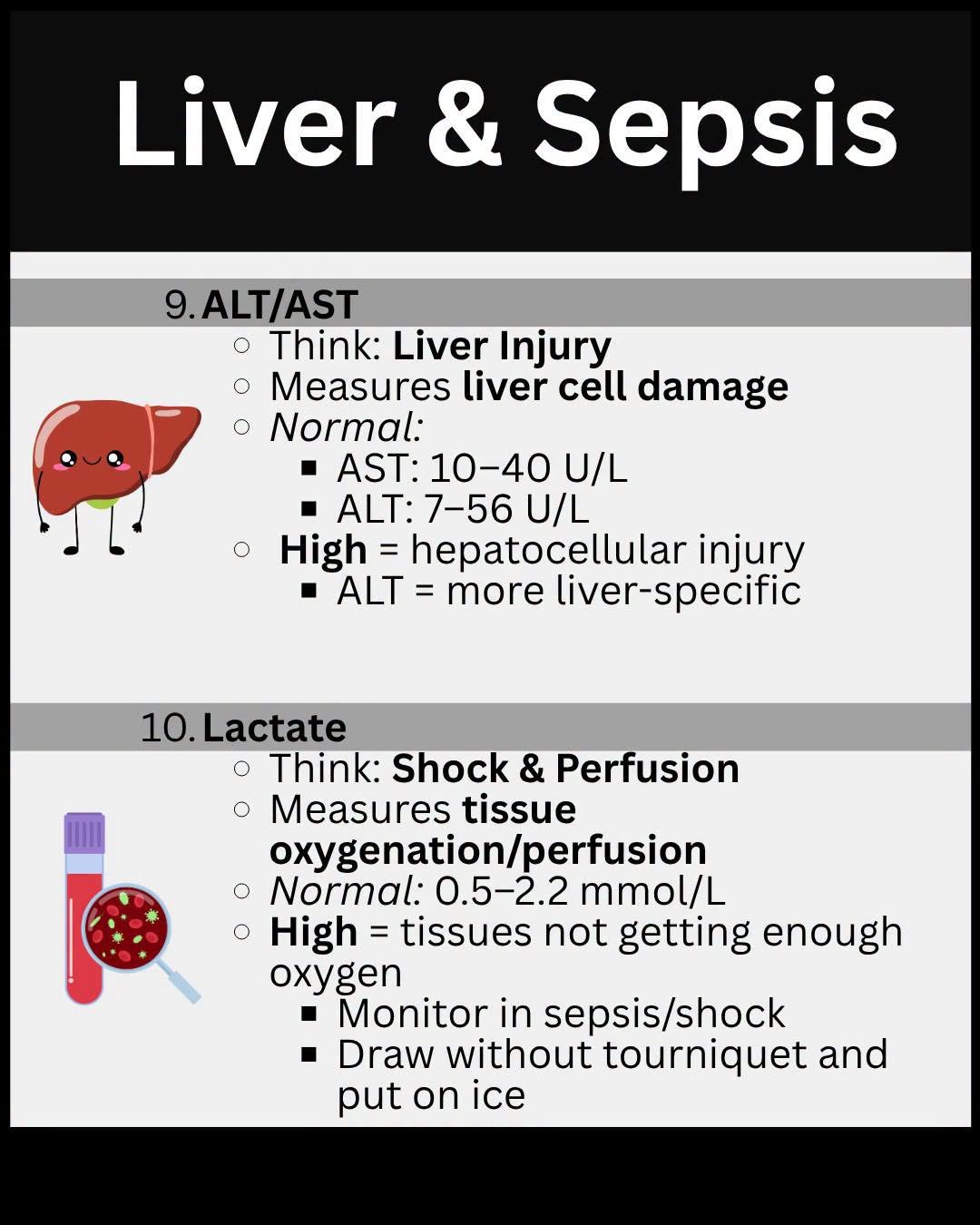
ALT/AST for liver cell damage and lactate for tissue perfusion β€” including the detail that lactate is drawn without a tourniquet and put on ice.
ALT/AST for liver cell damage and lactate for tissue perfusion β€” including the detail that lactate is drawn without a tourniquet and put on ice. — swipe it sideways if it is cut off, or tap to open it full size.

Saved study graphics from your own collection. Each one is someone else’s work — check anything clinical against your course materials before you rely on it.